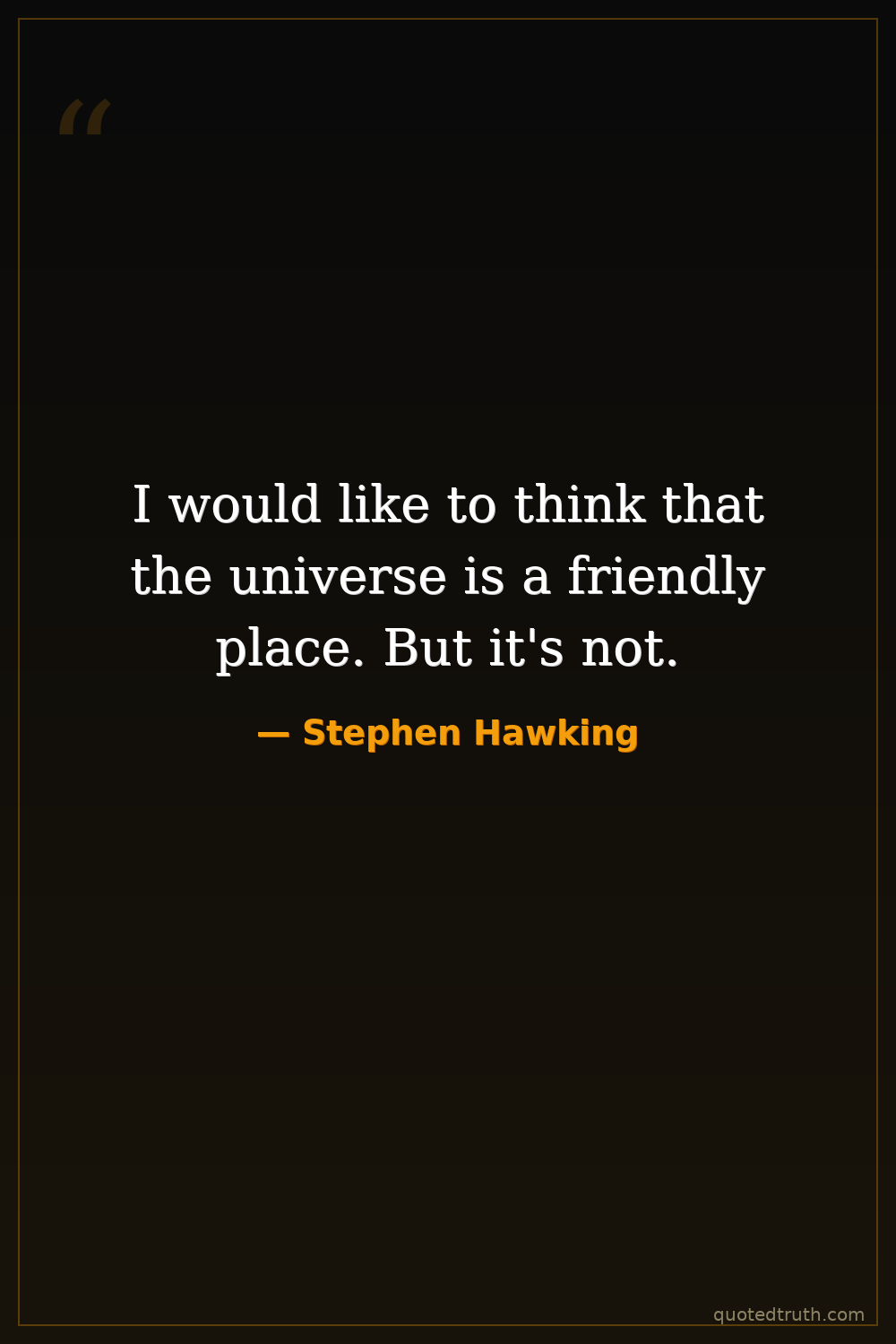
Stephen Hawking — "I would like to think that the universe is a friendly place. But it's not."
I would like to think that the universe is a friendly place. But it's not.
I would like to think that the universe is a friendly place. But it's not.
Click any product to generate a realistic preview. Up to 3 at a time.
* Initial load can take up to 90 seconds — revising the preview in another color is nearly instant.
"We are close to the tipping point, where global warming becomes irreversible. Trump's action could push the Earth over the brink, to become like Venus, with a temperature of 250 degrees [Celsius], and…"
"I think that the human race has a destiny to explore the universe."
"Yes. And also a universe where you're funny."
"I tell my kids: Don't spend all your time at the computer. But then I realize, I do that myself all day."
"There is a fundamental difference between religion, which is based on authority, and science, which is based on observation and reason. Science will win because it works."
British theoretical physicist whose Hawking radiation work and A Brief History of Time (1988) brought black-hole physics to a mass audience while he lived with ALS for 55 years. Closely associated with Roger Penrose (his collaborator on singularity theorems) and Carl Sagan (fellow popularizer who wrote Brief History's foreword). For an intellectual contrast, see William Lane Craig, American philosopher of religion — Craig's Kalam cosmological argument depends on the Big Bang requiring a divine first cause; Hawking's no-boundary proposal was specifically designed to remove the moment that would require one — the cleanest cosmology-vs-natural-theology contrast in modern thought.
Found in 1 providers: grok
1 source checked
Despite our natural wish for the cosmos to be welcoming or designed with us in mind, the universe is fundamentally indifferent — even hostile. Stars explode, black holes obliterate everything nearby, entropy drives everything toward disorder, and the vast majority of space is lethal vacuum. Hawking is rejecting the comforting illusion that existence has a nurturing order, insisting that clear-eyed realism about nature's harshness is more honest than wishful thinking.
Hawking's own life embodied this tension: diagnosed with ALS at 21, he lived decades under a progressively hostile biology, yet continued probing the cosmos with fierce intellectual joy. His scientific work — from singularity theorems to Hawking radiation revealing black holes slowly destroy everything — consistently demonstrated a cosmos governed by merciless physics. He rejected religious comfort, insisting on confronting reality as it is, not as we wish it to be.
Hawking lived through the Cold War's existential nuclear threat, the AIDS crisis, and the late-20th-century dismantling of cosmic optimism as telescopes revealed a universe dominated by dark matter, dark energy, and black holes. As New Atheism surged in the 2000s and climate science exposed Earth's fragility, his view resonated deeply. Humanity had ventured to the moon yet faced a cosmos of radiation belts, gamma-ray bursts, and billion-year voids utterly indifferent to life.
AI-generated insights based on extensive research and information for context. Factual errors? Email [email protected].
Your cart is empty