What it means
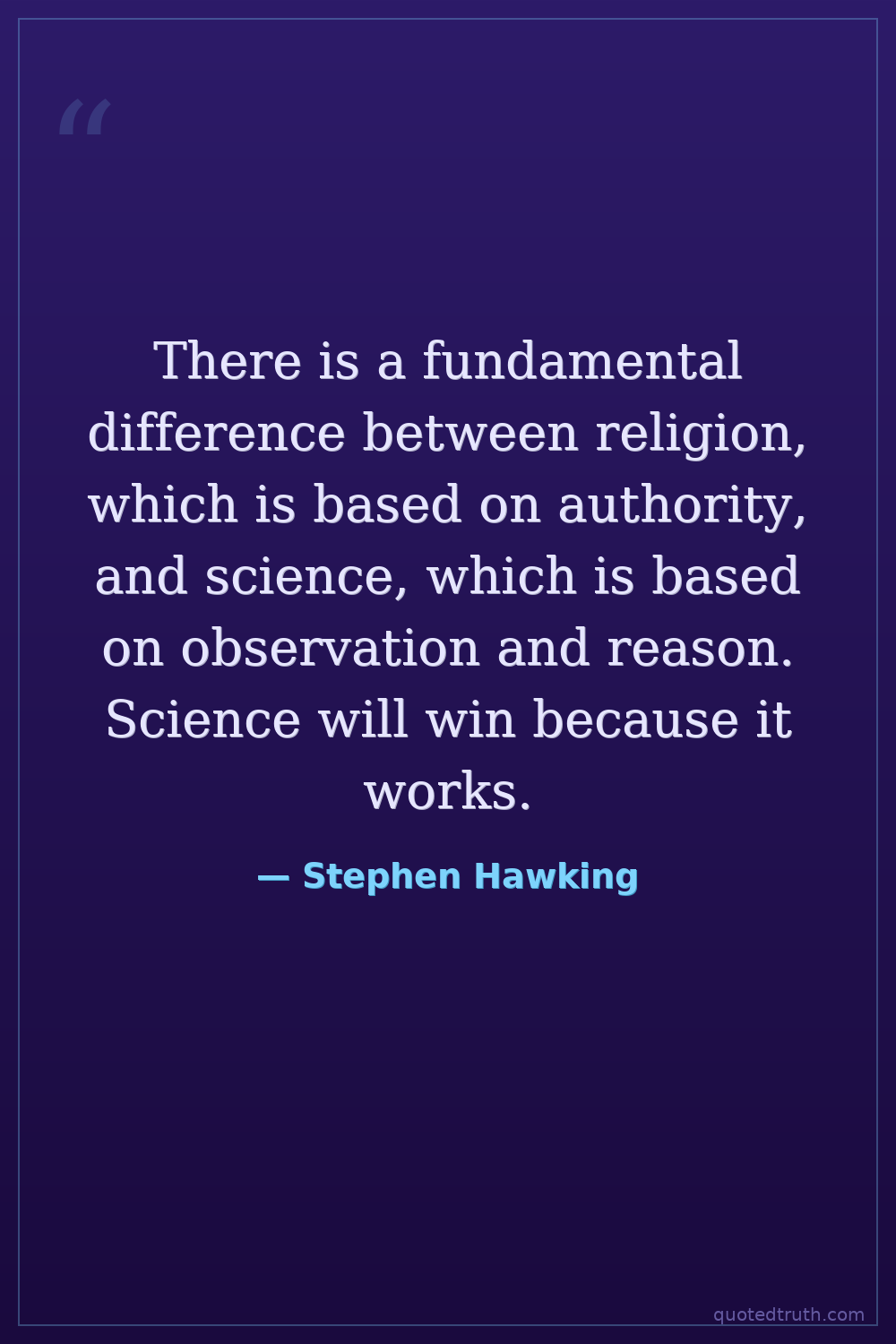
Religion and science use fundamentally different methods for establishing truth: religion defers to sacred authority and inherited doctrine, while science demands observable evidence and reproducible reasoning. Because scientific claims are empirically testable and generate real results — working technologies, accurate predictions, effective medicines — Hawking argues its track record of practical success makes it the superior framework. The test isn't belief or tradition; it's whether a method actually produces reliable outcomes in the world.
Relevance to Stephen Hawking
Hawking spent his career dismantling religious cosmological assumptions, demonstrating through black hole thermodynamics and Big Bang theory that the universe operates by discoverable physical laws requiring no creator. A lifelong atheist, he stated explicitly in The Grand Design that God was unnecessary to explain existence. Diagnosed with ALS at 21 and given two years to live, he survived 55 more years sustained entirely by medical science — personally embodying his own thesis about what actually works.
The era
Hawking made this statement in a 2010 Diane Sawyer interview, at the peak of New Atheism's cultural influence — Dawkins, Hitchens, and Dennett were publicly challenging religion's authority over truth. The 2005 Kitzmiller v. Dover ruling had just defeated intelligent design in schools. CERN's Large Hadron Collider was actively probing the origins of matter. Post-9/11 religious extremism had sharpened secular skepticism, making the science-versus-religion conflict more culturally urgent than any moment since Darwin.
AI-generated insights based on extensive research and information for context. Factual errors? Email [email protected].