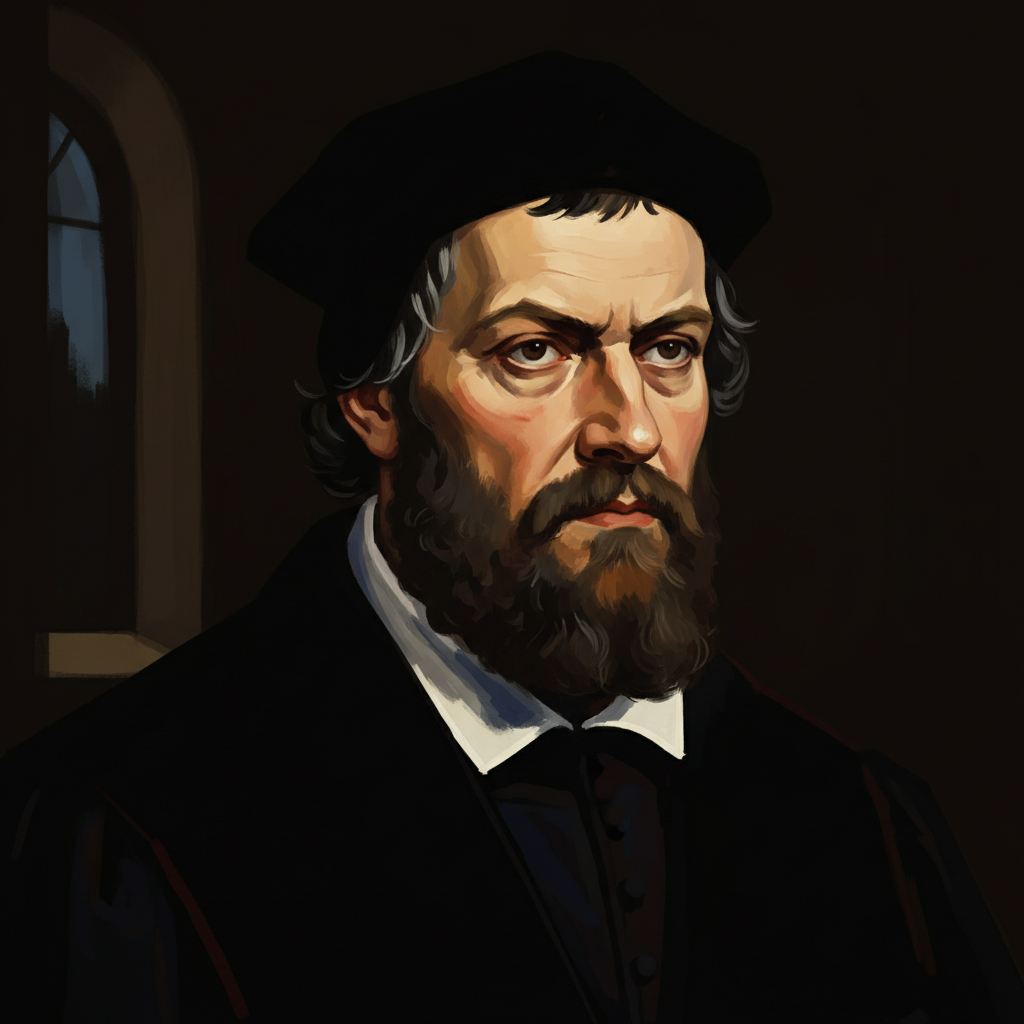
Martin Luther — "I would not smell the foul odor of your name."
I would not smell the foul odor of your name.
I would not smell the foul odor of your name.
Click any product to generate a realistic preview. Up to 3 at a time.
* Initial load can take up to 90 seconds — revising the preview in another color is nearly instant.
"Thirdly, their prayer books and Talmudic writings, which are full of idolatry, lies, curses, and blasphemy, should be taken from them."
"God has created men with broad chests and shoulders, not broad hips, so that men can understand wisdom. But the place where the filth flows out is small. With women it's the other way around. That's w…"
"I am a man of contention, and I thank God for it."
"The Bible is the cradle wherein Christ is laid."
"Next to the Word of God, the noble art of music is the greatest treasure in the world."
German theologian whose 95 Theses (1517) launched the Protestant Reformation and broke the Catholic Church's monopoly on Western Christianity. Closely associated with Philipp Melanchthon (Lutheran systematizer) and John Calvin (later Reformer who built on Luther's break). For an intellectual contrast, see Pope Leo X, Renaissance pope (1513-1521) — Leo X's indulgence sales triggered Luther's break and Leo excommunicated him in 1521 — Luther's entire Reformation is structured as a direct answer to the indulgence-funded Vatican Leo represented.
Found in 1 providers: gemini
1 source checked
This is a blunt expression of contempt, declaring the speaker refuses even the slightest association with someone so disgraceful that merely hearing their name feels repulsive, like catching a rotten stench. It's not a measured critique but a visceral dismissal, rejecting the person as beneath acknowledgment. The imagery turns reputation into something physical and foul, signaling moral disgust rather than disagreement. In modern terms, it means: you're so repugnant I won't even let your name enter my space.
Luther was famous for scorching, scatological invective against opponents like the Pope, Erasmus, and rival reformers, routinely calling them donkeys, devils, or filth. A former Augustinian monk turned theological bomb-thrower, he treated doctrinal enemies as spiritual contaminants, not debate partners. This line fits his lifelong pattern of moralizing hatred into sensory revulsion, collapsing disagreement into disgust. His 95 Theses opened a career of rhetorical warfare where naming the wrong side meant dirtying your mouth.
In early-modern Europe (1517 onward), Luther's Reformation split Christendom and weaponized print. Polemic tracts, woodcuts, and pulpit sermons flew between Catholics and Protestants, with reputations destroyed through vicious personal attack rather than civil argument. Naming an opponent carried weight: excommunication, heresy trials, and executions followed accusations. In a world where honor, orthodoxy, and identity were inseparable, refusing to utter someone's name was a public act of shunning, a weapon as sharp as theology itself.
AI-generated insights based on extensive research and information for context. Factual errors? Email [email protected].
Your cart is empty