Martin Luther — "Thirdly, their prayer books and Talmudic writings, which are full of idolatry, l…"
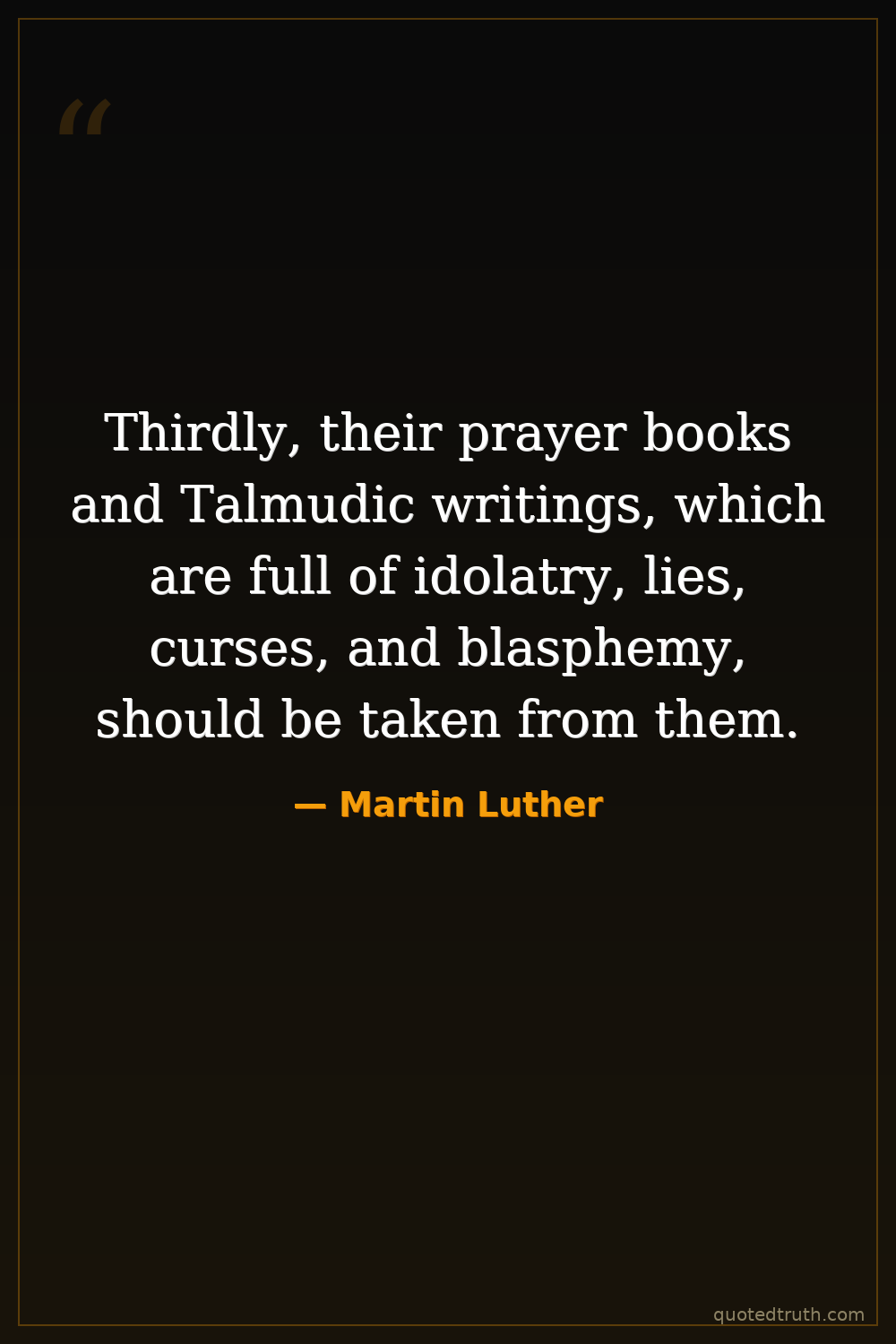
Thirdly, their prayer books and Talmudic writings, which are full of idolatry, lies, curses, and blasphemy, should be taken from them.
Thirdly, their prayer books and Talmudic writings, which are full of idolatry, lies, curses, and blasphemy, should be taken from them.
Click any product to generate a realistic preview. Up to 3 at a time.
* Initial load can take up to 90 seconds — revising the preview in another color is nearly instant.
"If I had to do it all over again, I would still burn the pope’s bull."
"Whoever drinks beer, he is quick to sleep; whoever sleeps long, does not sin; whoever does not sin, enters Heaven! Thus, let us drink beer!"
"I am a peasant's son; my father, grandfather, and great-grandfather were genuine peasants."
"You are not yet a master of the Scriptures. You will find that out when you try to preach."
"I have been so busy with writing that I have not had time to pray."
German theologian whose 95 Theses (1517) launched the Protestant Reformation and broke the Catholic Church's monopoly on Western Christianity. Closely associated with Philipp Melanchthon (Lutheran systematizer) and John Calvin (later Reformer who built on Luther's break). For an intellectual contrast, see Pope Leo X, Renaissance pope (1513-1521) — Leo X's indulgence sales triggered Luther's break and Leo excommunicated him in 1521 — Luther's entire Reformation is structured as a direct answer to the indulgence-funded Vatican Leo represented.
Found in 1 providers: grok
1 source checked
This statement calls for confiscating Jewish religious texts, claiming they contain idolatry, falsehoods, curses, and insults against Christianity. The speaker argues that removing these books would strip the community of materials he viewed as spiritually harmful. In plain terms, it is a demand to seize and suppress a religious minority's sacred literature based on the belief that its contents are dangerous and offensive to the dominant faith.
Luther wrote this in his 1543 treatise On the Jews and Their Lies, late in his life after Jews rejected his reformed theology. Once hopeful they would convert, he turned bitterly hostile, proposing seven harsh measures against Jewish communities. This reflects his combative polemical style, his biblical literalism, and his willingness to use state power to enforce religious conformity, a pattern also seen in his writings against peasants, Catholics, and Anabaptists.
In 1540s Germany, Jews lived as a tolerated but vulnerable minority under local princes who could expel or protect them. The Reformation had shattered Christian unity, intensifying disputes over scripture and authority. Luther's tract fed into centuries-old anti-Jewish stereotypes and book-burning traditions, and was used by German princes to justify expulsions. Tragically, these writings were later revived by Nazi propagandists in the 1930s as historical justification for antisemitic persecution.
AI-generated insights based on extensive research and information for context. Factual errors? Email [email protected].
Your cart is empty