Wright Brothers (Orville & Wilbur) — "If birds can glide for long periods of time, then why can't we?"
If birds can glide for long periods of time, then why can't we?
If birds can glide for long periods of time, then why can't we?
Click any product to generate a realistic preview. Up to 3 at a time.
* Initial load can take up to 90 seconds — revising the preview in another color is nearly instant.
"It is not the man who has done the most, but the man who has done the best, who is most deserving of praise."
"The airplane has forced us into a new relationship with each other."
"We have been making flights of over an hour in length."
"We had no idea of the amount of publicity that would follow our flights."
"The age of the flying machine is at hand."
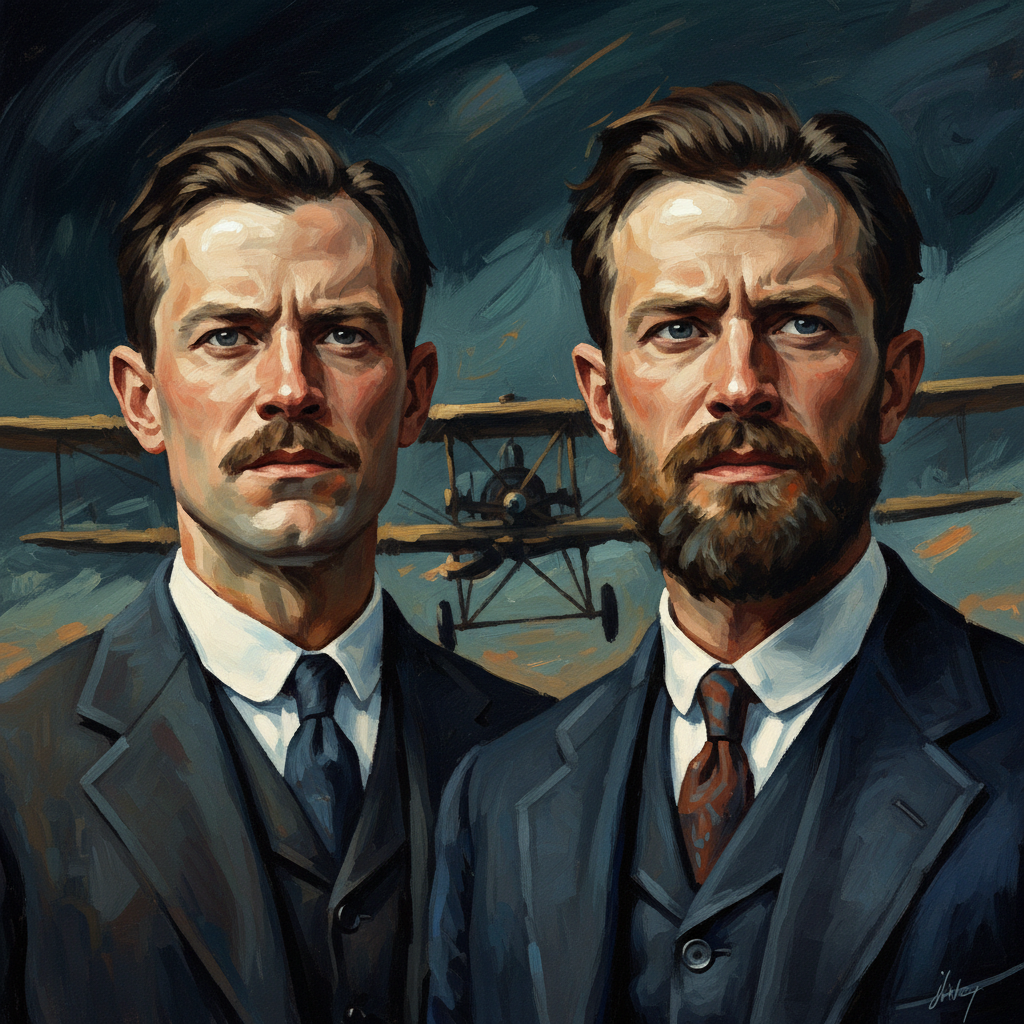
American aviation pioneers who achieved the first sustained powered controlled airplane flight at Kitty Hawk, NC, on December 17, 1903. Closely associated with Octave Chanute (their gliding mentor and aeronautical correspondent). For an intellectual contrast, see Samuel Pierpont Langley, Smithsonian Institution Secretary and government-funded aviation researcher — Langley's Aerodrome crashed twice into the Potomac in October-December 1903 with $50,000 of War Department funding; the Wright Brothers' bicycle-shop empiricism beat Langley's institutional Big Science by 9 days. The most-cited example in engineering history of empirical-tinkerer beating institution-funded credentialism.
Found in 2 providers: deepseek,grok
2 sources checked
Nature's evidence removes the 'impossible' label. If birds — creatures with no mechanical advantages — sustain effortless gliding, then flight isn't a physical impossibility but an engineering challenge waiting to be solved. The question reframes failure as a gap in human knowledge rather than a law of nature, turning observed biology into a mandate for investigation. It's the core logic of invention: if it exists anywhere, it can be understood and replicated.
Orville and Wilbur spent years observing birds in flight — particularly the wing-warping technique buzzards used to maintain balance. Their notebooks document meticulous bird studies that directly informed their three-axis control system, the key innovation rivals missed. As bicycle mechanics, they applied hands-on mechanical intuition rather than academic theory. Their faith that biology proved flight was achievable, not just theoretical, drove every iteration from their 1900 gliders to the 1903 Flyer at Kitty Hawk.
In 1900s America, heavier-than-air flight was widely treated as fantasy. Samuel Langley's government-funded Aerodrome crashed twice in 1903, reinforcing expert skepticism. Respected astronomer Simon Newcomb published mathematical arguments against powered flight just weeks before Kitty Hawk. Meanwhile, the Industrial Revolution had made Americans hungry for mechanical miracles. Two bicycle-shop owners from Dayton using bird-watching as primary research represented a radical reframing of what constituted valid scientific method.
AI-generated insights based on extensive research and information for context. Factual errors? Email [email protected].
Your cart is empty