Wright Brothers (Orville & Wilbur) — "We have been making flights of over an hour in length."
We have been making flights of over an hour in length.
We have been making flights of over an hour in length.
Click any product to generate a realistic preview. Up to 3 at a time.
* Initial load can take up to 90 seconds — revising the preview in another color is nearly instant.
"The problem of flight was not one of power, but of control."
"I have not the time for both a wife and an airplane."
"We had no idea of the amount of publicity that would follow our flights."
"We have not been able to get any very good pictures, as the camera was not very good."
"No flying machine will ever fly from New York to Paris."
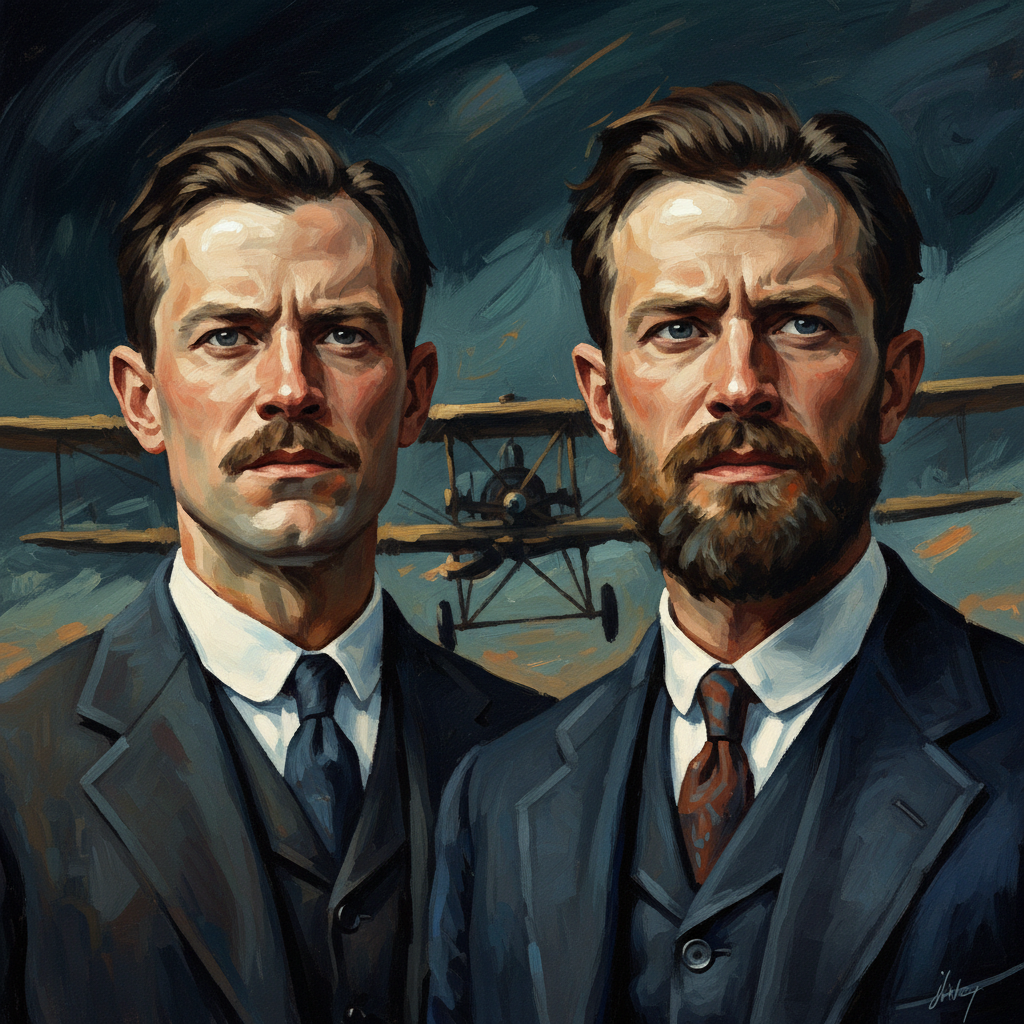
American aviation pioneers who achieved the first sustained powered controlled airplane flight at Kitty Hawk, NC, on December 17, 1903. Closely associated with Octave Chanute (their gliding mentor and aeronautical correspondent). For an intellectual contrast, see Samuel Pierpont Langley, Smithsonian Institution Secretary and government-funded aviation researcher — Langley's Aerodrome crashed twice into the Potomac in October-December 1903 with $50,000 of War Department funding; the Wright Brothers' bicycle-shop empiricism beat Langley's institutional Big Science by 9 days. The most-cited example in engineering history of empirical-tinkerer beating institution-funded credentialism.
Found in 1 providers: grok
1 source checked
The speaker calmly announces that powered, controlled flight has advanced beyond a brief stunt into genuine endurance — they can stay airborne for over an hour. That shift matters enormously: it transforms aviation from a curiosity into a practical technology. An hour in the air makes carrying mail, passengers, or cargo suddenly conceivable. The plain, almost bureaucratic tone is itself the point — what sounds like a dry status update is one of the most consequential sentences in the history of human transportation.
Orville and Wilbur were Dayton bicycle mechanics who treated flight as a solvable engineering problem. After their first 12-second hop at Kitty Hawk on December 17, 1903, they quietly refined their design in a local pasture. By 1905, the Flyer III circled for 30-plus minutes; by late 1908, Wilbur flew over 90 minutes before crowds in France. Reporting milestones in flat, technical language reflected their identity as meticulous craftsmen — they documented everything like engineers, never like showmen.
In the early 1900s, even after Kitty Hawk, most Americans and the U.S. Army dismissed the brothers' flight claims as exaggerated. European aviators were racing to catch up with what the Wrights had already surpassed. An hour-long flight was so far beyond what skeptics thought possible that it functioned as definitive proof, not mere boast. This was also the decade the automobile began reshaping daily life, making a transportation revolution feel imminent — sustained flight finally made aviation's practical future undeniable.
AI-generated insights based on extensive research and information for context. Factual errors? Email [email protected].
Your cart is empty