Francis Crick — "If, for example, a certain protein consistently appears in the urine of schizoph…"
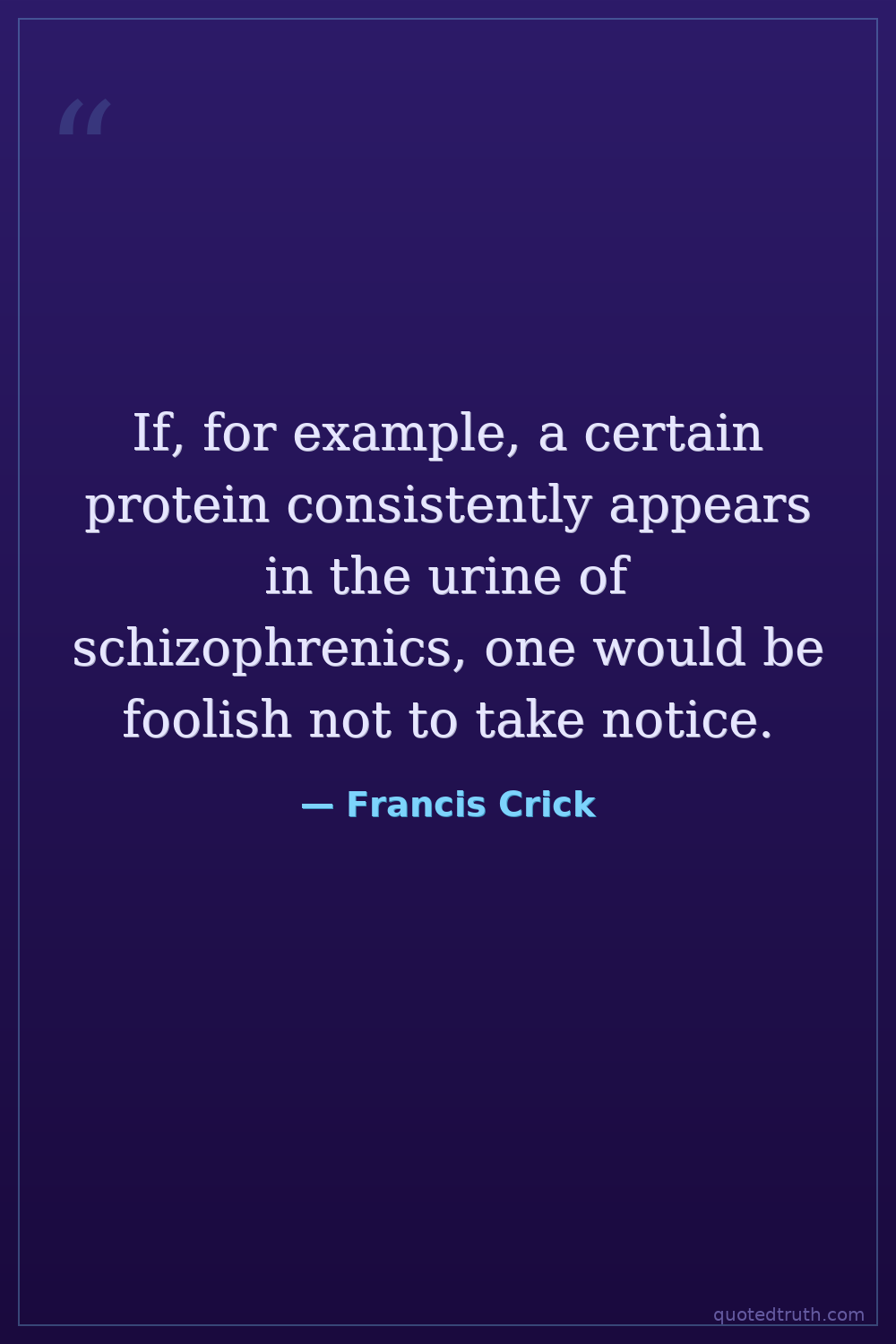
If, for example, a certain protein consistently appears in the urine of schizophrenics, one would be foolish not to take notice.
If, for example, a certain protein consistently appears in the urine of schizophrenics, one would be foolish not to take notice.
Click any product to generate a realistic preview. Up to 3 at a time.
* Initial load can take up to 90 seconds — revising the preview in another color is nearly instant.
"The more I learn about science, the more I realize that there is no God."
"If you are not a little bit mad, you will never discover anything new."
"Free will is an illusion."
"It is not the strongest of the species that survives, nor the most intelligent that survives. It is the one that is most adaptable to change."
"Our brains are machines."
Found in 1 providers: deepseek
1 source checked
Crick argues that if a specific biological marker, like a protein, repeatedly shows up in people with a mental illness, scientists should investigate it seriously rather than dismiss the connection. Even without immediately understanding why, consistent patterns in biology demand attention. Ignoring such observable, repeatable evidence in favor of purely psychological or social explanations would be intellectually negligent and a missed opportunity for medical breakthroughs.
Crick spent his later career at the Salk Institute applying molecular biology to consciousness and the brain, convinced mental phenomena had physical, chemical bases. After co-discovering DNA's double helix in 1953, he championed reductionism, the idea that biology explains behavior. This quote reflects his lifelong conviction that mental illness, like genetics, would yield to rigorous chemical investigation rather than abstract psychoanalytic theory.
During Crick's later decades, psychiatry was transitioning from Freudian dominance toward biological models. The 1980s and 1990s saw antidepressants, brain imaging, and the Decade of the Brain initiative reshape how mental illness was understood. Schizophrenia research increasingly hunted for genetic markers, neurotransmitter imbalances, and biomarkers. Crick's reductionist framing aligned with this shift, championing molecular explanations over psychosocial ones during a revolutionary era for neuroscience and psychiatric medicine.
AI-generated insights based on extensive research and information for context. Factual errors? Email [email protected].
Your cart is empty