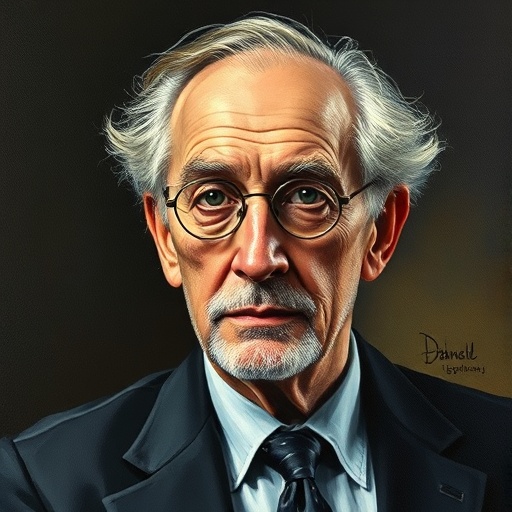
Francis Crick — "Free will is an illusion."
Free will is an illusion.
Free will is an illusion.
Click any product to generate a realistic preview. Up to 3 at a time.
* Initial load can take up to 90 seconds — revising the preview in another color is nearly instant.
"I do not believe that God exists."
"No newborn child has a soul."
"The idea of a soul is a myth."
"We are just a collection of molecules."
"The genetic code is a frozen accident."
Found in 1 providers: grok
1 source checked
The statement claims that our sense of choosing freely among options is a subjective experience produced by brain activity, not a genuine independent power. Every decision, intention, and apparent act of will is the lawful output of neurons firing according to physics and chemistry. We feel like authors of our actions because the underlying machinery is hidden from introspection, but that feeling does not correspond to any uncaused mental cause steering behavior.
Crick co-discovered DNA's double helix in 1953, then spent his later decades at the Salk Institute hunting the neural basis of consciousness, culminating in his 1994 book The Astonishing Hypothesis. He insisted that joys, sorrows, memories, and the sense of personal agency are 'no more than the behavior of a vast assembly of nerve cells.' Reducing free will to neurochemistry was a direct extension of his lifelong reductionist, materialist conviction that biology fully explains mind.
Crick's later career coincided with the 1990s 'Decade of the Brain,' when fMRI, PET imaging, and Benjamin Libet's readiness-potential experiments suggested the brain initiates actions before conscious awareness. Genetics, neuroscience, and computational models were dismantling dualist assumptions, while debates with religious and philosophical traditions intensified. Declaring free will an illusion fit a broader cultural shift toward viewing humans as biological machines whose behavior is, in principle, fully explainable by molecular and neural science.
AI-generated insights based on extensive research and information for context. Factual errors? Email [email protected].
Your cart is empty