What it means
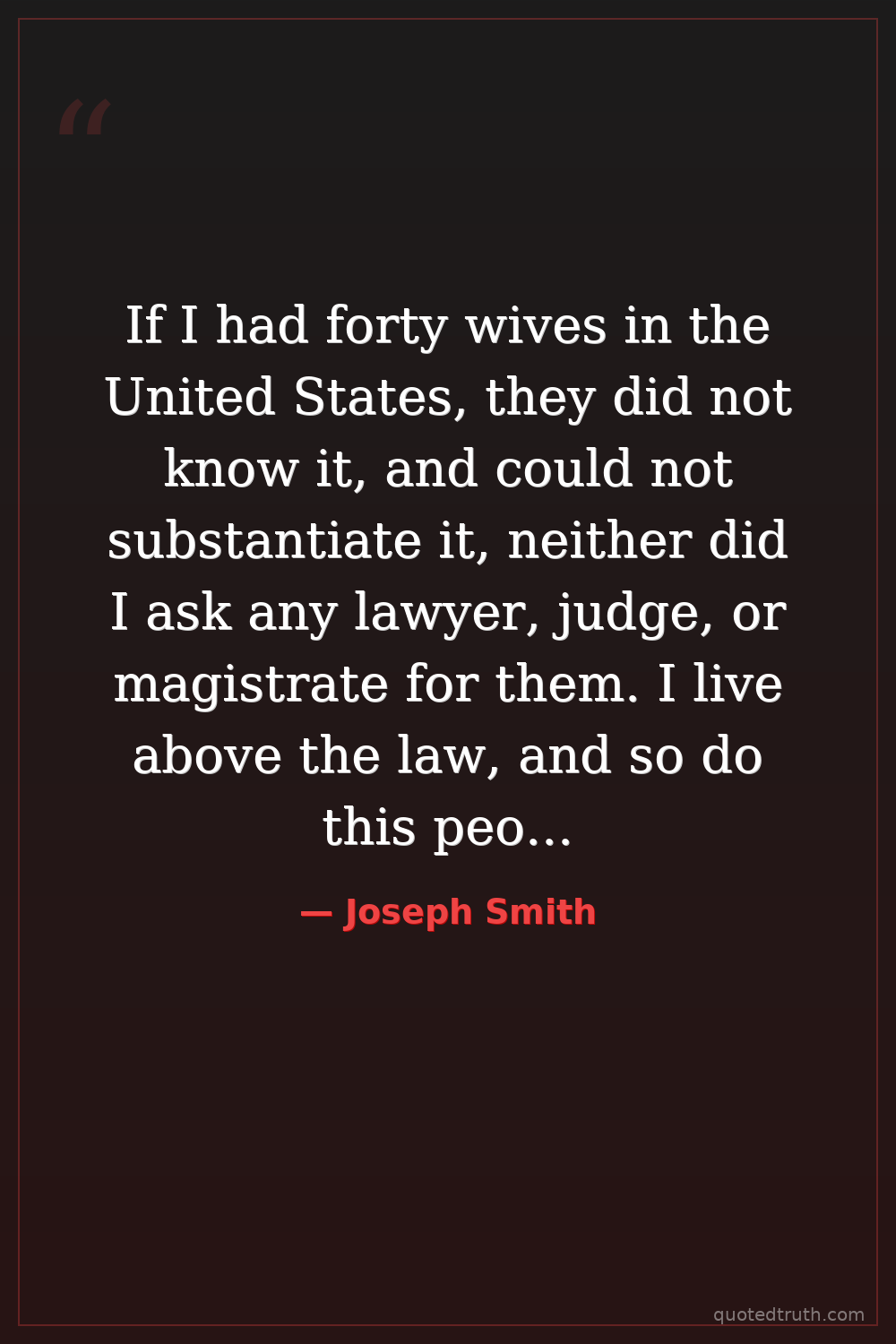
Smith asserts that even if he had dozens of plural wives, none of it could be legally proven because those marriages never entered civil courts. He goes further, claiming he and his followers operate under divine law rather than government authority. It's a declaration of religious sovereignty — spiritual covenants require no judge or magistrate, and a community answering to God is simply beyond the jurisdiction of earthly law.
Relevance to Joseph Smith
Smith privately married an estimated 30–40 women while publicly denying polygamy for years. He believed plural marriage was divinely commanded through direct revelation, later canonized as Doctrine and Covenants 132. His claim to stand 'above the law' mirrors his broader conviction that he held restored priesthood authority superseding civil government. He governed Nauvoo as a near-theocracy, commanded its militia, and was ultimately jailed and killed in 1844 after ordering destruction of a newspaper exposing these marriages.
The era
In 1840s Nauvoo, Illinois, Smith led a semi-autonomous city-state with its own charter, courts, and militia — creating real tension with Illinois civil authority. Polygamy was flatly illegal, and its exposure inflamed surrounding communities. The era's Second Great Awakening bred intense religious movements claiming direct divine revelation, but Smith's theocratic ambitions went furthest. He announced a presidential run in early 1844; months later he was dead in Carthage jail, killed by a mob after his newspaper-suppression order backfired.
AI-generated insights based on extensive research and information for context. Factual errors? Email [email protected].