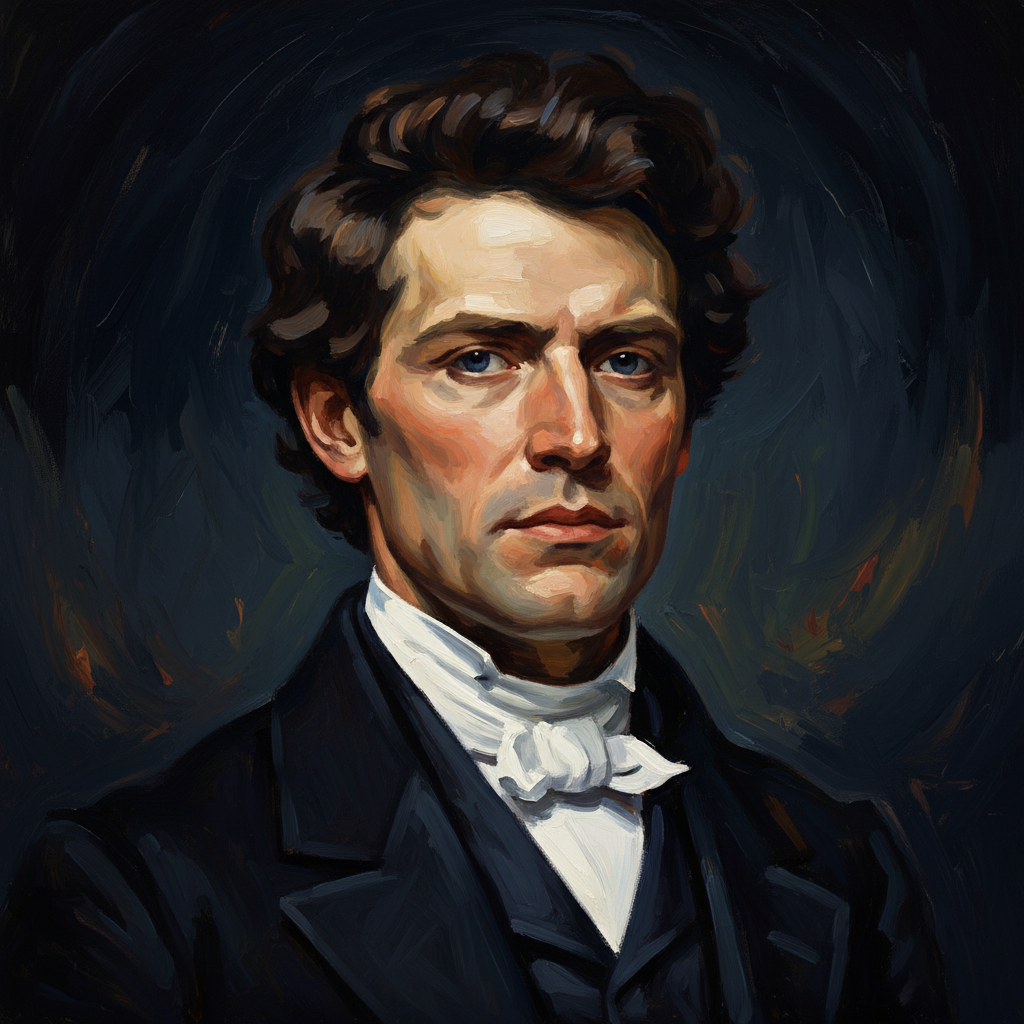
Joseph Smith — "I am a man of God, and I will stand for the truth, though the heavens fall."
I am a man of God, and I will stand for the truth, though the heavens fall.
I am a man of God, and I will stand for the truth, though the heavens fall.
Click any product to generate a realistic preview. Up to 3 at a time.
* Initial load can take up to 90 seconds — revising the preview in another color is nearly instant.
"I am a lover of the Constitution, and I believe in the principles of republicanism."
"I am a rough stone, and the sound of the hammer and chisel are continually upon me."
"There is an infinite number of holy personages, drawn from worlds without number, who have passed on to exaltation and are thus gods."
"If I had forty wives in the United States, they did not know it, and could not substantiate it, neither did I ask any lawyer, judge, or magistrate for them. I live above the law, and so do this people…"
"I am tired of the traditions of men, and the doctrines of devils."
Found in 1 providers: grok
1 source checked
A person declares their identity and values non-negotiable, vowing to defend what they believe is true no matter the consequences. Even if everything collapses or the entire world turns against them, they will not retreat or compromise. This captures radical moral courage — the refusal to bend under pressure, social rejection, or threat of destruction. It prioritizes personal integrity and divine accountability over safety or social acceptance.
Joseph Smith spent his adult life defending claims that shocked contemporaries — that God had spoken to him, that he translated ancient scripture, that true Christianity was restored through him. He was beaten, imprisoned, and expelled from states, ultimately killed by a mob in Carthage, Illinois in 1844. His willingness to die rather than recant his prophetic mission makes this declaration less rhetoric and more a literal statement of how he lived.
America's Second Great Awakening (1790s–1840s) produced explosive religious competition and fierce theological disputes. New movements claiming divine revelation faced deep suspicion. Anti-Mormon violence was institutionalized — Missouri's governor issued an extermination order in 1838, legally authorizing citizens to kill Mormons. In this climate, claiming to speak for God was not merely controversial but physically dangerous. Standing for unpopular religious truth carried genuine risk of imprisonment, displacement, or death.
AI-generated insights based on extensive research and information for context. Factual errors? Email [email protected].
Your cart is empty