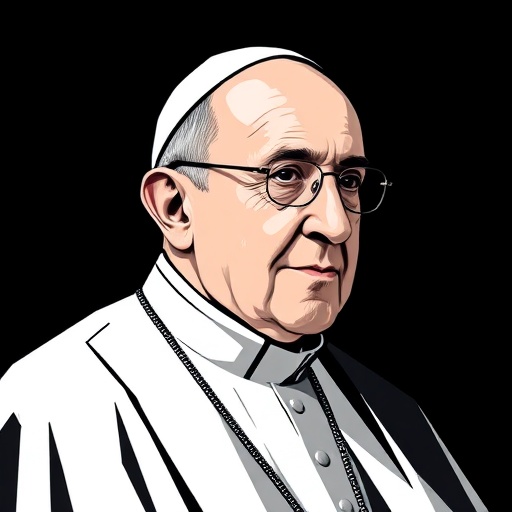
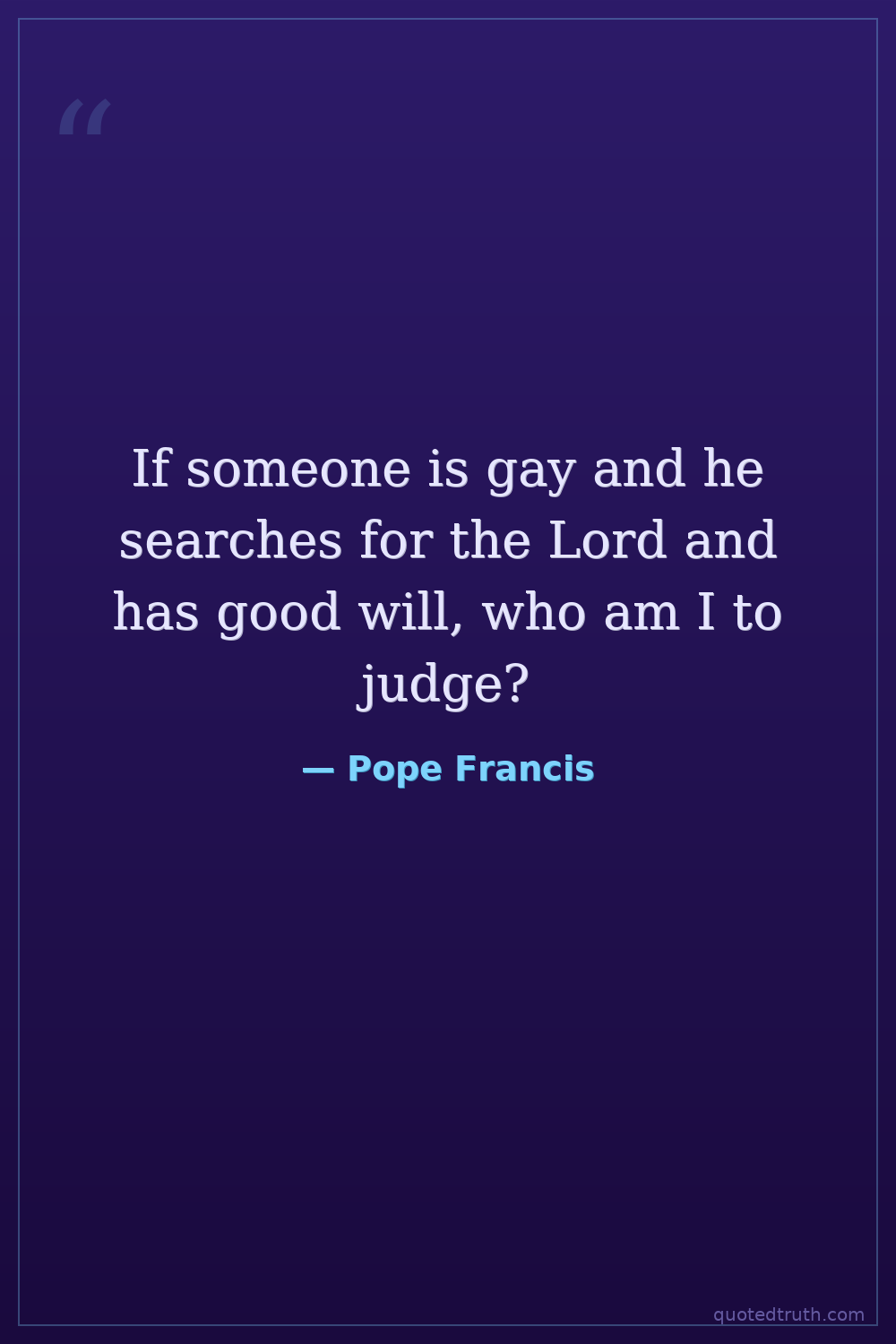
Pope Francis — "If someone is gay and he searches for the Lord and has good will, who am I to ju…"
If someone is gay and he searches for the Lord and has good will, who am I to judge?
If someone is gay and he searches for the Lord and has good will, who am I to judge?
Click any product to generate a realistic preview. Up to 3 at a time.
* Initial load can take up to 90 seconds — revising the preview in another color is nearly instant.
"A person who thinks only about building walls, wherever they may be, and not building bridges, is not Christian."
"The family is in crisis."
"The Lord has redeemed all of us, all of us, with the Blood of Christ: all of us, not just Catholics. Everyone!"
"The Church must ask forgiveness for the scandals committed by its members."
"The Lord makes us see that there is no true joy without love."
First Latin American and Jesuit pope (2013-), who has steered the Catholic Church toward pastoral inclusion on LGBTQ pastoral care, divorced Catholics, and climate. Closely associated with Pope John XXIII (the Vatican II reformer pope) and Cardinal Walter Kasper (his theological ally on pastoral reform). For an intellectual contrast, see Cardinal Raymond Burke, American traditionalist cardinal, former head of the Vatican Apostolic Signatura — Burke is the public face of Catholic traditionalism that views Francis's pastoral approach as doctrinally dangerous — he has formally challenged Amoris Laetitia and other Francis reforms.
Found in 2 providers: deepseek,grok
2 sources checked
This quote rejects religious authority as a moral gatekeeper over sexual identity. It argues that sincere faith and good intentions — not conformity to traditional sexual norms — define a person's standing before God. By turning the question back on himself, Francis displaces judgment from human institutions to the divine, inviting compassion over condemnation and fundamentally reframing how faith communities should engage with LGBTQ+ believers seeking belonging.
Bergoglio, elected in 2013 as the first Latin American Jesuit pope, consistently described the Church as a 'field hospital' prioritizing mercy over doctrine. Raised in Buenos Aires, his pastoral instincts favored direct human encounter over theological rigidity. Though he maintained traditional Church teaching on marriage, he deliberately broke from his predecessors' combative rhetoric on homosexuality, reflecting his core conviction that humble accompaniment of struggling people must define institutional posture.
Spoken in July 2013, weeks after the US Supreme Court struck down the Defense of Marriage Act and as same-sex marriage expanded across Europe and the Americas. The Catholic Church was also navigating deep credibility damage from clergy abuse scandals. Francis's statement landed at a cultural inflection point, signaling a pastoral reset for an institution many felt had prioritized condemnation over welcome at precisely the moment LGBTQ+ visibility reached a historic peak.
AI-generated insights based on extensive research and information for context. Factual errors? Email [email protected].
Your cart is empty