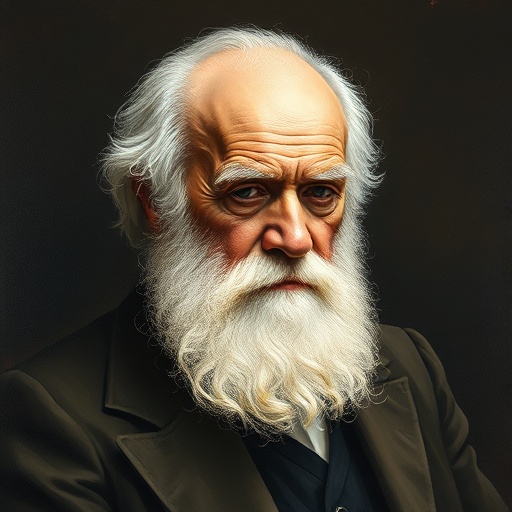
Charles Darwin — "Ignorance more frequently begets confidence than does knowledge: it is those who…"

Ignorance more frequently begets confidence than does knowledge: it is those who know little, and not those who know much, who so positively assert that this or that problem will never be solved by science.
Charles Darwin — Charles Darwin Modern · Theory of evolution

Get This Quote & Author's Image Illustrated On:

Click any product to generate a realistic preview. Up to 3 at a time.
* Initial load can take up to 90 seconds — revising the preview in another color is nearly instant.

Kitchen

Apparel

Other

About Charles Darwin (1809-1882)

British naturalist whose On the Origin of Species (1859) established evolution by natural selection — the unifying theory of modern biology. Closely associated with Thomas Henry Huxley (his 'bulldog' public defender) and Alfred Russel Wallace (independent co-discoverer of natural selection). For an intellectual contrast, see William Paley, Anglican theologian and Natural Theology author (1743-1805) — Origin of Species is structurally a 400-page reply to Paley — Darwin admired Paley's watchmaker-argument as an undergraduate at Cambridge and then spent 20 years building the empirical machinery to displace him. The cleanest 'design argument vs natural selection' founding rebuttal in science.

The standard scholarly entry points to Charles Darwin's work: Janet Browne (Harvard, history of science) — Charles Darwin: Voyaging (1995) and The Power of Place (2002); Adrian Desmond (UCL, biographer) — Darwin: The Life of a Tormented Evolutionist (1991, with James Moore). These are the works graduate seminars cite when teaching Charles Darwin.

Details

Introduction to The Descent of Man

Date: 1871

Educational

Verification

Unverifiable

Found in 1 providers: grok

1 source checked

Understanding this quote

What it means

People who barely understand a subject speak with the greatest certainty—confidently declaring what science can or cannot solve. Those with real knowledge grasp how complex problems are and stay appropriately humble. False confidence flourishes in ignorance; deep expertise reveals how much remains unknown. It's the amateur who calls something impossible; the expert knows better than to set permanent limits on human understanding.

Relevance to Charles Darwin

Darwin delayed publishing for over 20 years, accumulating overwhelming evidence precisely because he understood complexity his critics didn't. He personally faced confident dismissal from clergy and laypeople who knew little biology yet declared evolution absurd or impossible. Darwin acknowledged genuine uncertainties in his theory—like the complexity of the eye—while untrained opponents used those very gaps as supposed proof that science could never explain life's diversity.

The era

Darwin wrote amid Victorian-era battles between science and religious orthodoxy. Church authorities confidently declared evolution and deep geological time incompatible with scripture—claims born of theological certainty, not scientific inquiry. Meanwhile, the 19th century was demolishing supposedly unsolvable problems in physics, chemistry, and medicine at a rapid pace. This quote directly addressed an era when non-scientists loudly set limits on what science could achieve, limits science kept crossing.

AI-generated insights based on extensive research and information for context. Factual errors? Email [email protected].
Your Cart

Your cart is empty