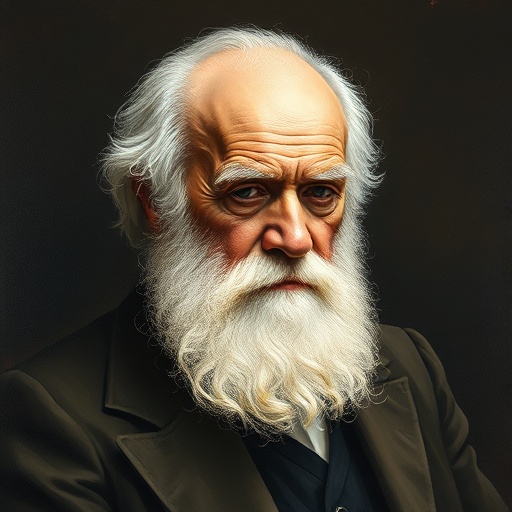
Charles Darwin — "I am almost convinced that species are not (it is like confessing a murder) immu…"
I am almost convinced that species are not (it is like confessing a murder) immutable.
I am almost convinced that species are not (it is like confessing a murder) immutable.
Click any product to generate a realistic preview. Up to 3 at a time.
* Initial load can take up to 90 seconds — revising the preview in another color is nearly instant.
"Man in his arrogance thinks himself a great work, worthy of the interposition of a deity. More humble and I believe truer to consider him created from animals."
"The difference in mind between man and the higher animals, great as it is, certainly is one of degree and not of kind."
"The highest possible stage in moral culture is when we recognize that we ought to control our thoughts."
"Man, with all his noble qualities, with sympathy which feels for the most debased, with benevolence which extends not only to other men but to the humblest living creature, with his god-like intellect…"
"Man is descended from a hairy, tailed quadruped, probably arboreal in its habits, and an inhabitant of the Old World."
British naturalist whose On the Origin of Species (1859) established evolution by natural selection — the unifying theory of modern biology. Closely associated with Thomas Henry Huxley (his 'bulldog' public defender) and Alfred Russel Wallace (independent co-discoverer of natural selection). For an intellectual contrast, see William Paley, Anglican theologian and Natural Theology author (1743-1805) — Origin of Species is structurally a 400-page reply to Paley — Darwin admired Paley's watchmaker-argument as an undergraduate at Cambridge and then spent 20 years building the empirical machinery to displace him. The cleanest 'design argument vs natural selection' founding rebuttal in science.
The standard scholarly entry points to Charles Darwin's work: Janet Browne (Harvard, history of science) — Charles Darwin: Voyaging (1995) and The Power of Place (2002); Adrian Desmond (UCL, biographer) — Darwin: The Life of a Tormented Evolutionist (1991, with James Moore). These are the works graduate seminars cite when teaching Charles Darwin.
From a private notebook entry, revealing his early, cautious thoughts on evolution.
Date: 1837
Self-DeprecatingFound in 1 providers: grok
1 source checked
Darwin is saying he's nearly certain that species change and evolve over time — they are not fixed, permanent creations. The phrase 'like confessing a murder' captures how scandalous and dangerous this felt to admit. Publicly, most believed God created species as unchanging forms. Acknowledging mutability meant contradicting Genesis and risking his scientific reputation and social standing in one stroke.
Darwin wrote this in an 1844 private letter to botanist Joseph Hooker — fifteen years before publishing On the Origin of Species. His extreme caution defined him: he spent two decades gathering evidence before going public. He knew the theological and professional fallout would be severe. The guilt-laden parenthetical reveals a deeply conscientious man wrestling privately with a discovery he knew would upend science and religion.
In 1844 Victorian England, natural theology reigned: William Paley's argument that complex organisms proved divine design was scientific orthodoxy. Species were believed to be God's immutable creations. The geological revolution — Lyell's ancient Earth, fossil evidence of extinction — was already shaking foundations. Religious and social consequences of denying fixed creation were severe enough to end careers and invite accusations of atheism and moral degeneracy.
AI-generated insights based on extensive research and information for context. Factual errors? Email [email protected].
Your cart is empty