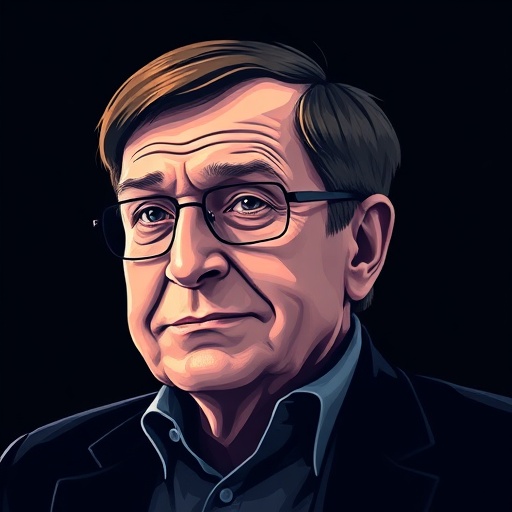
Stephen Hawking — "I'm a physicist, and I believe in science. I don't believe in miracles."
I'm a physicist, and I believe in science. I don't believe in miracles.
I'm a physicist, and I believe in science. I don't believe in miracles.
Click any product to generate a realistic preview. Up to 3 at a time.
* Initial load can take up to 90 seconds — revising the preview in another color is nearly instant.
"Women. They are a complete mystery."
"The universe is a cruel, uncaring void. The key to being happy isn't to search for meaning. It's to just keep yourself busy with unimportant nonsense, and eventually, you'll be dead."
"Although the chance of a disaster to planet Earth in a given year may be quite low, it adds up over time, and becomes a near certainty in the next thousand or 10 thousand years."
"The universe is a mystery, and I'm trying to solve it."
"Both of us."
British theoretical physicist whose Hawking radiation work and A Brief History of Time (1988) brought black-hole physics to a mass audience while he lived with ALS for 55 years. Closely associated with Roger Penrose (his collaborator on singularity theorems) and Carl Sagan (fellow popularizer who wrote Brief History's foreword). For an intellectual contrast, see William Lane Craig, American philosopher of religion — Craig's Kalam cosmological argument depends on the Big Bang requiring a divine first cause; Hawking's no-boundary proposal was specifically designed to remove the moment that would require one — the cleanest cosmology-vs-natural-theology contrast in modern thought.
Found in 1 providers: grok
1 source checked
Science operates through evidence, experimentation, and natural law—not supernatural intervention. This is a straightforward declaration of methodological naturalism: the universe follows discoverable rules, and unexplained phenomena call for investigation rather than appeals to miracles. It positions scientific inquiry as sufficient for understanding reality and implicitly challenges religious or mystical frameworks that invoke the miraculous to fill gaps in human knowledge. Mystery, for Hawking, is a problem to solve.
Hawking dedicated his life to explaining the universe's most extreme phenomena—black holes, the Big Bang, quantum gravity—purely through mathematics and physics. Diagnosed with ALS at 21 and given two years to live, he survived over 50 more years, yet publicly credited medicine and determination, never providence. His books, especially A Brief History of Time and The Grand Design, explicitly argued that physical laws alone explain cosmic origins, leaving no room for a creator.
Hawking worked through an era of fierce science-religion tension: creationism and intelligent design debates in Western schools, post-9/11 religious resurgence, and the New Atheism movement led by Dawkins, Hitchens, and Harris. Simultaneously, physics achieved extraordinary breakthroughs—the Standard Model, Hubble Deep Field images, gravitational wave detection—explaining cosmic structure without supernatural input. Hawking's rejection of miracles landed in a culture actively debating whether God was still necessary to explain the universe.
AI-generated insights based on extensive research and information for context. Factual errors? Email [email protected].
Your cart is empty