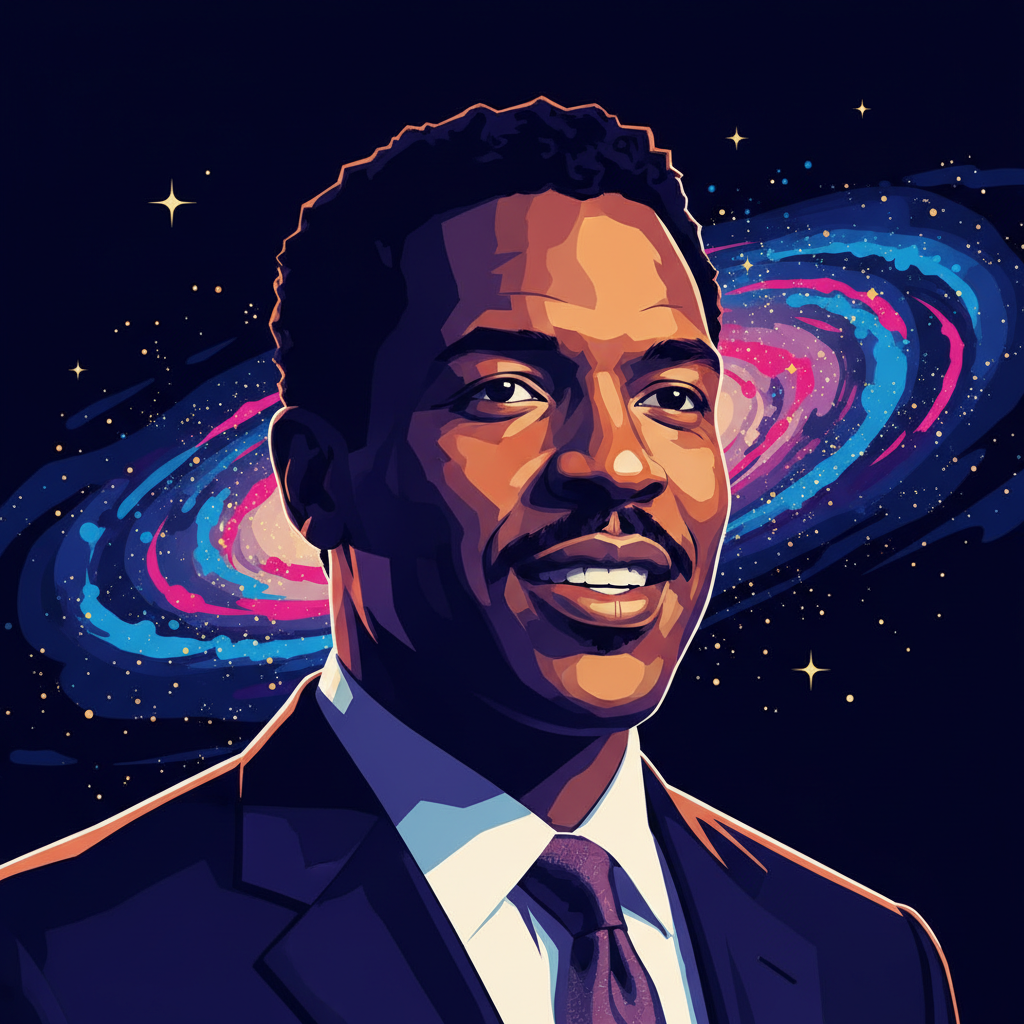
Neil deGrasse Tyson — "I'm not saying I'm a god. I'm just saying I have a really good telescope."
I'm not saying I'm a god. I'm just saying I have a really good telescope.
I'm not saying I'm a god. I'm just saying I have a really good telescope.
Click any product to generate a realistic preview. Up to 3 at a time.
* Initial load can take up to 90 seconds — revising the preview in another color is nearly instant.
"The universe is not just stranger than we imagine, it is stranger than we can imagine."
"The greatest discoveries in science are not always the ones that get the most attention."
"I'm not saying there are no aliens. I'm just saying the evidence is insufficient for me to conclude it."
"I'm a big believer in the power of curiosity. It's what drives us to explore, to discover, to learn."
"We are part of this universe; we are in this universe, but perhaps more important than both of those facts is that the universe is in us."
American astrophysicist, Hayden Planetarium director, and Cosmos: A Spacetime Odyssey host who carries the Carl Sagan public-science mantle. Closely associated with Bill Nye (fellow science communicator) and Brian Greene (theoretical physicist and string-theory popularizer). For an intellectual contrast, see Ken Ham, founder of Answers in Genesis and the Creation Museum — Ham's career has been organized around defending biblical 6-day creationism — exactly the science-education position Tyson's mainstream-science communication is structured to refute.
Found in 1 providers: grok
1 source checked
The speaker jokes about possessing extraordinary vision or knowledge without claiming divine status. It's a playful way of saying: I can see things others cannot, not because I'm supernatural, but because I have better tools and training. The humor deflects arrogance while still asserting genuine expertise and a privileged vantage point on reality.
Tyson built his career democratizing cosmic perspective through tools like the Hubble Space Telescope and observatories. His humor is central to his public persona—he routinely uses self-deprecating wit to make astrophysics accessible. The quip mirrors his real role: not a prophet, but someone whose instruments and expertise genuinely reveal truths invisible to most people.
In the 2010s–2020s, science communicators faced tension between public skepticism and a hunger for wonder. Tyson became a cultural icon during debates over science denial, climate change, and space exploration funding. His celebrity-scientist status made humor essential—self-aware jokes about authority helped him engage mass audiences without triggering the anti-expert backlash common in this polarized era.
AI-generated insights based on extensive research and information for context. Factual errors? Email [email protected].
Your cart is empty