Jane Goodall — "I'm often asked if I get lonely out in the field. And the answer is no, because …"
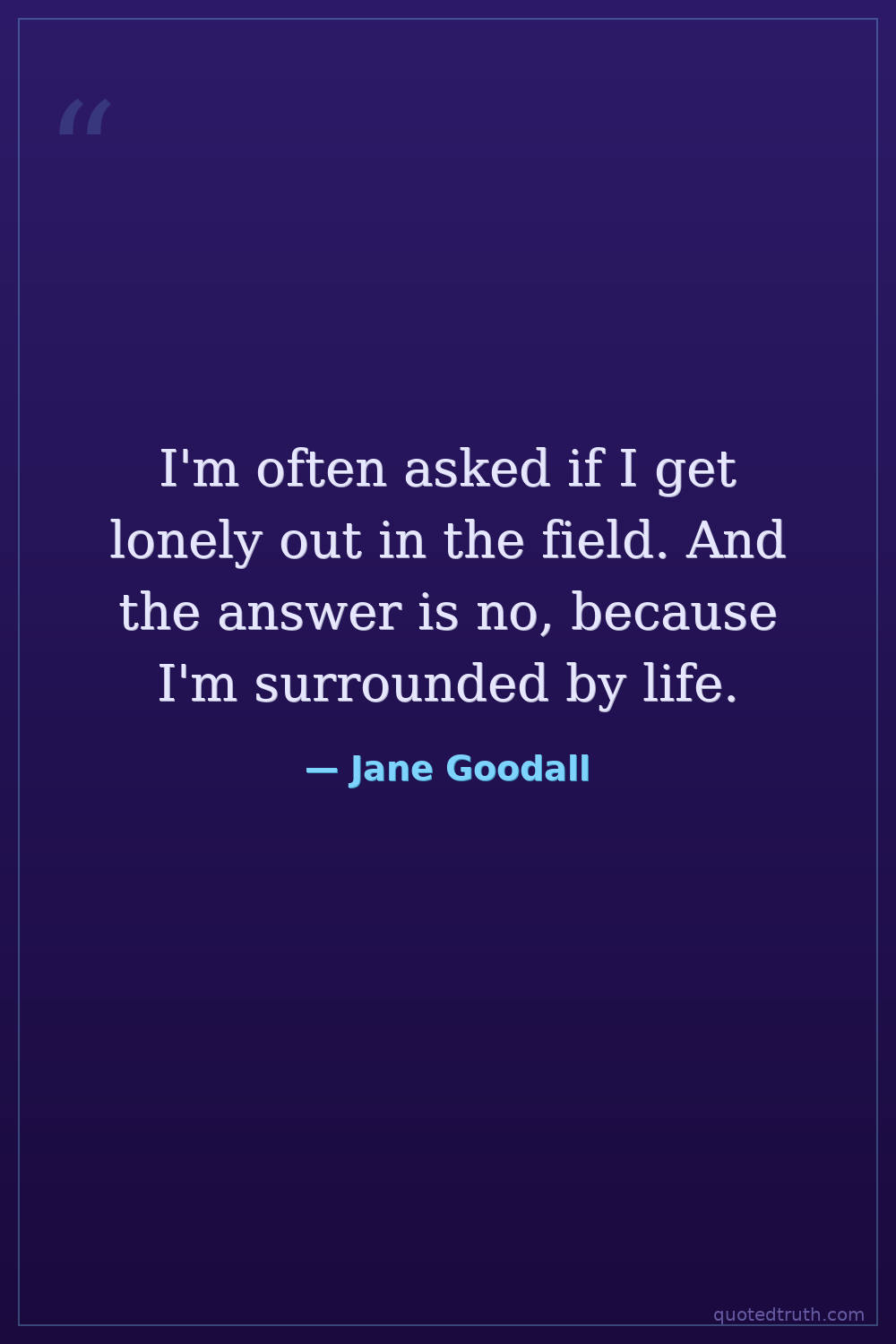
I'm often asked if I get lonely out in the field. And the answer is no, because I'm surrounded by life.
I'm often asked if I get lonely out in the field. And the answer is no, because I'm surrounded by life.
Click any product to generate a realistic preview. Up to 3 at a time.
* Initial load can take up to 90 seconds — revising the preview in another color is nearly instant.
"Every day is a chance to make a difference."
"I'm not an activist, I'm a pragmatist. I just want to save the world."
"We have to be the change we want to see in the world, and that starts with each of us."
"We need to foster a sense of empathy and compassion in our children, and teach them to care about others."
"It is our responsibility to protect the planet and all the species that live on it."
British primatologist who in 1960 began the longest-running wild primate study at Gombe Stream, transforming our understanding of chimpanzees. Closely associated with Dian Fossey (mountain-gorilla researcher) and Birutė Galdikas (orangutan researcher; together with Goodall and Fossey one of Louis Leakey's 'Trimates'). For an intellectual contrast, see Walter Palmer, American dentist who killed Cecil the Lion in Zimbabwe in 2015 — Palmer represents the trophy-hunting tradition Goodall's life's work has been organized against — the colonial-era hunter-naturalist worldview that treated primates and big game as specimens or trophies, which Goodall's Roots & Shoots and Jane Goodall Institute exist specifically to displace.
Found in 1 providers: grok
1 source checked
Solitude in wild places is not the same as loneliness. The quote rejects the human-centric idea that companionship requires other people. When immersed in a living ecosystem — surrounded by animals, insects, plants — a person is never truly alone. Connection exists at every scale of life. It reframes what company means, arguing that nature's constant, animate presence is as real and sustaining as any human relationship.
Goodall spent decades living in Gombe Stream, Tanzania, often alone for months among chimpanzees beginning in 1960. She named individual chimps — David Greybeard, Flo — recognizing their personalities and emotions at a time when science discouraged it. Her career rests on the conviction that non-human animals have rich inner lives. For her, this was not philosophy but daily lived reality: the forest was home, its inhabitants her community.
Goodall entered fieldwork in 1960 amid a scientific culture demanding detachment from nature. The Cold War era accelerated urbanization and industrial development, widening the gap between humans and the natural world. Environmentalism was barely organized — Rachel Carson's Silent Spring arrived only in 1962. Her statement challenged scientific detachment and the emerging cultural assumption that modernity meant leaving nature behind. Today it resonates sharply amid a documented loneliness epidemic and widespread nature-deficit disorder.
AI-generated insights based on extensive research and information for context. Factual errors? Email [email protected].
Your cart is empty