What it means
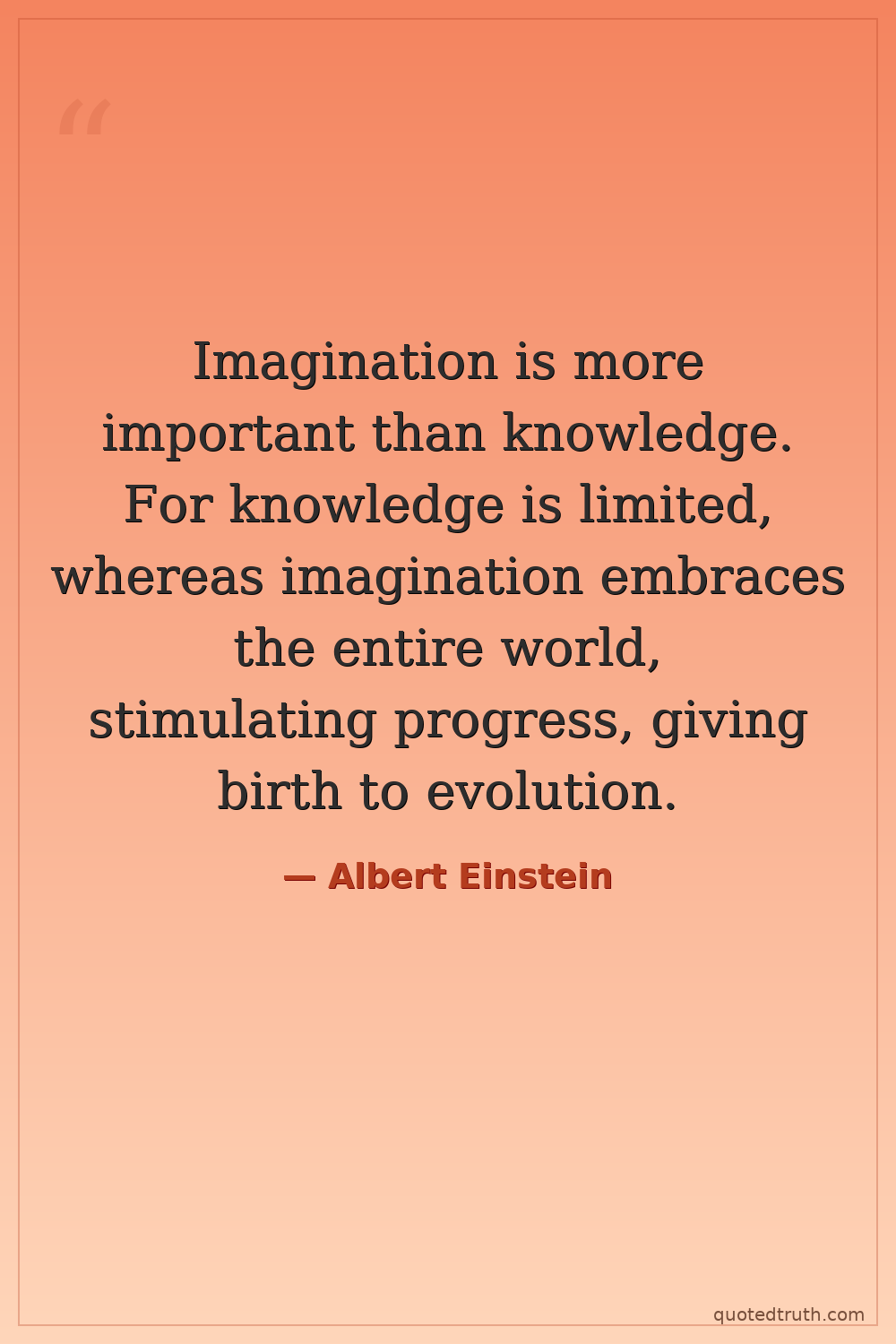
The quote argues that the capacity to envision what doesn't yet exist outweighs accumulated facts. Knowledge is bounded by what has already been discovered, but imagination reaches beyond current understanding to conceive entirely new possibilities. It's imagination that drives scientific breakthroughs, artistic creation, and human advancement—not merely cataloging existing information. Facts give you a map; imagination lets you draw new territory that the map doesn't yet show.
Relevance to Albert Einstein
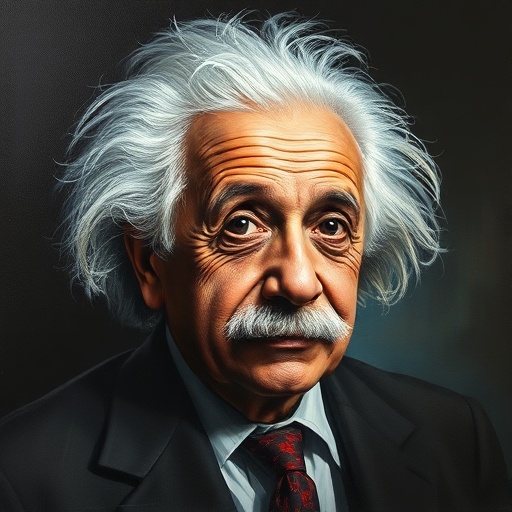
Einstein famously conducted thought experiments rather than lab work—he imagined riding alongside a light beam, which birthed special relativity. Working at a Swiss patent office with no university resources, he overturned Newtonian physics purely through mental visualization. He distrusted rote memorization, reportedly never memorizing facts he could look up. His greatest breakthroughs emerged from disciplined daydreaming, making him a living proof of his own principle.
The era
Einstein published his landmark papers in 1905 and general relativity in 1915, during a period when Western civilization glorified scientific and industrial expertise. World War I demonstrated that knowledge without moral imagination produced poison gas and mass slaughter. The early 20th century also saw rigid academic institutions dismissing intuition in favor of empiricism. Einstein's claim was a direct challenge to the era's technocratic assumption that more data automatically equals more progress.
AI-generated insights based on extensive research and information for context. Factual errors? Email [email protected].