What it means
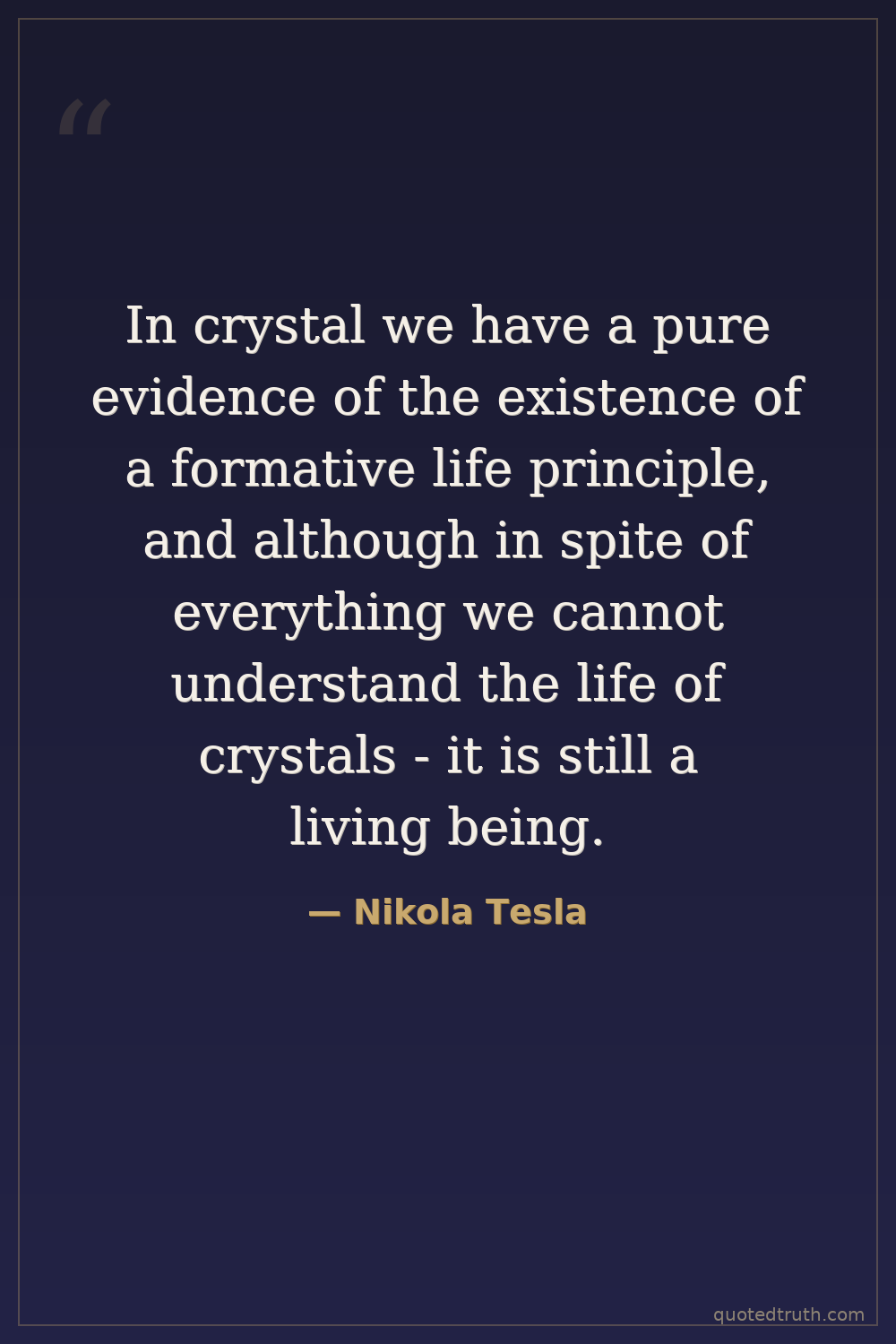
Tesla argues that crystals provide concrete proof of a universal organizing force — some principle that drives matter to arrange itself with geometric precision and purpose. Even without fully understanding how or why crystals grow so perfectly, he treats that structured self-formation as evidence of something alive. He extends the definition of life beyond biology to include any matter that grows, organizes, and expresses an inner pattern.
Relevance to Nikola Tesla
Tesla viewed the universe as fundamentally energetic and interconnected, not merely mechanical. He believed invisible forces — resonance, frequency, electromagnetic fields — governed everything. His AC system was built on harnessing nature's own rhythms. Deeply attached to living things (he famously loved pigeons), Tesla consistently blurred boundaries between animate and inanimate. His notebooks show genuine reverence for natural self-organization, and crystals, growing in perfect geometric lattices without human intervention, fit exactly his belief that nature itself is purposeful and alive.
The era
Tesla's active years (1880s–1940s) straddled a fierce scientific debate: vitalism versus mechanism — whether life required a special 'vital force' or was purely chemical. X-ray crystallography was just emerging, revealing crystals' atomic lattices for the first time. Scientists were dismantling spontaneous generation while simultaneously struggling to define life's boundaries. Tesla's crystal remarks reflect this unresolved tension: a world newly mapping matter's inner structure yet still uncertain whether organization itself constitutes a form of living.
AI-generated insights based on extensive research and information for context. Factual errors? Email [email protected].