What it means
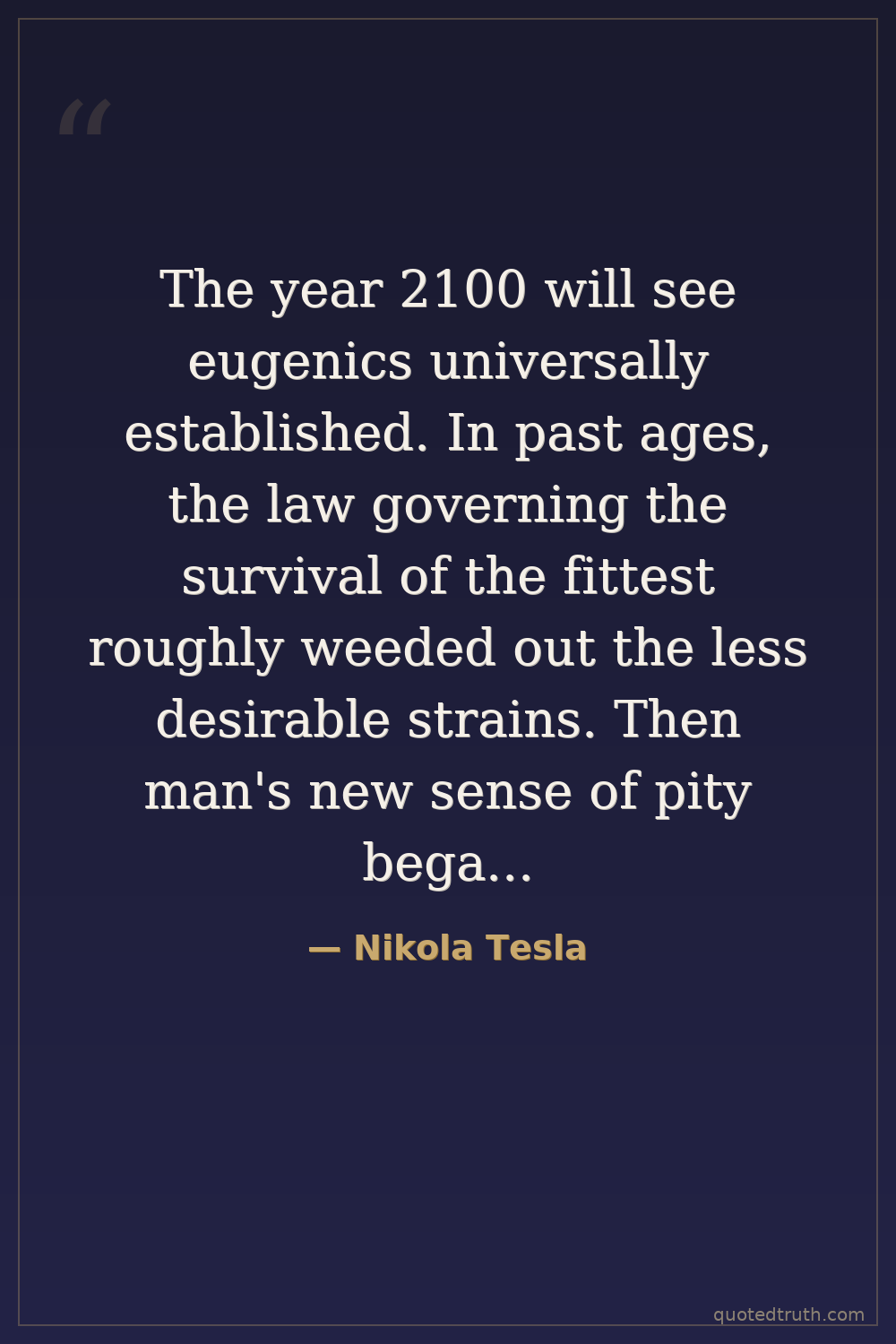
Tesla predicts that by 2100, eugenics—deliberate control of human reproduction to breed supposedly superior traits—would be universally adopted. He argues natural selection once eliminated weaker hereditary lines, but human compassion through medicine and charity now allows those traits to persist. He frames this as a civilizational problem requiring scientific correction, reflecting a deeply flawed but once-mainstream belief that humanity should engineer its own biological future.
Relevance to Nikola Tesla
Tesla was a compulsive futurist, making sweeping predictions about electricity, wireless communication, and now civilization itself. A lifelong bachelor who chose celibacy, he wrote about human reproduction with clinical detachment. His faith in science as humanity's supreme guide extended into social engineering. This quote reveals the shadow side of his scientism—the same certainty that powered his electrical genius led him to endorse ideas now recognized as profoundly harmful.
The era
Tesla wrote this around the 1930s, when eugenics was mainstream intellectual culture across America and Europe. Universities offered eugenics coursework, the American Eugenics Society hosted public exhibitions, and over thirty U.S. states had enacted forced sterilization laws. This predated Nazi Germany's atrocities, which ultimately collapsed the movement's credibility. What Tesla expressed was tragically unremarkable among educated Western thinkers of his generation—a chilling reminder of how 'scientific consensus' can embody profound moral failure.
AI-generated insights based on extensive research and information for context. Factual errors? Email [email protected].