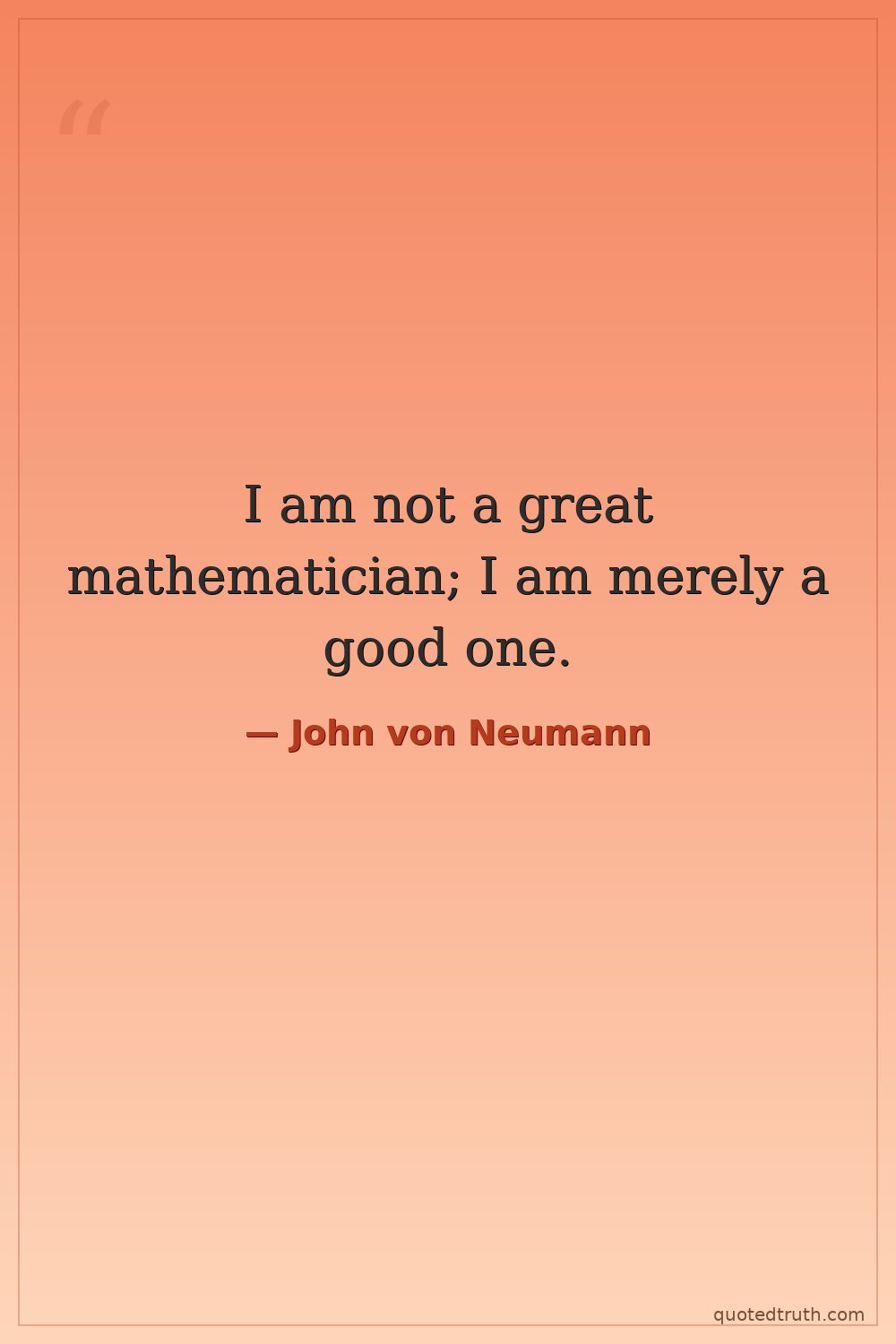
John von Neumann — "I am not a great mathematician; I am merely a good one."
I am not a great mathematician; I am merely a good one.
I am not a great mathematician; I am merely a good one.
Click any product to generate a realistic preview. Up to 3 at a time.
* Initial load can take up to 90 seconds — revising the preview in another color is nearly instant.
"The only way to be sure of yourself is to be a little bit unsure."
"It is just as important to know what not to do as it is to know what to do."
"The world is not logical, it is psychological."
"The world is not as simple as we would like it to be."
"Mathematics is a game played according to certain simple rules with meaningless marks on paper."
Self-deprecating remark from a man widely considered a genius.
Date: 1930s-1940s
Self-DeprecatingFound in 1 providers: grok
1 source checked
The speaker distinguishes honest competence from transcendent genius—acknowledging real limits while claiming genuine skill. This is intellectual humility without false self-deprecation: 'good' is still exceptional, but 'great' implies timeless, foundational brilliance on par with Gauss or Euler. It signals self-awareness about one's ceiling and resists ego inflation, recognizing that being excellent is not the same as being among the irreplaceable few who permanently reshape a field at its deepest foundations.
Von Neumann was a supreme generalist—fluid across pure mathematics, quantum physics, economics, and early computing—yet he worked alongside titans like Hilbert and Gödel whom he deeply admired. His contributions spanned game theory, the Manhattan Project, and stored-program computer architecture, yet he reportedly felt his intuition was computational and broad rather than purely creative. His colleagues largely disagreed, ranking him among the century's finest minds, making this quote a rare window into his genuine self-assessment.
Von Neumann (1903–1957) worked alongside Hilbert, Gödel, Einstein, and Turing during an era when mathematics faced existential crises—Gödel's incompleteness theorems shattered hopes of a complete axiomatic foundation while physics demanded radical new tools. WWII accelerated applied mathematics through weapons development and early computing. Standards for 'greatness' were extraordinarily high in that generation, making even the most brilliant minds cautious about claiming the title against historical giants like Gauss, Riemann, or Euler.
AI-generated insights based on extensive research and information for context. Factual errors? Email [email protected].
Your cart is empty