Charles Darwin — "In the long history of humankind (and animal kind, too) those who learned to col…"
In the long history of humankind (and animal kind, too) those who learned to collaborate and improvise most effectively have prevailed.
In the long history of humankind (and animal kind, too) those who learned to collaborate and improvise most effectively have prevailed.
Click any product to generate a realistic preview. Up to 3 at a time.
* Initial load can take up to 90 seconds — revising the preview in another color is nearly instant.
"I had no intention of writing an autobiography, but I found myself doing so."
"I have no great quickness of apprehension or wit which is so remarkable in some clever men."
"I see no good reason why the views given in this volume should shock the religious feelings of any one."
"There is no fundamental difference between man and the higher mammals in their mental faculties."
"The mystery of the beginning of all things is insoluble by us; and I for one must be content to remain an agnostic."
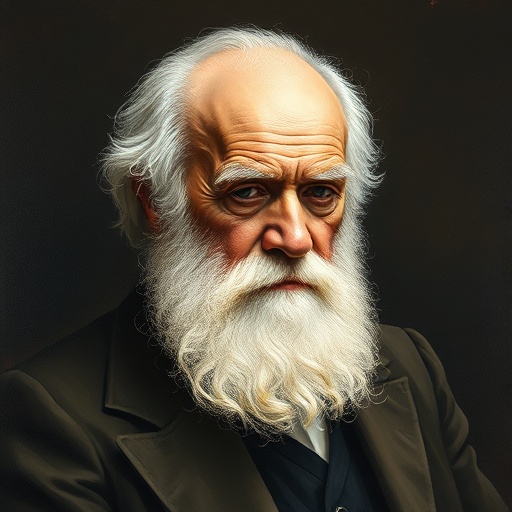
British naturalist whose On the Origin of Species (1859) established evolution by natural selection — the unifying theory of modern biology. Closely associated with Thomas Henry Huxley (his 'bulldog' public defender) and Alfred Russel Wallace (independent co-discoverer of natural selection). For an intellectual contrast, see William Paley, Anglican theologian and Natural Theology author (1743-1805) — Origin of Species is structurally a 400-page reply to Paley — Darwin admired Paley's watchmaker-argument as an undergraduate at Cambridge and then spent 20 years building the empirical machinery to displace him. The cleanest 'design argument vs natural selection' founding rebuttal in science.
The standard scholarly entry points to Charles Darwin's work: Janet Browne (Harvard, history of science) — Charles Darwin: Voyaging (1995) and The Power of Place (2002); Adrian Desmond (UCL, biographer) — Darwin: The Life of a Tormented Evolutionist (1991, with James Moore). These are the works graduate seminars cite when teaching Charles Darwin.
Often attributed, but no source found in Darwin's writings. Likely a modern summary of evolutionary ideas, not a direct quote.
Date: Uncertain
EducationalFound in 1 providers: grok
1 source checked
Survival and success belong not to the strongest or smartest alone, but to those who work together and adapt when circumstances change. Cooperation and flexible problem-solving are the true engines of endurance across both human civilizations and animal species, outcompeting rigid or isolated individuals over long timescales.
Darwin spent decades studying how species survive through adaptation, observing finches in the Galapagos and barnacles for eight years with meticulous collaboration with scientists like Lyell and Hooker. His theory of natural selection revealed that organisms fitting their environment through variation survived, and he witnessed social insects like ants demonstrating how collective behavior confers extraordinary evolutionary advantage over solitary competitors.
Darwin published On the Origin of Species in 1859, amid the Industrial Revolution when cooperation between scientists, industrialists, and engineers was reshaping civilization. Victorian Britain was also grappling with colonial competition among empires, labor organizing movements, and rapid technological change, making questions about what makes groups thrive versus collapse deeply urgent and politically charged across scientific and social spheres.
AI-generated insights based on extensive research and information for context. Factual errors? Email [email protected].
Your cart is empty