Charles Darwin — "There is no fundamental difference between man and the higher mammals in their m…"
There is no fundamental difference between man and the higher mammals in their mental faculties.
There is no fundamental difference between man and the higher mammals in their mental faculties.
Click any product to generate a realistic preview. Up to 3 at a time.
* Initial load can take up to 90 seconds — revising the preview in another color is nearly instant.
"I confess I am not much interested in the future, for I am too much occupied with the present."
"One day, on looking at an orchid, I was struck with the idea that the structure of the flower was adapted to the visits of insects."
"If I have seen further than others, it is by standing upon the shoulders of giants."
"I have called this principle, by which each slight variation, if useful, is preserved, by the term Natural Selection."
"I have always maintained that, in this country, a man can do whatever he likes, provided he is a gentleman."
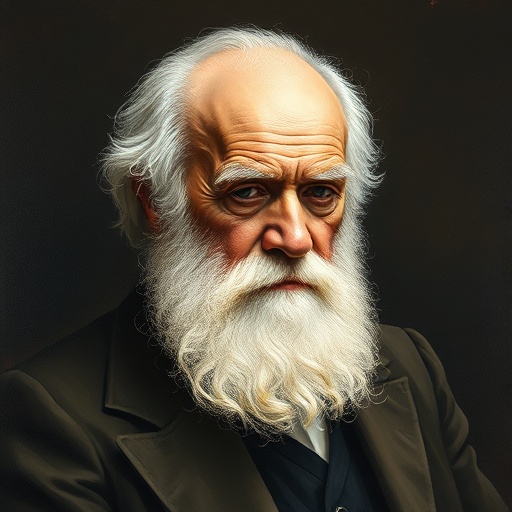
British naturalist whose On the Origin of Species (1859) established evolution by natural selection — the unifying theory of modern biology. Closely associated with Thomas Henry Huxley (his 'bulldog' public defender) and Alfred Russel Wallace (independent co-discoverer of natural selection). For an intellectual contrast, see William Paley, Anglican theologian and Natural Theology author (1743-1805) — Origin of Species is structurally a 400-page reply to Paley — Darwin admired Paley's watchmaker-argument as an undergraduate at Cambridge and then spent 20 years building the empirical machinery to displace him. The cleanest 'design argument vs natural selection' founding rebuttal in science.
The standard scholarly entry points to Charles Darwin's work: Janet Browne (Harvard, history of science) — Charles Darwin: Voyaging (1995) and The Power of Place (2002); Adrian Desmond (UCL, biographer) — Darwin: The Life of a Tormented Evolutionist (1991, with James Moore). These are the works graduate seminars cite when teaching Charles Darwin.
Found in 1 providers: grok
1 source checked
Humans do not possess a uniquely superior mind that separates us categorically from other mammals. The cognitive abilities we consider distinctly human—reasoning, memory, emotion, imagination, curiosity—exist in other mammals too, though perhaps less developed. The difference is one of degree, not of kind. This challenges the comfortable assumption that human intelligence places us in a wholly separate category from the rest of the animal kingdom.
Darwin spent decades observing animal behavior alongside human behavior, most systematically in 'The Descent of Man' (1871). Having proved physical continuity between humans and apes through natural selection, he extended the argument to the mind, drawing on observations of dogs, primates, and other mammals exhibiting problem-solving, grief, and affection. This was his most controversial extension of evolutionary theory.
Victorian society held firmly to religious and philosophical traditions placing humans apart from animals by virtue of a rational, God-given soul. Darwin published 'The Descent of Man' in 1871, twelve years after 'On the Origin of Species,' directly confronting this anthropocentric worldview. The claim struck at human exceptionalism during an era when such exceptionalism underpinned morality, theology, and social hierarchy.
AI-generated insights based on extensive research and information for context. Factual errors? Email [email protected].
Your cart is empty