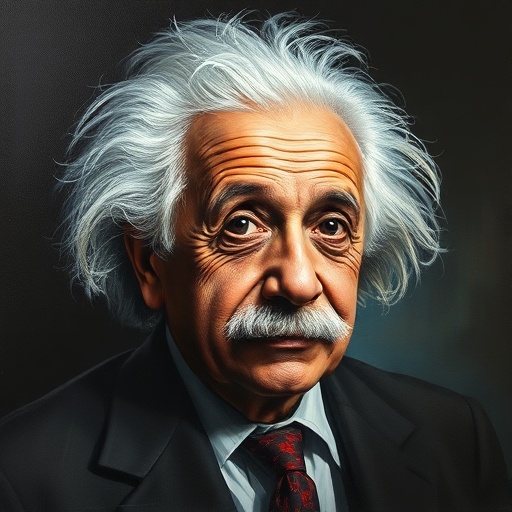
Albert Einstein — "The difference between genius and stupidity is that genius has its limits."
The difference between genius and stupidity is that genius has its limits.
The difference between genius and stupidity is that genius has its limits.
Click any product to generate a realistic preview. Up to 3 at a time.
* Initial load can take up to 90 seconds — revising the preview in another color is nearly instant.
"My passion for social justice has often brought me into conflict with people, as has my aversion to all kinds of authority."
"Strange is our situation here on Earth. Each of us comes for a short visit, not knowing why, yet sometimes seeming to divine a purpose."
"The most beautiful thing we can experience is the mysterious. It is the source of all true art and all science. He to whom this emotion is a stranger, who can no longer pause to wonder and stand rapt …"
"The important thing is not to stop questioning. Curiosity has its own reason for existence."
"I am by heritage a Jew, by citizenship a Swiss, and by temperament a human being, and only a human being, without any special attachment to any state or national entity whatsoever."
Found in 2 providers: deepseek,grok
2 sources checked
Human intelligence, no matter how extraordinary, reaches a ceiling. There are problems even the brightest minds cannot solve, boundaries knowledge cannot cross. Stupidity, by contrast, faces no such constraint — foolishness is boundless. The quote is darkly humorous: it acknowledges genius as finite and fallible, while implying that ignorance and poor judgment operate without any upper bound or natural stopping point.
Einstein, who revolutionized physics with relativity and quantum theory, was acutely aware that even his own understanding had limits — he spent decades failing to unify gravity with electromagnetism. He was famous for self-deprecating wit and philosophical humility. Having fled Nazi Germany, he witnessed how unchecked ignorance and ideology could overwhelm reason, giving this observation both personal and political weight.
Einstein lived through two World Wars, the rise of fascism, and the atomic age — periods when catastrophic decisions by leaders demonstrated that destructive foolishness operated at civilizational scale. Meanwhile, scientific progress exposed how much remained unknown. The mid-20th century's collision of unprecedented technological genius with unprecedented political stupidity made this sardonic observation resonate as more than wordplay — it was lived reality.
AI-generated insights based on extensive research and information for context. Factual errors? Email [email protected].
Your cart is empty