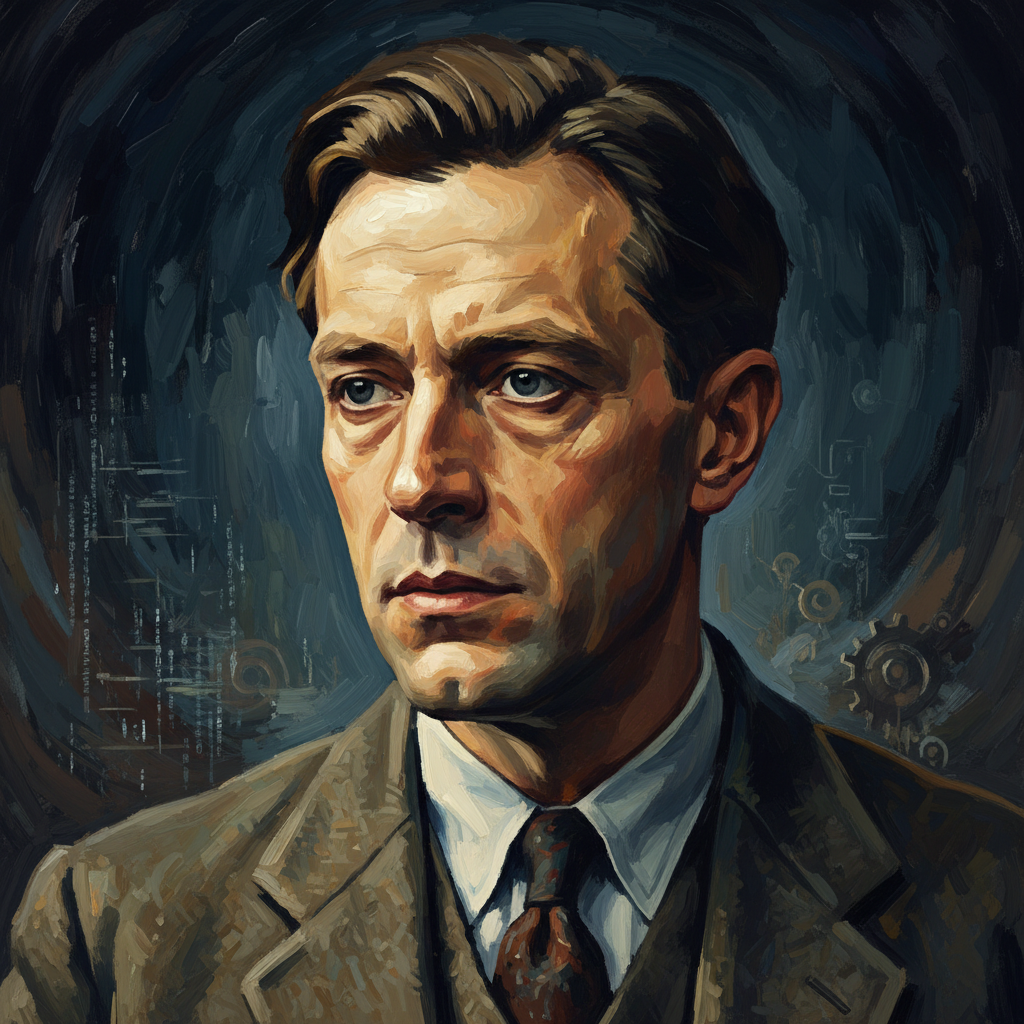
Alan Turing — "Instead of trying to produce a programme to simulate the adult mind, why not rat…"
Instead of trying to produce a programme to simulate the adult mind, why not rather try to produce one which simulates the child's?
Instead of trying to produce a programme to simulate the adult mind, why not rather try to produce one which simulates the child's?
Click any product to generate a realistic preview. Up to 3 at a time.
* Initial load can take up to 90 seconds — revising the preview in another color is nearly instant.
"It is not possible to produce a set of rules purporting to describe what a man should do in every conceivable set of circumstances."
"The human brain is a very complex machine, but it is still a machine."
"It is possible for a machine to have a memory in the sense that a human being has a memory."
"A human being is a machine for converting food into thoughts."
"The possibility of a machine thinking is a disturbing thought for many people."
Found in 1 providers: grok
1 source checked
Building an artificial mind from scratch doesn't require replicating decades of accumulated human knowledge. Instead, start with a blank, teachable system — like a child — capable of learning through exposure and feedback. Given the right inputs and training, that system grows toward adult-level competence naturally. The insight is strategic: the hardest part isn't the goal state, it's choosing the right starting point and learning mechanism to reach it.
Turing wrote this in his landmark 1950 paper that introduced what became the Turing Test. A mathematician who cracked Enigma at Bletchley Park, he approached intelligence empirically, not philosophically. He believed the mind emerges from process rather than substance — consistent with his later morphogenesis work showing how complex biological patterns arise from simple chemical rules. His habit of bypassing conventional framing to find elegant entry points defined his entire scientific character.
In 1950, computers occupied entire rooms and performed basic arithmetic. No one had formally asked whether machines could think — Turing's paper was the first serious scientific treatment of the question. Psychology was dominated by behaviorism, viewing learning as stimulus-response conditioning, precisely the teachable incremental process Turing described. The Cold War simultaneously created military pressure to automate cognition, making machine intelligence urgent far beyond academic philosophy.
AI-generated insights based on extensive research and information for context. Factual errors? Email [email protected].
Your cart is empty