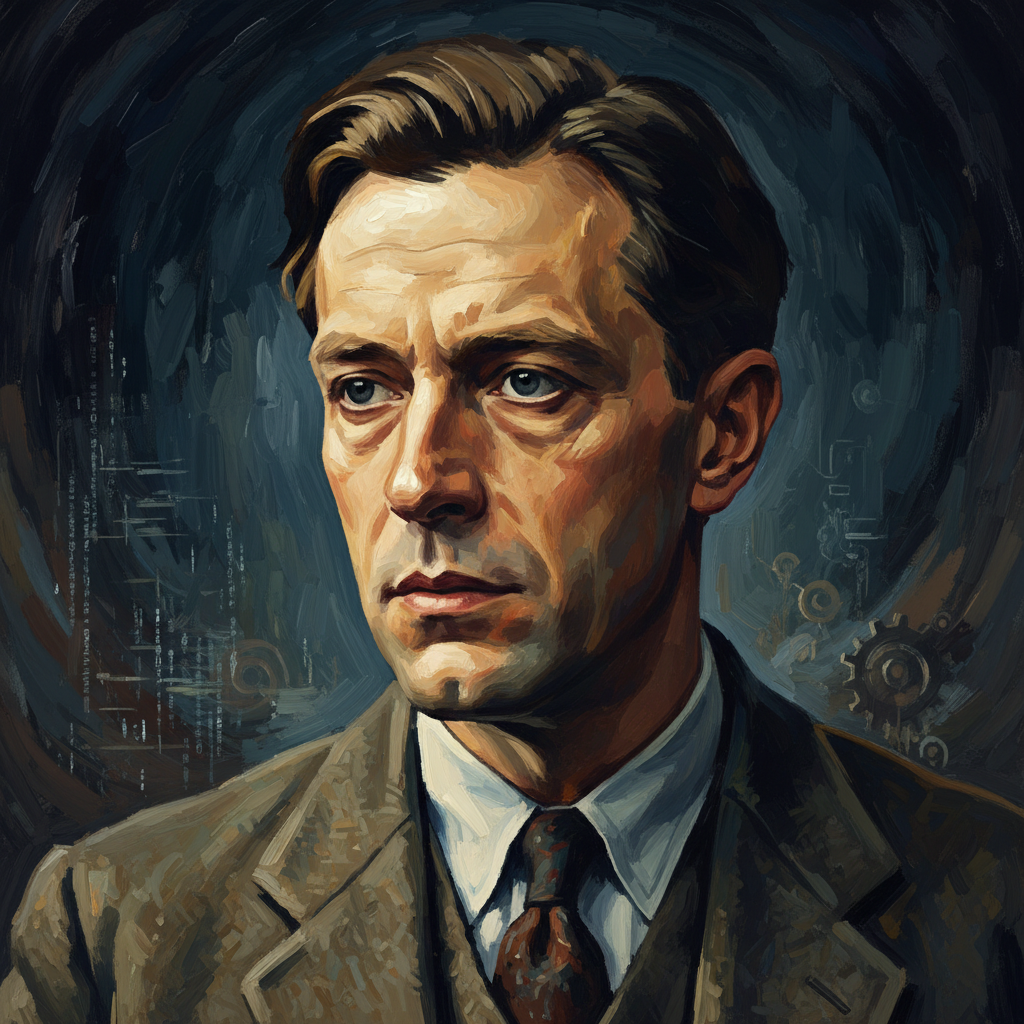
Alan Turing — "The possibility of a machine thinking is a disturbing thought for many people."
The possibility of a machine thinking is a disturbing thought for many people.
The possibility of a machine thinking is a disturbing thought for many people.
Click any product to generate a realistic preview. Up to 3 at a time.
* Initial load can take up to 90 seconds — revising the preview in another color is nearly instant.
"My interest in the brain is not so much in its structure, but in its function."
"I like to think the brain is a kind of pudding, but not a Christmas pudding."
"Arguments against the hope of artificial intelligence included that 'you will never be able to make [a machine] to do' any of these: Be kind, resourceful, beautiful, friendly, have initiative, have a …"
"The only constant in life is change."
"We are not interested in the fact that the machine can do well, but in the fact that it can do badly."
Attributed, general implication from his writings, but exact quote is elusive.
Date: Approx. 1950
ShockingFound in 1 providers: grok
1 source checked
The idea that machines could think genuinely unsettles people. It challenges the assumption that thought, consciousness, and intelligence are uniquely human traits. If a machine can think, what separates humans from their creations? This forces uncomfortable questions about identity, purpose, and what makes human minds special — questions most people would rather avoid than confront directly.
Turing spent his career building the theoretical and practical foundations for computing, including his famous Turing Test to evaluate machine intelligence. He understood viscerally why this disturbed people — his 1950 paper 'Computing Machinery and Intelligence' directly challenged human exceptionalism, and his own prosecution for homosexuality showed how deeply society resisted ideas threatening its assumptions about nature.
In the late 1940s and 1950s, post-war Britain grappled with technology's rapid advance — atomic bombs, early computers, automation fears. Cold War anxieties amplified concerns about machines replacing or surpassing humans. The Church-Turing thesis and early AI discussions emerged in a culture still processing mechanized warfare's horrors, making machine cognition feel not just philosophically threatening but existentially alarming.
AI-generated insights based on extensive research and information for context. Factual errors? Email [email protected].
Your cart is empty