What it means
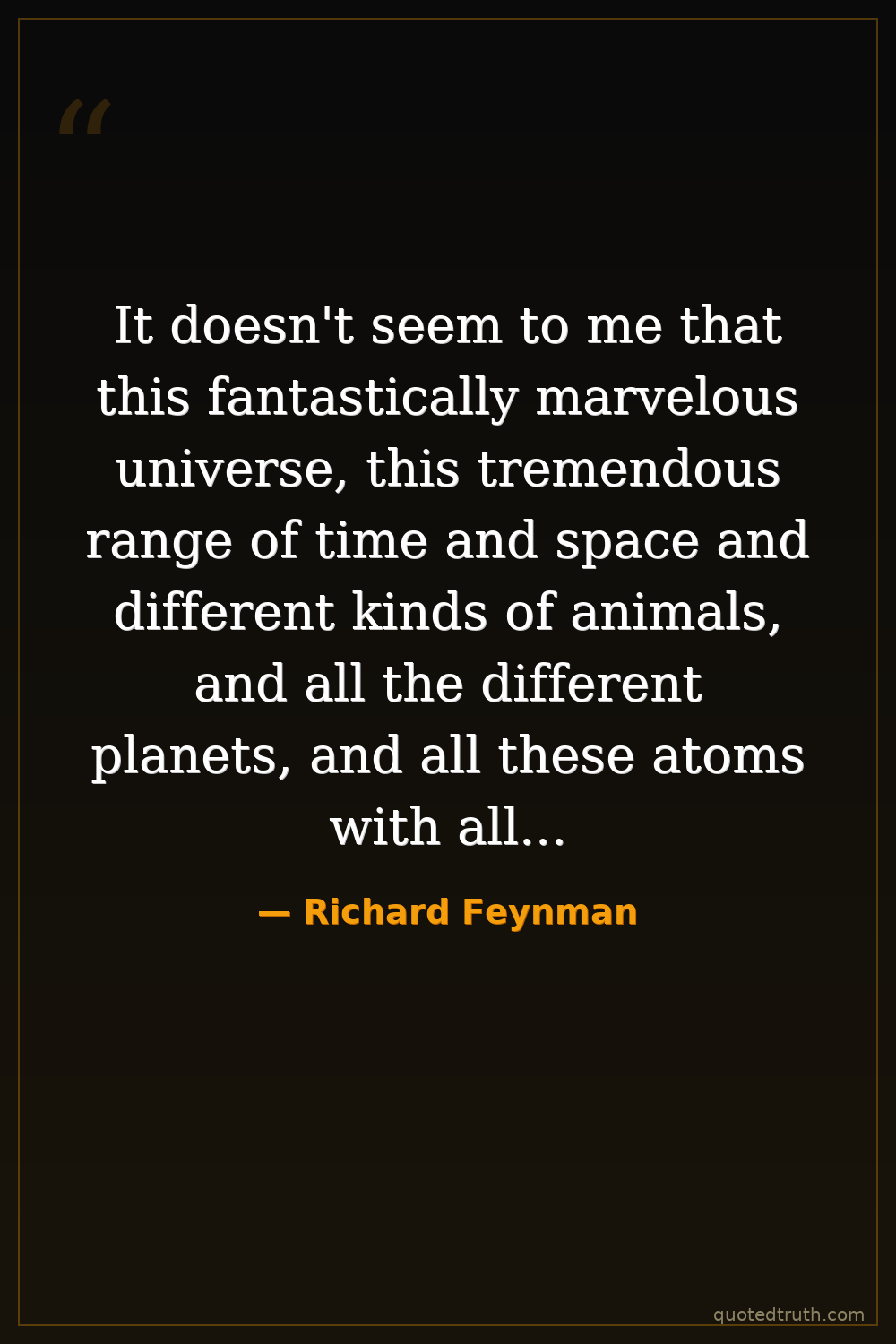
The universe is incomprehensibly vast — billions of galaxies, trillions of planets, countless atoms in constant motion across billions of years. Against that scale, the religious idea that all of it exists as backdrop for human moral drama seems absurdly disproportionate. The cosmos is too enormous, too complex, and too indifferent to plausibly center on one species' struggle between good and evil on one small planet.
Relevance to Richard Feynman
Feynman spent his career mapping the fundamental rules of reality — quantum electrodynamics, particle physics, the deep structure of matter. That work gave him visceral appreciation for the universe's true scale and complexity. He was a proud agnostic who believed wonder at nature required no supernatural framework. His objection is physicist's logic: extraordinary claims require proportionate evidence, and the religious claim fails the proportionality test spectacularly.
The era
Feynman spoke and wrote this during the Cold War space age, when humanity first saw Earth from orbit and began grasping interstellar distances. The 1950s–70s saw explosive growth in cosmology, nuclear physics, and evolutionary biology — all revealing a universe far older, larger, and stranger than scripture described. Religious authority was simultaneously being challenged by civil rights, secularism, and scientific education, making this tension between cosmic scale and theological anthropocentrism culturally charged.
AI-generated insights based on extensive research and information for context. Factual errors? Email [email protected].