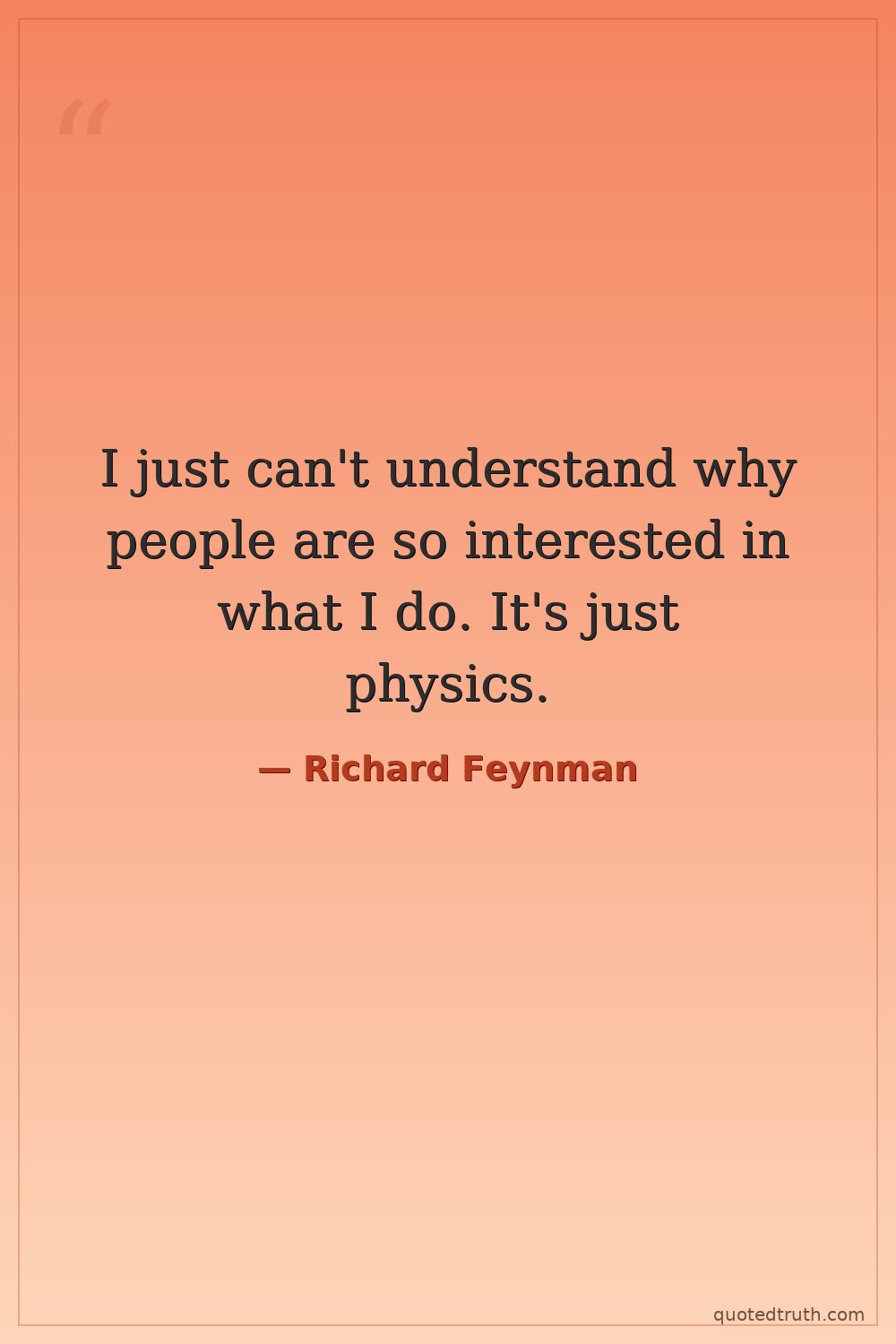
Richard Feynman — "I just can't understand why people are so interested in what I do. It's just phy…"
I just can't understand why people are so interested in what I do. It's just physics.
I just can't understand why people are so interested in what I do. It's just physics.
Click any product to generate a realistic preview. Up to 3 at a time.
* Initial load can take up to 90 seconds — revising the preview in another color is nearly instant.
"If you thought that science was certain — well, that is just an error on your part."
"I don't like to be called a genius. I just like to think."
"I don't know anything, but I know that I know nothing. And that's the beginning of wisdom."
"I object to having my fun regulated."
"I don't know what's the matter with people: they don't learn by understanding; they learn by some other way — by rote or something. Their knowledge is so fragile!"
American theoretical physicist who shared the 1965 Nobel for QED, developed Feynman diagrams, and wrote the Feynman Lectures on Physics. Closely associated with Julian Schwinger (co-Nobelist for QED) and Murray Gell-Mann (Caltech rival and Eightfold-Way physicist). For an intellectual contrast, see Deepak Chopra, physician and quantum-mysticism author — Feynman's Caltech 'cargo cult science' commencement address is the precise template for what he saw as misuse of physics terminology — Chopra-style appropriation of quantum vocabulary for metaphysical claims is the canonical example of what Feynman called 'fooling yourself'.
Found in 1 providers: grok
1 source checked
Genuine curiosity and love for a subject makes the work feel natural and obvious to the person doing it, even when outsiders find it extraordinary. When you are truly absorbed in something you love, the gap between your effort and the world's admiration becomes invisible to you. What feels like simple exploration to you looks like genius to everyone else.
Feynman was famous for his infectious enthusiasm for physics as pure play and discovery. He developed quantum electrodynamics, won the Nobel Prize, yet consistently downplayed his celebrity, preferring bongo drums and cracking safes to fame. His Lectures on Physics were legendary precisely because he conveyed wonder, not importance. He genuinely could not separate 'doing physics' from 'just having fun thinking.'
Post-WWII America elevated scientists to cultural heroes after the Manhattan Project and the Space Race. Physicists like Feynman became public intellectuals and media figures whether they wanted it or not. Cold War anxiety made nuclear and quantum science seem mysterious and powerful, creating a celebrity-scientist phenomenon that puzzled researchers who simply wanted to solve problems, not become symbols.
AI-generated insights based on extensive research and information for context. Factual errors? Email [email protected].
Your cart is empty