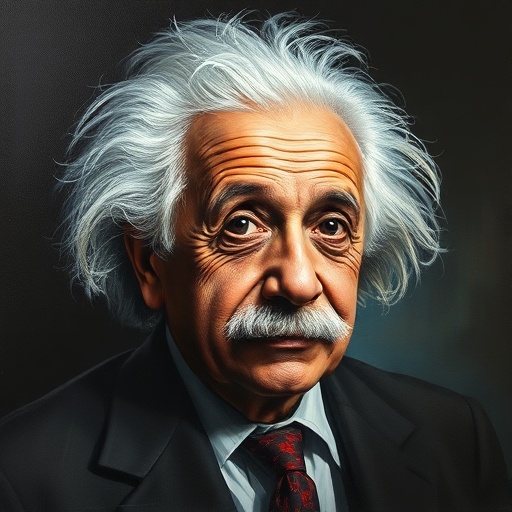
Albert Einstein — "It has become appallingly obvious that our technology has exceeded our humanity."
It has become appallingly obvious that our technology has exceeded our humanity.
It has become appallingly obvious that our technology has exceeded our humanity.
Click any product to generate a realistic preview. Up to 3 at a time.
* Initial load can take up to 90 seconds — revising the preview in another color is nearly instant.
"Marriage is the unsuccessful attempt to make something lasting out of an incident."
"My passion for social justice has often brought me into conflict with people, as has my aversion to all kinds of authority."
"Nationalism is an infantile disease. It is the measles of mankind."
"The only way to escape the corrupting influence of praise is to go on working."
"The difference between genius and stupidity is that genius has its limits."
Attributed, but definitive primary source is elusive and often paraphrased.
Date: Uncertain
GeneralFound in 1 providers: grok
1 source checked
Technology has outpaced human wisdom and moral development. We've built weapons, systems, and tools of enormous power without developing the ethical frameworks, empathy, or collective judgment needed to wield them responsibly. Our capacity to destroy, manipulate, and control has grown faster than our compassion and conscience. The result: tools meant to serve humanity now threaten it, because the people using them haven't grown proportionally in wisdom or restraint.
Einstein's theoretical work—especially E=mc²—provided the foundation for nuclear weapons, a fact that haunted him. He signed the 1939 Einstein-Szilard letter urging the U.S. to develop atomic bombs before Nazi Germany, then spent his final years campaigning for nuclear disarmament after Hiroshima. A lifelong pacifist and humanist, he co-founded the Emergency Committee of Atomic Scientists. His own career became living proof of this warning: brilliant physics unleashed devastating consequences he never intended.
Einstein lived through two World Wars and witnessed atomic bombs obliterate Hiroshima and Nagasaki in 1945. The early 20th century saw science transform warfare—from mustard gas in WWI to nuclear annihilation in WWII—while international institutions struggled to keep pace. The Cold War then launched a nuclear arms race threatening civilizational survival. An era of astonishing scientific breakthroughs—relativity, quantum mechanics, aviation, nuclear fission—unfolded alongside industrialized genocide and weapons capable of ending civilization.
AI-generated insights based on extensive research and information for context. Factual errors? Email [email protected].
Your cart is empty