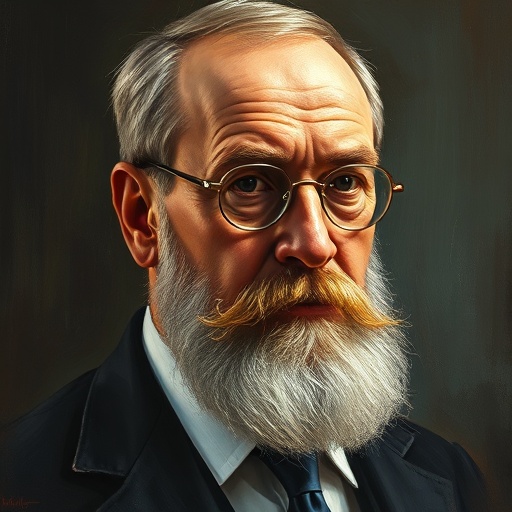
Robert Koch — "It is a great privilege to be able to contribute to the progress of human knowle…"
It is a great privilege to be able to contribute to the progress of human knowledge.
It is a great privilege to be able to contribute to the progress of human knowledge.
Click any product to generate a realistic preview. Up to 3 at a time.
* Initial load can take up to 90 seconds — revising the preview in another color is nearly instant.
"The greatest obstacle to progress is not ignorance, but the illusion of knowledge."
"The importance of pure cultures cannot be overstated in bacteriological research."
"I have no other aim than to advance science and to contribute to the welfare of mankind."
"The existence of microorganisms as a cause of disease is no longer a matter of theory, but a demonstrated fact."
"I have always tried to be as objective as possible in my scientific investigations."
Found in 1 providers: grok
1 source checked
Advancing what humanity collectively knows is a privilege, not a right — a rare opening granted by circumstance, education, and timing as much as by talent alone. The idea conveys genuine humility: those who push knowledge forward should feel honored by the opportunity, not merely proud of outcomes. Discovery and insight belong to all humanity; being positioned to generate them is the truly exceptional part.
Koch spent decades in German laboratories identifying the specific bacteria responsible for tuberculosis, cholera, and anthrax — diseases that killed millions. His Koch's Postulates gave science a rigorous method for linking pathogens to disease. He worked through failed experiments, professional rivalries with Pasteur, and firsthand public health crises. Winning the 1905 Nobel Prize capped a career defined by the conviction that meticulous laboratory work was medicine's highest calling.
In Koch's era, bacteriology was dismantling centuries of miasma theory — the belief that disease arose from bad air. Tuberculosis alone killed one in seven Europeans. Cholera swept continents in pandemic waves. The germ theory revolution meant individual discoveries in a single lab could redirect global public health policy. Scientific contribution had never carried higher stakes; identifying one pathogen could, and did, save tens of millions of lives.
AI-generated insights based on extensive research and information for context. Factual errors? Email [email protected].
Your cart is empty