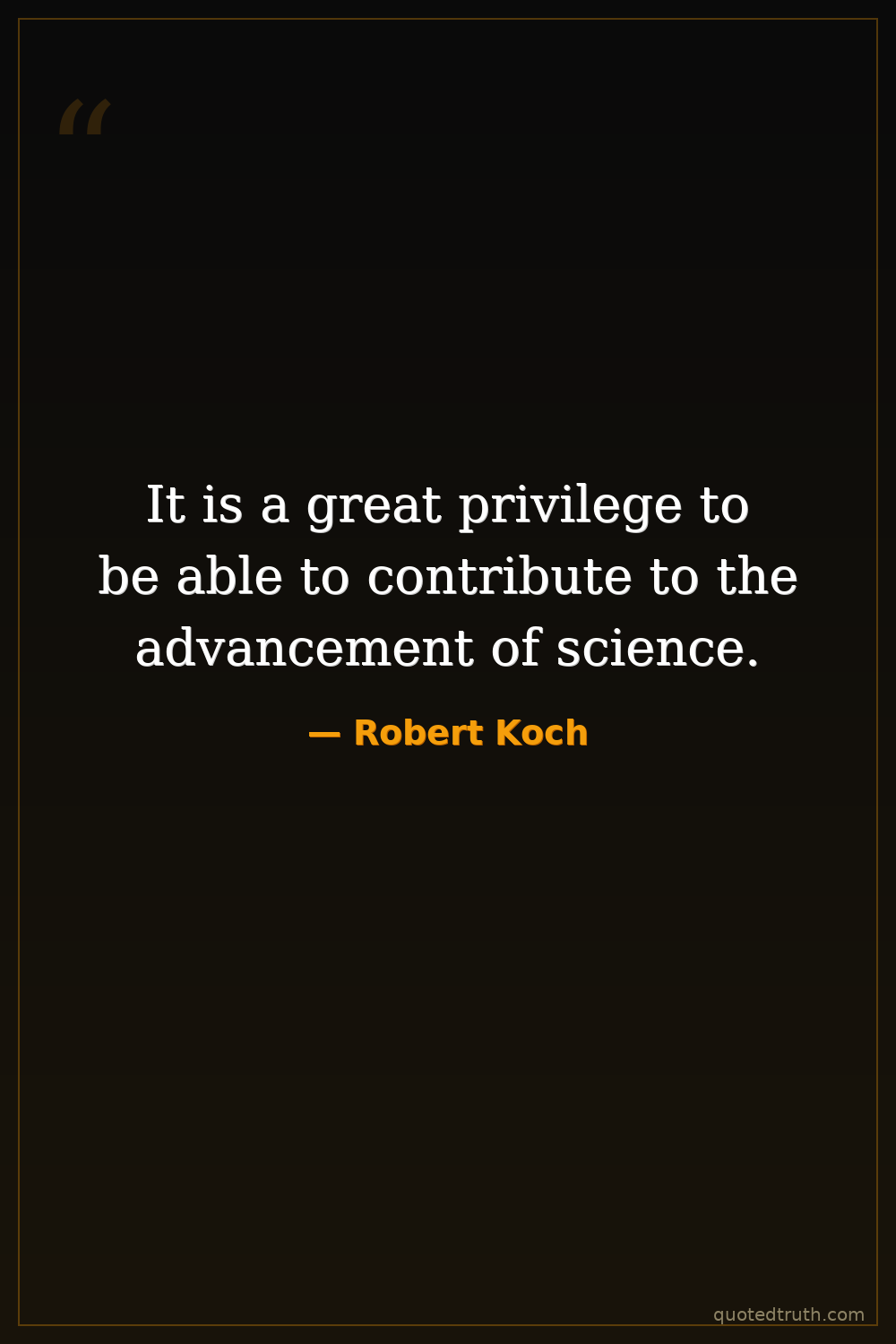
Robert Koch — "It is a great privilege to be able to contribute to the advancement of science."
It is a great privilege to be able to contribute to the advancement of science.
It is a great privilege to be able to contribute to the advancement of science.
Click any product to generate a realistic preview. Up to 3 at a time.
* Initial load can take up to 90 seconds — revising the preview in another color is nearly instant.
"I have always believed that careful observation is the key to scientific discovery."
"The prevention of disease is far more important than its cure."
"The isolation of disease-causing microorganisms is the first step towards controlling them."
"A doctor must be able to do two things: see microscopically and think logically."
"The fight against tuberculosis is not a question of science alone, but of social reform."
Found in 1 providers: grok
1 source checked
Scientific contribution is an honor, not an entitlement. Koch means that being positioned — through education, circumstance, and effort — to add something genuine to humanity's shared body of knowledge is rare and should be treated with reverence. Most people live and die without that opportunity. Those who have it owe the endeavor seriousness and gratitude rather than ego or expectation of reward.
Koch identified the tuberculosis bacterium in 1882, the cholera pathogen in 1883, and won the 1905 Nobel Prize — yet he began as a rural country doctor with self-built equipment. He understood that breakthroughs depend on access to tools, institutions, and time. Decades of unglamorous microscopy preceded recognition, giving his gratitude genuine weight: most researchers never crack a problem of that magnitude.
Koch worked during bacteriology's golden age (1870s–1900s), when germ theory was displacing miasma theory as medicine's foundation. Tuberculosis killed roughly one in seven Europeans. Pasteur's parallel work created fierce Franco-German scientific rivalry. Microscopy had just improved enough to visualize bacteria, yet no antibiotics existed — identifying a pathogen was itself the breakthrough. Public health infrastructure was embryonic, making each discovery carry enormous stakes for entire populations.
AI-generated insights based on extensive research and information for context. Factual errors? Email [email protected].
Your cart is empty