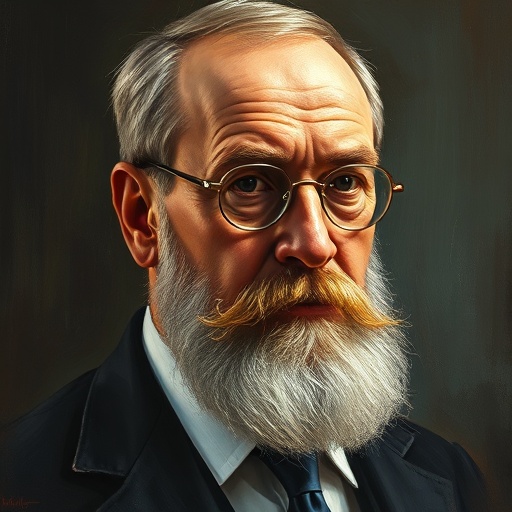
Robert Koch — "It is a great satisfaction to me to see that my work has been recognized and app…"
It is a great satisfaction to me to see that my work has been recognized and appreciated.
It is a great satisfaction to me to see that my work has been recognized and appreciated.
Click any product to generate a realistic preview. Up to 3 at a time.
* Initial load can take up to 90 seconds — revising the preview in another color is nearly instant.
"The public needs to be educated about the importance of preventing the spread of germs."
"The future of medicine lies in the prevention of disease, not in its cure."
"I have always been driven by a desire to understand the causes of disease."
"The search for remedies against infectious diseases requires tireless effort."
"The fight against disease is a never-ending battle, but we must never give up."
Found in 1 providers: grok
1 source checked
Work validated by peers carries deeper meaning than the work itself. The feeling described isn't pride or arrogance — it's relief and fulfillment that years of disciplined effort were not wasted. Recognition confirms that difficult, painstaking research has moved from one person's conviction into shared human knowledge. For anyone who has labored against doubt and indifference, having that work finally seen and respected is a profound, quietly earned reward.
Koch worked for years as an obscure rural German physician before his 1876 anthrax studies and 1882 identification of Mycobacterium tuberculosis transformed medicine. His rigorous laboratory methods faced skepticism from established figures including Rudolf Virchow. International recognition came slowly — honorary degrees, the 1905 Nobel Prize, global acclaim — making his satisfaction genuine rather than assumed. For Koch, recognition meant germ theory itself was vindicated, not merely one researcher's career.
The late 19th century was medicine's most contested intellectual battleground. Germ theory was overthrowing centuries of miasma-based disease explanation, and tuberculosis — 'the white plague' — killed roughly one in seven Europeans. Scientific institutions were formalizing through international congresses, peer-reviewed journals, and prizes like the Nobel, established 1901. Having work acknowledged in that environment meant a scientific paradigm had genuinely shifted, carrying consequences for millions of lives worldwide.
AI-generated insights based on extensive research and information for context. Factual errors? Email [email protected].
Your cart is empty