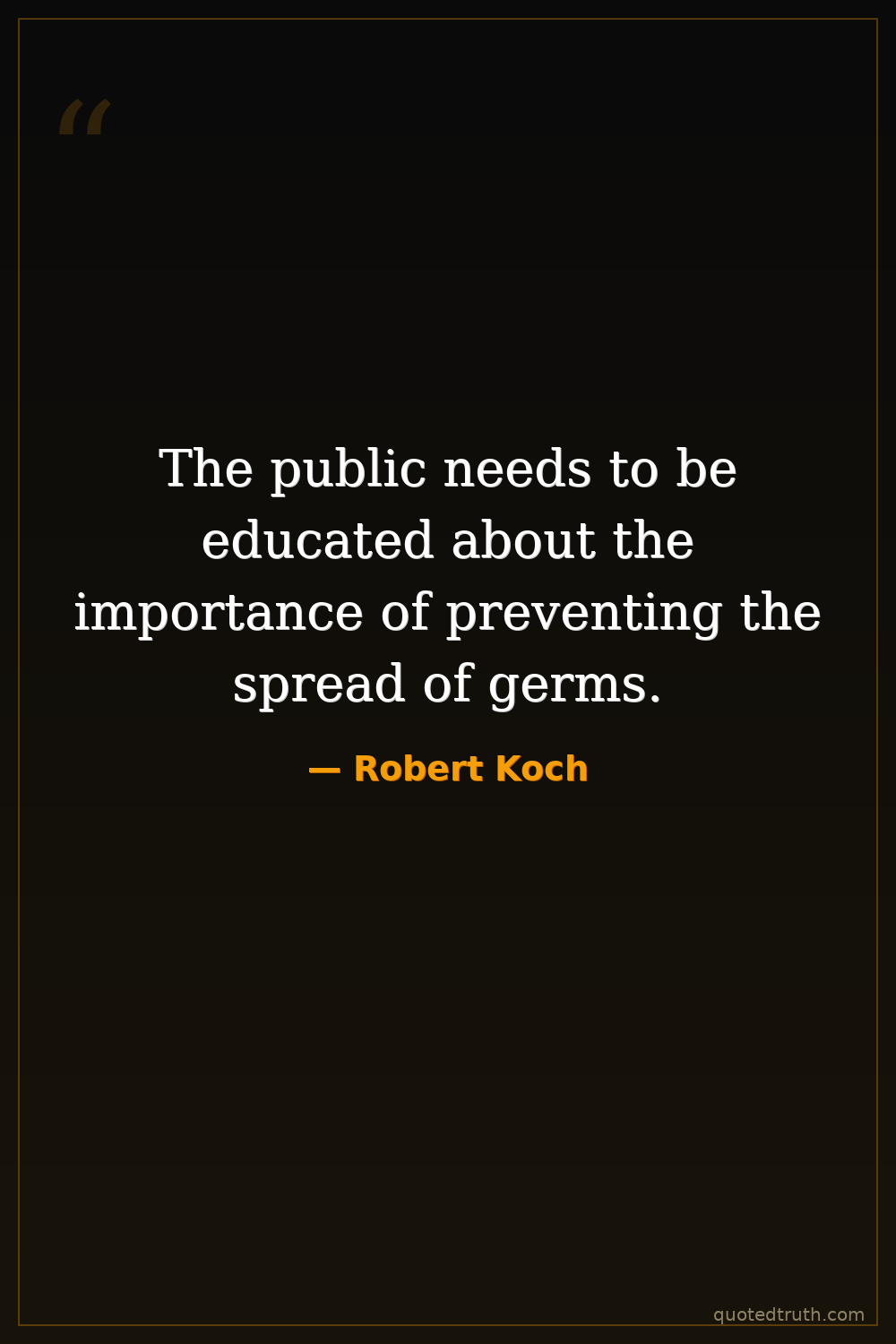
Robert Koch — "The public needs to be educated about the importance of preventing the spread of…"
The public needs to be educated about the importance of preventing the spread of germs.
The public needs to be educated about the importance of preventing the spread of germs.
Click any product to generate a realistic preview. Up to 3 at a time.
* Initial load can take up to 90 seconds — revising the preview in another color is nearly instant.
"The results of my investigations have been confirmed by many other workers."
"My work has shown that specific microorganisms cause specific diseases."
"The fight against disease requires international cooperation."
"The experimental method is the foundation of all scientific progress."
"The ultimate goal of all research must be the prevention of disease."
Found in 1 providers: grok
1 source checked
Ordinary people, not just doctors, must understand how infectious diseases travel from person to person—and what daily habits can stop that spread. Personal hygiene, avoiding contact with the sick, and clean water aren't mysterious medical concepts; they're practical tools everyone can use. When communities grasp how germs move, they make better collective decisions that protect public health far more effectively than any single physician treating patients one by one.
Koch spent his career proving that specific bacteria cause specific diseases—identifying the tuberculosis bacillus in 1882 and the cholera vibrio in 1883. But laboratory proof meant little without behavioral change. TB spread through coughing in crowded cities; cholera through contaminated water. Koch understood medicine alone couldn't stop epidemics—communities had to change habits. His public advocacy reflected a conviction that scientific discovery only mattered when ordinary people actually acted on it.
In the late 19th century, tuberculosis killed one in seven Europeans, and miasma theory—the idea that bad air caused illness—still competed with emerging germ theory. Rapid industrialization packed workers into unsanitary tenements where disease spread unchecked. Governments were just beginning to build public health infrastructure and sanitation reform movements were gaining traction. Educating citizens about germ transmission was genuinely radical—it shifted responsibility from fate or foul air to preventable human behavior.
AI-generated insights based on extensive research and information for context. Factual errors? Email [email protected].
Your cart is empty