What it means
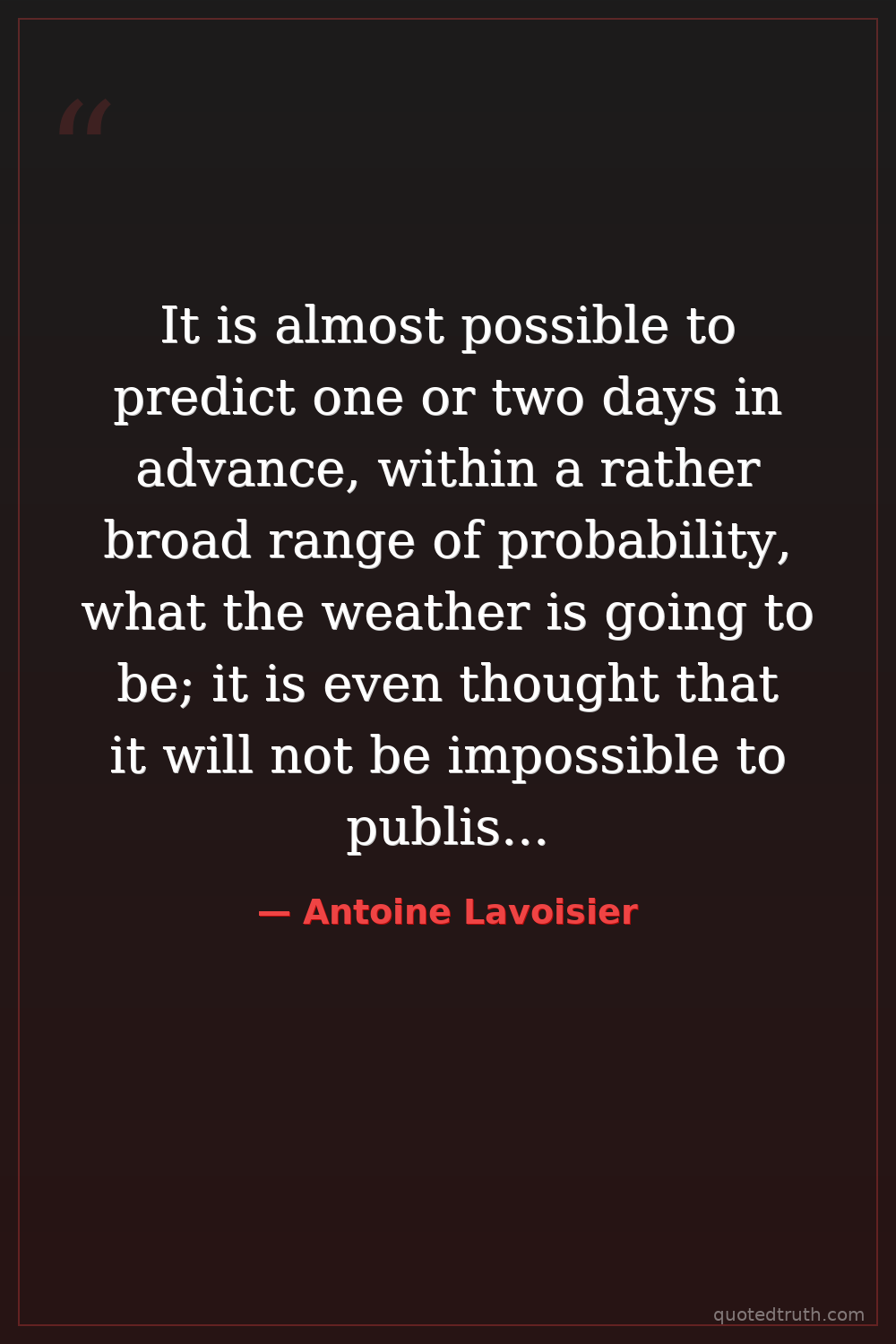
Lavoisier suggests that weather can be forecast a day or two ahead with reasonable accuracy, and he anticipates that regular daily weather predictions will eventually become practical. He frames this not as idle speculation but as a public service, arguing that routine forecasts would benefit everyday life, agriculture, commerce, and safety by helping people plan around atmospheric conditions.
Relevance to Antoine Lavoisier
Lavoisier was a systematic empiricist who transformed chemistry through careful measurement, quantitative experiments, and the law of conservation of mass. He kept meticulous barometric and meteorological records for years, treating weather as a measurable natural phenomenon rather than providence. This quote reflects his faith that rigorous observation could tame seemingly chaotic systems, and his characteristic drive to connect pure science with tangible public utility, a hallmark of his tax and agricultural reform work.
The era
In late eighteenth-century France, the Enlightenment pushed thinkers to replace superstition with measurement. Barometers, thermometers, and hygrometers were spreading, and learned societies coordinated observation networks across Europe. Yet no telegraph existed, so synoptic real-time forecasting was impossible. Lavoisier wrote as revolutionary upheaval loomed, during an age when rational science was believed capable of improving governance, agriculture, and public welfare, prefiguring the state meteorological services that would emerge only a century later.
AI-generated insights based on extensive research and information for context. Factual errors? Email [email protected].