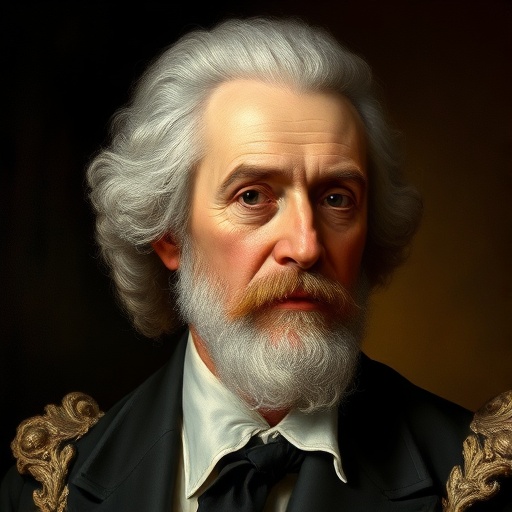
Antoine Lavoisier — "The greatest pleasure of the human mind is to discover the truth."
The greatest pleasure of the human mind is to discover the truth.
The greatest pleasure of the human mind is to discover the truth.
Click any product to generate a realistic preview. Up to 3 at a time.
* Initial load can take up to 90 seconds — revising the preview in another color is nearly instant.
"The greatest discoveries are not made by chance, but by observation and reflection."
"The true wealth of a nation is its knowledge and its industry."
"The art of concluding from experience and observation consists in evaluating probabilities, in estimating if they are high or numerous enough to constitute proof."
"The more I study, the more I am convinced of the existence of a superior intelligence."
"I have always regarded the study of nature as the most noble and elevated of pursuits."
Found in 1 providers: grok
1 source checked
The deepest satisfaction a person can experience comes not from wealth, status, or comfort, but from uncovering what is actually real and true. Understanding how the world works—stripping away assumption and error to reach demonstrable fact—provides a fulfillment that surpasses other human pursuits. Knowledge itself, arrived at through rigorous inquiry, is presented here as the highest reward available to the human mind.
Lavoisier dismantled centuries of phlogiston theory by designing meticulous experiments proving oxygen drives combustion. He named elements, established conservation of mass, and co-created chemical nomenclature still used today. His entire career was a relentless pursuit of empirical truth over inherited assumption, making this declaration autobiographical—he lived it, risking his reputation against entrenched scientific orthodoxy repeatedly.
The late 18th century Enlightenment placed reason and empirical investigation at civilization's center, directly challenging Church authority and aristocratic tradition. Scientific societies flourished across Europe. Lavoisier worked in Paris as the French Revolution approached, a moment when truth-seeking and rational governance were intertwined ideals—tragically, revolutionary politics ultimately sent him to the guillotine in 1794, silencing one of history's greatest truth-seekers.
AI-generated insights based on extensive research and information for context. Factual errors? Email [email protected].
Your cart is empty