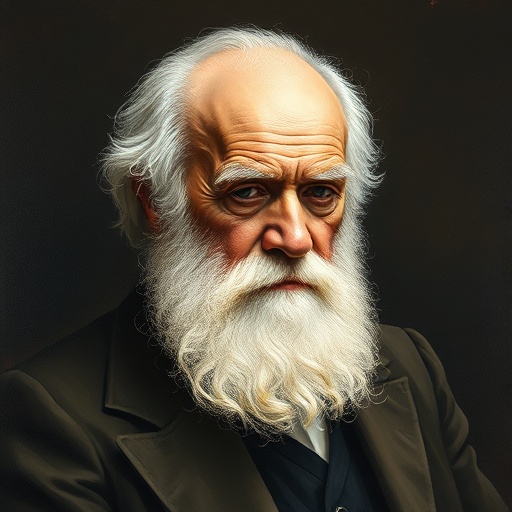
Charles Darwin — "It is always best to be a little under rather than over the mark."
It is always best to be a little under rather than over the mark.
It is always best to be a little under rather than over the mark.
Click any product to generate a realistic preview. Up to 3 at a time.
* Initial load can take up to 90 seconds — revising the preview in another color is nearly instant.
"I could show fight on natural selection having done and doing more for the progress of civilization than you seem inclined to admit."
"Blushing is the most peculiar and most human of all expressions."
"Looking to the world at no very distant date, what an endless number of the lower races will have been eliminated by the higher civilized races throughout the world."
"I hate a Barnacle as no man ever did before, not even a Sailor in a slow-sailing ship."
"Ignorance more frequently begets confidence than does knowledge."
British naturalist whose On the Origin of Species (1859) established evolution by natural selection — the unifying theory of modern biology. Closely associated with Thomas Henry Huxley (his 'bulldog' public defender) and Alfred Russel Wallace (independent co-discoverer of natural selection). For an intellectual contrast, see William Paley, Anglican theologian and Natural Theology author (1743-1805) — Origin of Species is structurally a 400-page reply to Paley — Darwin admired Paley's watchmaker-argument as an undergraduate at Cambridge and then spent 20 years building the empirical machinery to displace him. The cleanest 'design argument vs natural selection' founding rebuttal in science.
The standard scholarly entry points to Charles Darwin's work: Janet Browne (Harvard, history of science) — Charles Darwin: Voyaging (1995) and The Power of Place (2002); Adrian Desmond (UCL, biographer) — Darwin: The Life of a Tormented Evolutionist (1991, with James Moore). These are the works graduate seminars cite when teaching Charles Darwin.
Found in 1 providers: grok
1 source checked
Restraint and modesty lead to better outcomes than overconfidence or overreach. When setting expectations, making claims, or taking action, erring slightly short of the target is wiser than exceeding it. Overshooting risks error, embarrassment, or failure; undershooting preserves credibility and leaves room to correct course. This champions measured, conservative judgment over bold overstatement — a reminder that humility in estimation is a practical strength, not a weakness.
Darwin exemplified this principle by sitting on his theory of evolution for over 20 years before publishing On the Origin of Species in 1859. Aware that extraordinary claims demand extraordinary evidence, he painstakingly gathered data from global fieldwork, correspondence, and breeding experiments. Known for meticulous understatement, he preferred presenting evidence so thorough it could not be refuted rather than publishing prematurely. His cautious, methodical character made him one of science's most credible and enduring voices.
Victorian England in the mid-1800s was a battleground between scientific inquiry and religious orthodoxy. Darwin published during a period when the Church of England held enormous intellectual authority and evolution directly challenged Genesis. Overreach or premature claims could permanently destroy a naturalist's reputation before peers and public alike. The scientific establishment demanded rigorous, evidence-based restraint. In this charged environment, understating conclusions was both a strategic necessity and a mark of genuine intellectual credibility.
AI-generated insights based on extensive research and information for context. Factual errors? Email [email protected].
Your cart is empty