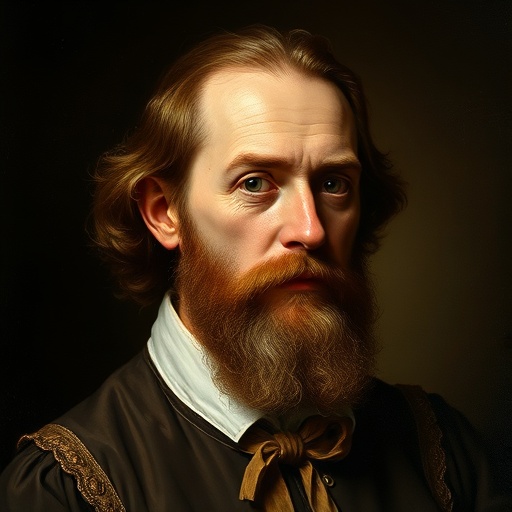
William Harvey — "It is better to know a little perfectly than to know much imperfectly."
It is better to know a little perfectly than to know much imperfectly.
It is better to know a little perfectly than to know much imperfectly.
Click any product to generate a realistic preview. Up to 3 at a time.
* Initial load can take up to 90 seconds — revising the preview in another color is nearly instant.
"The more accurately we observe, the more clearly we understand."
"The knowledge of man is the knowledge of God."
"I have not only affirmed, but also demonstrated, the circulation of the blood."
"Nature is nowhere accustomed to exhibit herself more openly than in her failures."
"The blood, therefore, moves in a circuit, and is impelled by the heart."
English physician whose On the Motion of the Heart and Blood in Animals (1628) demonstrated blood circulation, overturning 1,400 years of Galenic medicine. Closely associated with Francis Bacon (his contemporary in the new English empiricism). For an intellectual contrast, see Galenic medicine, the 2nd-century Greek medical tradition (humors, blood-as-consumed-fuel) — Harvey calculated that the heart pumps more blood per hour than the body could possibly produce as fuel — a single quantitative observation that demolished the entire Galenic-Aristotelian medical worldview. The cleanest example in medical history of arithmetic disproving 14 centuries of authority.
Found in 1 providers: grok
1 source checked
Depth of understanding outweighs breadth of information. Thoroughly mastering a narrow subject — verifying it through observation and evidence — is more valuable than accumulating broad but shallow knowledge. A small truth held with certainty is more useful than a large collection of half-understood ideas. It champions precision, rigor, and intellectual honesty over the appearance of being widely learned.
Harvey spent over a decade dissecting animals and cadavers before publishing his discovery of blood circulation in 1628. Rather than accepting Galen's 1,400-year-old theory as received wisdom, he tested one precise question obsessively until the evidence was undeniable. His career exemplifies the quote: he knew one physiological system with absolute certainty while contemporaries catalogued anatomy broadly but incorrectly. Perfection in a focused inquiry changed medicine forever.
The early modern Scientific Revolution was dismantling Scholastic tradition that prized encyclopedic knowledge drawn from ancient texts. Natural philosophers were drowning in imperfectly understood classical authority — Aristotle, Galen — repeated confidently but rarely tested. Harvey's era demanded a choice: breadth of inherited doctrine or depth of empirical proof. The printing press had flooded Europe with information, making the ability to know something precisely and verifiably more urgent than ever.
AI-generated insights based on extensive research and information for context. Factual errors? Email [email protected].
Your cart is empty