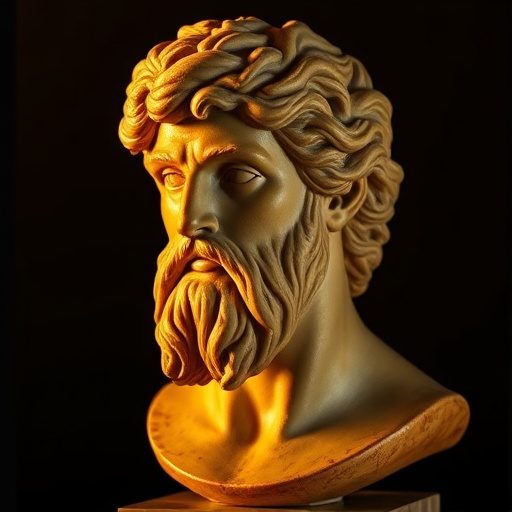
Pythagoras — "It is difficult to walk at one and the same time many paths of life."
It is difficult to walk at one and the same time many paths of life.
It is difficult to walk at one and the same time many paths of life.
Click any product to generate a realistic preview. Up to 3 at a time.
* Initial load can take up to 90 seconds — revising the preview in another color is nearly instant.
"The universe is a living creature, endowed with soul and reason."
"Abstain from animals."
"The number seven held a sacred meaning since it correlated with the number of classical planets... as well as the number of strings on a lyre."
"The oldest and shortest words, 'yes' and 'no,' are those which require the most thought."
"The highest goal of music is to connect one's soul to their Divine Nature, not entertainment."
Greek philosopher and mathematician whose school in Croton combined geometry (the Pythagorean theorem), number-mysticism, and a religious-vegetarian way of life. Closely associated with Thales of Miletus (earlier pre-Socratic and the first philosopher). For an intellectual contrast, see Heraclitus, pre-Socratic Greek philosopher of flux — Heraclitus called Pythagoras 'the chief of swindlers' — among the founding insults of the philosophical-rivalry tradition. Their 'all is flux' vs 'all is number' poles still organize the philosophy of mathematics today (Platonist vs anti-realist).
A philosophical observation on focus and commitment.
Date: c. 570-495 BCE (attributed later)
WisdomFound in 2 providers: gemini,deepseek
2 sources checked
Trying to pursue multiple directions in life at once dilutes your effectiveness in each. You cannot split your focus, energy, and commitment across several different callings or ways of living without paying a cost in all of them. The quote argues for singular dedication — choosing one path and walking it fully — rather than spreading yourself across competing goals, roles, or philosophies that pull you in different directions simultaneously.
Pythagoras founded the Pythagorean Brotherhood, a religious-philosophical community demanding total commitment from its members — strict dietary rules, communal living, years of silent study, and complete devotion to mathematics and mysticism. He saw these as one unified path, not many. Accepting disciples required them to abandon other pursuits entirely. His own life unified mathematics, philosophy, and spirituality into a single disciplined calling, embodying the singular focus this quote demands.
Pythagoras lived in sixth-century BCE Greece, a world where educated men faced competing demands as warriors, merchants, civic leaders, and emerging philosophers. Greek city-states expected citizens to participate in multiple spheres simultaneously. As pre-Socratic thinkers began separating philosophy from religion, many tried combining several disciplines at once. Pythagoras deliberately rejected this fragmentation, establishing his school at Croton as an institution requiring full renunciation of competing pursuits — radical in a culture of generalist civic participation.
AI-generated insights based on extensive research and information for context. Factual errors? Email [email protected].
Your cart is empty