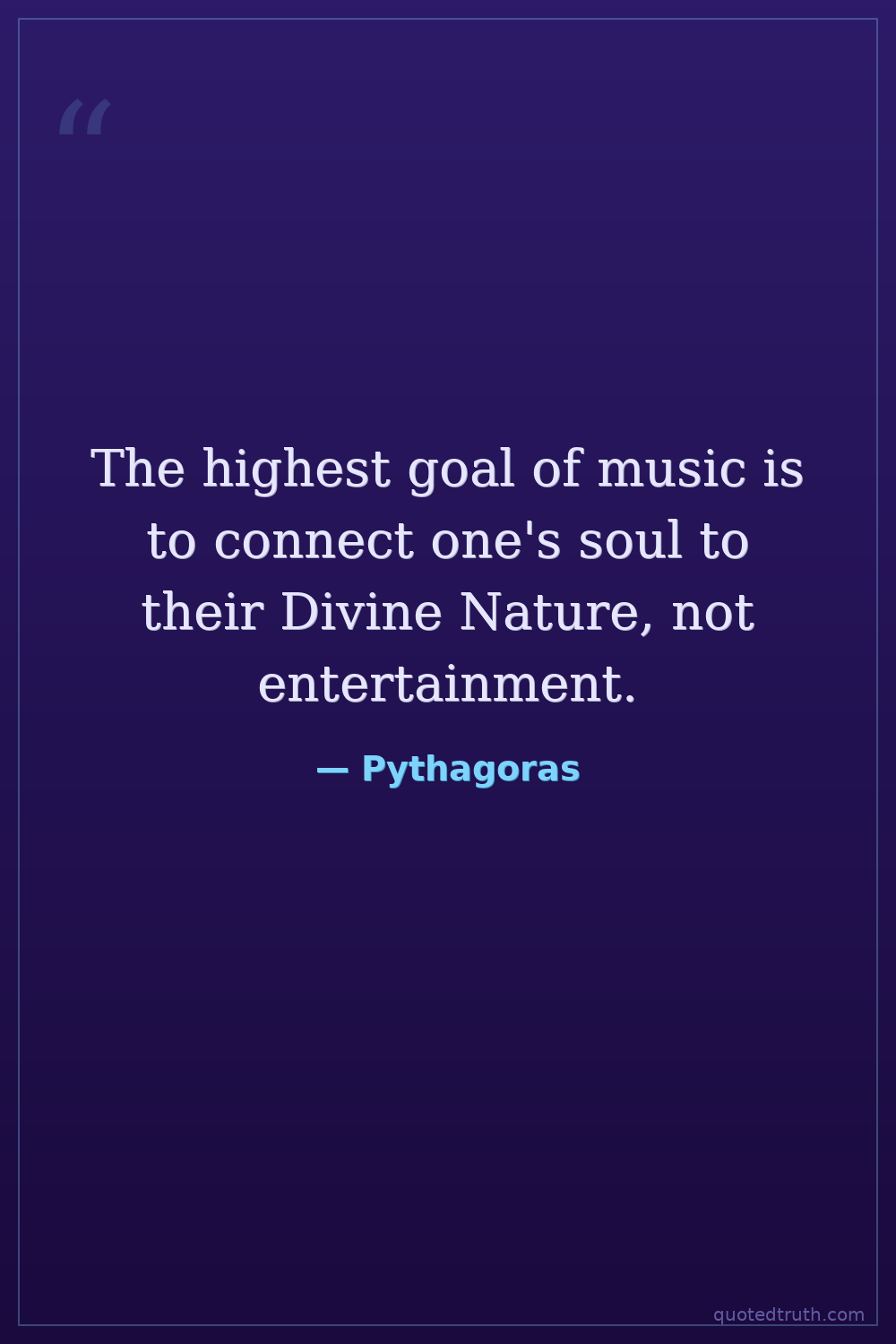
Pythagoras — "The highest goal of music is to connect one's soul to their Divine Nature, not e…"
The highest goal of music is to connect one's soul to their Divine Nature, not entertainment.
The highest goal of music is to connect one's soul to their Divine Nature, not entertainment.
Click any product to generate a realistic preview. Up to 3 at a time.
* Initial load can take up to 90 seconds — revising the preview in another color is nearly instant.
"Reason is immortal, all else mortal."
"We come from God, and we return to God."
"As long as Man continues to be the ruthless destroyer of lower living beings, he will never know health or peace. For as long as men massacre animals, they will kill each other. Indeed, he who sows th…"
"It is difficult to walk at one and the same time many paths of life."
"If you're asked: What is the silence? Respond: It is the first stone of the Wisdom's temple."
Greek philosopher and mathematician whose school in Croton combined geometry (the Pythagorean theorem), number-mysticism, and a religious-vegetarian way of life. Closely associated with Thales of Miletus (earlier pre-Socratic and the first philosopher). For an intellectual contrast, see Heraclitus, pre-Socratic Greek philosopher of flux — Heraclitus called Pythagoras 'the chief of swindlers' — among the founding insults of the philosophical-rivalry tradition. Their 'all is flux' vs 'all is number' poles still organize the philosophy of mathematics today (Platonist vs anti-realist).
A philosophical statement on the purpose of music, reflecting Pythagorean mysticism.
Date: c. 570-495 BCE (attributed later)
BiblicalFound in 2 providers: gemini,deepseek
2 sources checked
Music at its peak serves a spiritual function — it stirs something deep in the listener that points toward the divine or transcendent self. This isn't about enjoyment, pleasure, or spectacle. True music creates inner resonance that lifts consciousness beyond the mundane. The difference between entertainment and sacred purpose is intention and effect: one distracts, the other transforms.
Pythagoras discovered that musical harmony follows precise mathematical ratios — octaves, fifths, fourths — revealing that music and math share a hidden order. He founded a mystical community in Croton where music was used as spiritual discipline, not recreation. He taught the cosmos itself vibrates in mathematical harmony (musica universalis). For Pythagoras, music was proof that the universe operates on divine mathematical principles the soul could directly access.
In 6th-century BCE Greece, music (mousikē) was inseparable from religious ritual, poetry, and civic life — far from mere entertainment. Mystery cults like the Orphic tradition used chant and rhythm to induce spiritual states. Philosophy was emerging as distinct from theology, and thinkers like Pythagoras mapped connections between cosmos, number, and soul. Music wasn't art for art's sake; it was considered capable of purifying the psyche and aligning it with cosmic order.
AI-generated insights based on extensive research and information for context. Factual errors? Email [email protected].
Your cart is empty