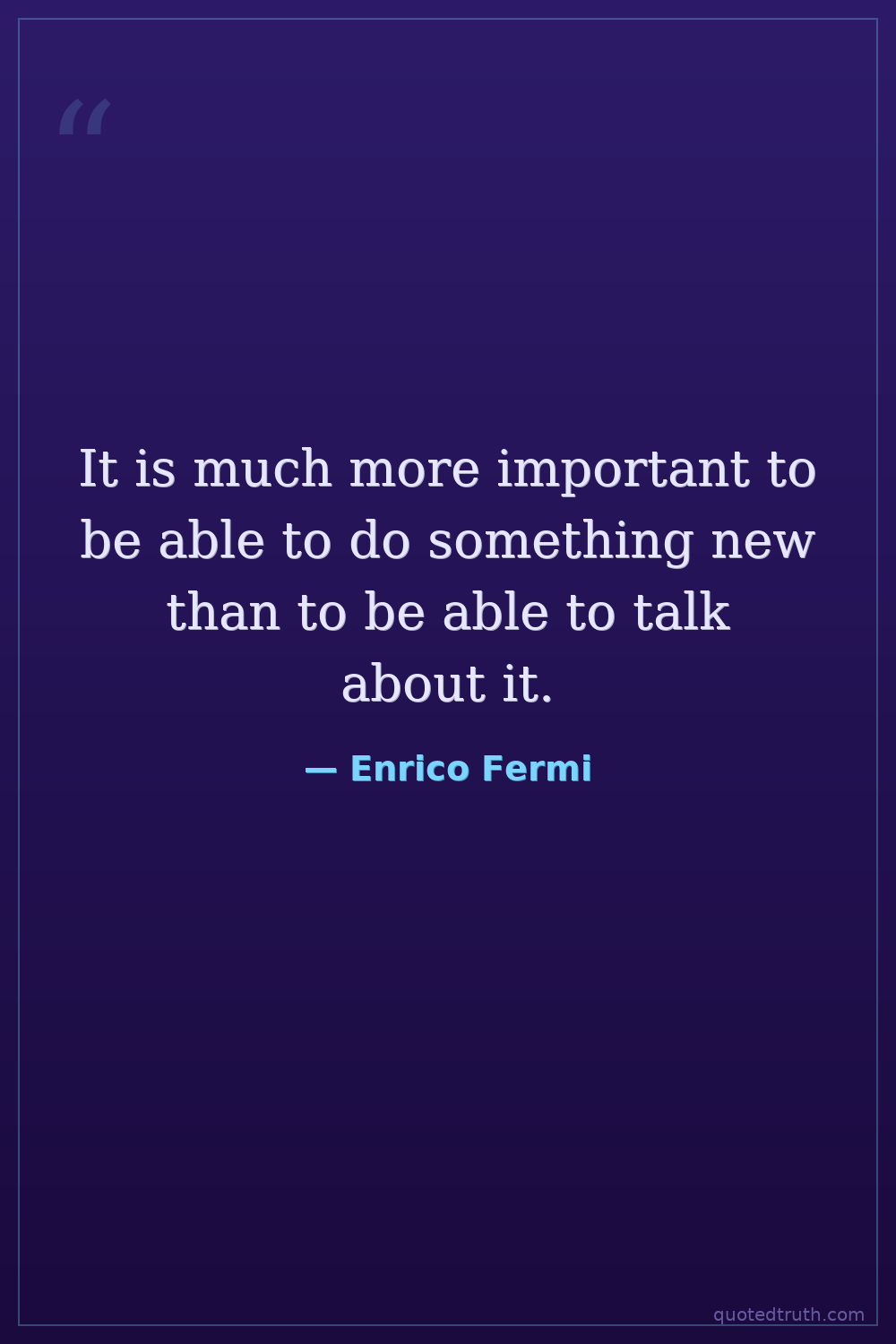
Enrico Fermi — "It is much more important to be able to do something new than to be able to talk…"
It is much more important to be able to do something new than to be able to talk about it.
It is much more important to be able to do something new than to be able to talk about it.
Click any product to generate a realistic preview. Up to 3 at a time.
* Initial load can take up to 90 seconds — revising the preview in another color is nearly instant.
"It is not good to be the only intelligent man in the world."
"The atomic age will either usher in a new era of prosperity, or it will be the end of civilization."
"The purpose of science is to make sense of the world, not to explain it away."
"The most exciting phrase to hear in science, the one that heralds new discoveries, is not 'Eureka!' but 'That's funny...'"
"We may be living in a world where the future is already written, but we still have the power to change it."
Found in 1 providers: grok
1 source checked
The quote champions practical capability over verbal theorizing. True progress requires building, experimenting, and demonstrating results — not merely describing possibilities. Talk is cheap; genuine innovation demands hands-on mastery and the ability to make something work that didn't exist before. The person who can actually create something new drives civilization forward, while those who only discuss possibilities contribute little without the skill and will to execute.
Fermi was the rare physicist who excelled at both theory and experiment. He built Chicago Pile-1, the world's first nuclear reactor, in 1942 beneath a University of Chicago squash court. Famous for rapid practical estimation known as Fermi problems, he prized doing over deliberating. His Nobel Prize in 1938 rewarded direct experimental discoveries. Throughout his career, Fermi consistently transformed abstract physics into working reality, embodying this maxim completely.
Fermi's career spanned the 1930s through 1950s, when physics leapt from blackboard abstraction to civilization-reshaping technology. The Manhattan Project demanded scientists who delivered results under wartime urgency — designing reactors, calculating critical masses, engineering systems at Los Alamos. The atomic age elevated builders over pure theorists. Cold War arms competition and peacetime nuclear energy programs continued rewarding those who could actually create new capabilities, not merely theorize about them.
AI-generated insights based on extensive research and information for context. Factual errors? Email [email protected].
Your cart is empty