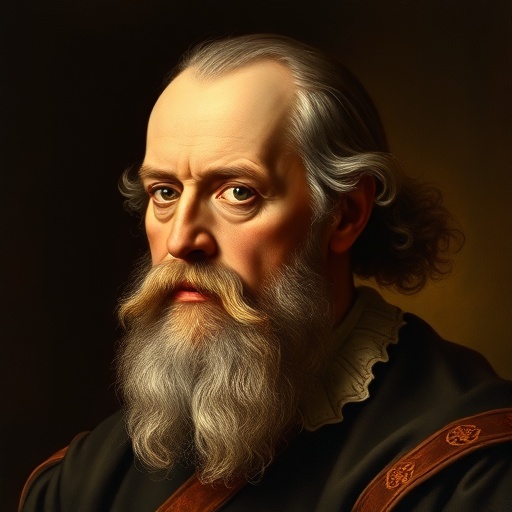
Galileo Galilei — "It is necessary to examine the actual structure of the universe, and not to clin…"
It is necessary to examine the actual structure of the universe, and not to cling to old ideas.
It is necessary to examine the actual structure of the universe, and not to cling to old ideas.
Click any product to generate a realistic preview. Up to 3 at a time.
* Initial load can take up to 90 seconds — revising the preview in another color is nearly instant.
"That man will be very fortunate who, led by some unusual inner light, shall be able to turn from the dark and confused labyrinths within which he might have gone forever wandering with the crowd and b…"
"The universe is a grand book which cannot be understood unless one first learns to comprehend the language and interpret the characters in which it is written."
"The greatest wisdom consists in knowing what is truly useful."
"I give infinite thanks to God, who has been pleased to make me the first observer of admirable things unrevealed to bygone ages."
"I wish to persuade the wise and not to compel them."
General sentiment from his scientific work, not a single exact quote.
Date: 1610-1632
WisdomFound in 1 providers: grok
1 source checked
Stop assuming inherited beliefs are correct just because they're familiar. Look at how things actually work through direct observation and evidence. Truth comes from examining reality itself, not from deferring to tradition or authority. When evidence contradicts what you were taught, follow the evidence. Intellectual honesty demands updating your understanding based on what you can actually observe and verify.
Galileo spent his career dismantling Aristotelian physics and Ptolemaic astronomy through telescopic observation and mathematical proof. He didn't theorize from an armchair—he pointed a telescope at Jupiter and found moons orbiting it, directly contradicting Earth-centered cosmology. His trial by the Inquisition shows exactly what clinging to old ideas looked like institutionally, and what resisting that cost personally.
The early modern period saw Catholic Church doctrine fused with Aristotelian science as unchallengeable truth. The Inquisition actively prosecuted heresy, and Copernicus's heliocentric model was banned. Galileo published during the Scientific Revolution's most dangerous years—when challenging ancient cosmology wasn't academic disagreement but potential imprisonment. His statement was a direct challenge to scholastic authority that controlled European intellectual life for centuries.
AI-generated insights based on extensive research and information for context. Factual errors? Email [email protected].
Your cart is empty