What it means
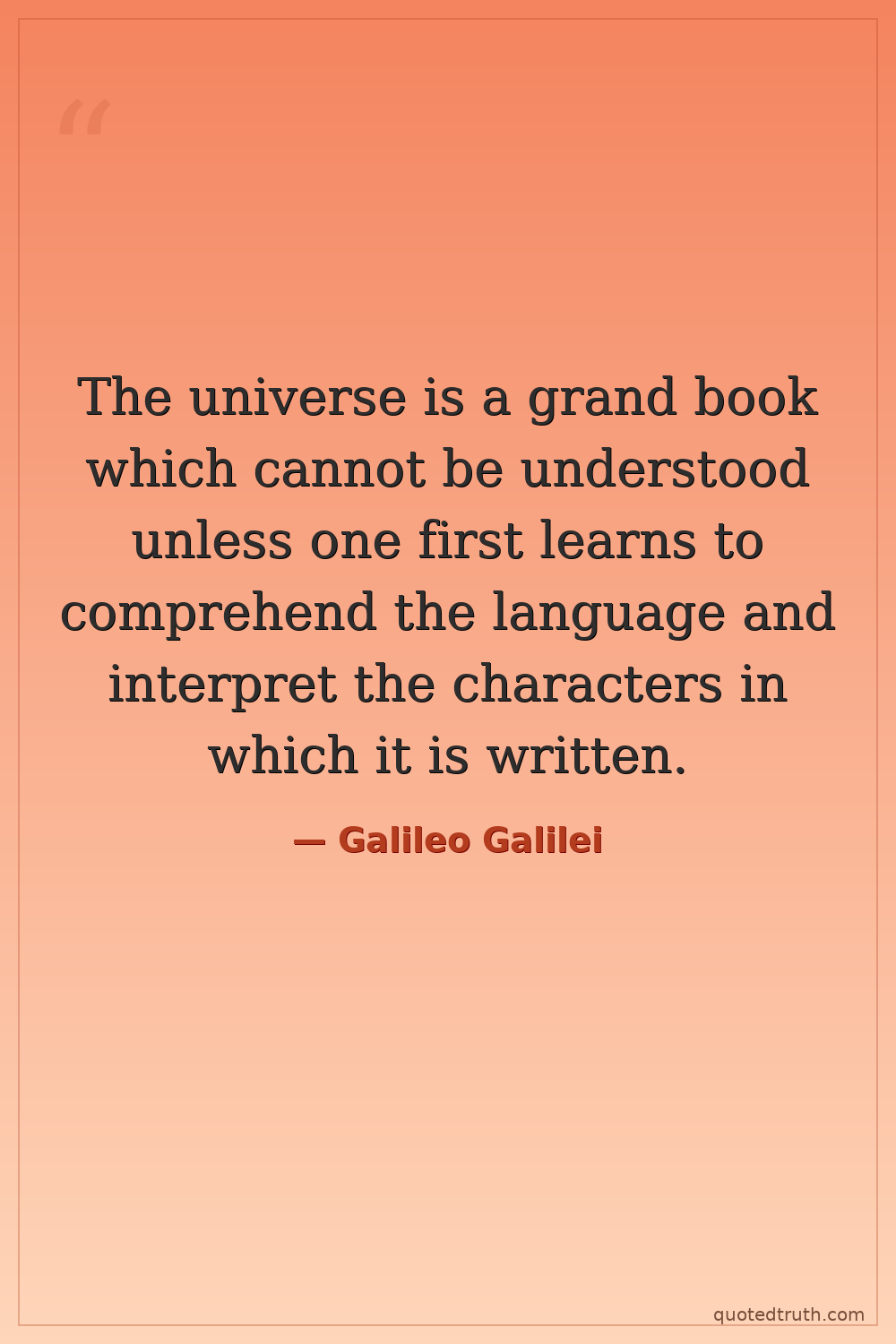
The universe operates by discoverable rules, but grasping them requires learning its native language—mathematics. Just as a book is meaningless to someone who cannot read, nature reveals nothing to those unable to interpret its patterns. Observation alone is insufficient; raw experience must be translated into precise quantitative relationships. True understanding is not intuitive—it demands rigorous, systematic effort to decode a structure that exists independently of human opinion or inherited tradition.
Relevance to Galileo Galilei
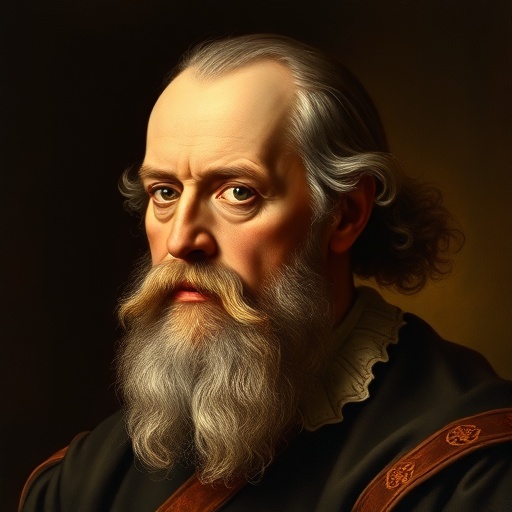
Galileo spent his life proving this conviction through action: he described falling objects with equations, mapped Jupiter's moons mathematically, and demonstrated that Venus's phases confirmed the Copernican model. The Inquisition tried him in 1633 for defending heliocentrism, yet he never abandoned the belief that empirical observation plus mathematics—not Church authority—revealed truth. His mathematical treatment of motion in Discorsi directly embodied this quote, treating physics as a language to decode rather than a doctrine to accept.
The era
In early modern Europe, the Catholic Church held supreme intellectual authority, treating Scripture as the definitive explanation of creation. Aristotelian natural philosophy—learned through texts, not experiments—dominated universities. Galileo's era saw the printing press democratize literacy, making the book metaphor culturally resonant. By declaring nature its own book requiring mathematical literacy, he implicitly dethroned Scripture as nature's sole interpreter. His 1633 trial crystallized the conflict: who had authority to read the universe's language—theologians or mathematicians?
AI-generated insights based on extensive research and information for context. Factual errors? Email [email protected].