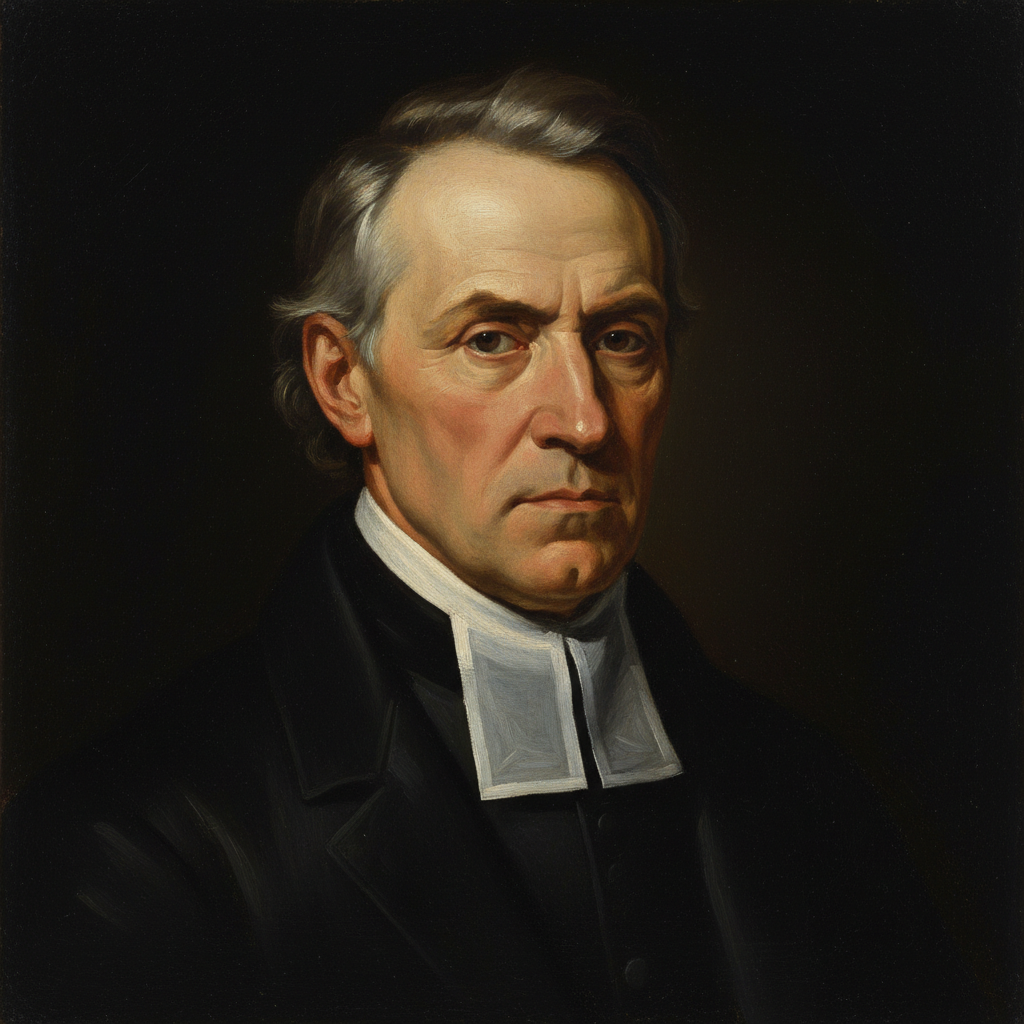
John Wesley — "It is no proof of a man's understanding that he can find fault."
It is no proof of a man's understanding that he can find fault.
It is no proof of a man's understanding that he can find fault.
Click any product to generate a realistic preview. Up to 3 at a time.
* Initial load can take up to 90 seconds — revising the preview in another color is nearly instant.
"I desire to have but one thing in view, to please God."
"My hair is much whiter than it was a year ago; but my eyes are not much dimmer, nor my natural strength much abated."
"I cannot but observe, that the Methodists are not a people who are fond of novelties."
"I have often thought, that if I were to choose a text to preach from, it should be 'God is love.'"
"I am never solitary, for I am never alone."
English Anglican cleric and founder of Methodism, whose open-air preaching and class-meeting structure created the largest 18th-century evangelical revival. Closely associated with Charles Wesley (his hymn-writing brother) and George Whitefield (early co-revivalist, later doctrinal opponent). For an intellectual contrast, see George Whitefield, Calvinist evangelical revivalist — Whitefield's predestinarian Calvinism vs Wesley's free-grace Arminian theology split the early Methodist movement permanently in the 1739-41 break. The founding evangelical Calvinist-Arminian schism — the two parallel evangelical traditions American Christianity descends from.
Found in 1 providers: grok
1 source checked
Being able to criticize something doesn't demonstrate intelligence or wisdom. Anyone can point out flaws, defects, or failures in others' work or ideas. True understanding requires constructive engagement — grasping why something exists, what it attempts, and how it might be improved. Mere fault-finding is intellectually cheap; it requires no depth, no synthesis, and no responsibility for solutions.
Wesley spent decades building Methodism against fierce criticism from Anglican clergy and mobs who attacked his open-air preaching. He responded not by complaining but by organizing societies, publishing sermons, and training lay preachers. His entire ministry was constructive rather than destructive — he identified spiritual poverty in England and built institutions to address it rather than simply condemning the Church of England's failures.
Eighteenth-century Britain was rife with religious controversy, political pamphlet warfare, and coffeehouse debate culture where critics gained social standing through wit and attack. The Enlightenment elevated reason, but often as a weapon of skepticism rather than construction. Wesley wrote amid deist critiques of Christianity and sectarian infighting, where fault-finding was fashionable currency but genuine reform — social, spiritual, institutional — was rare and costly.
AI-generated insights based on extensive research and information for context. Factual errors? Email [email protected].
Your cart is empty