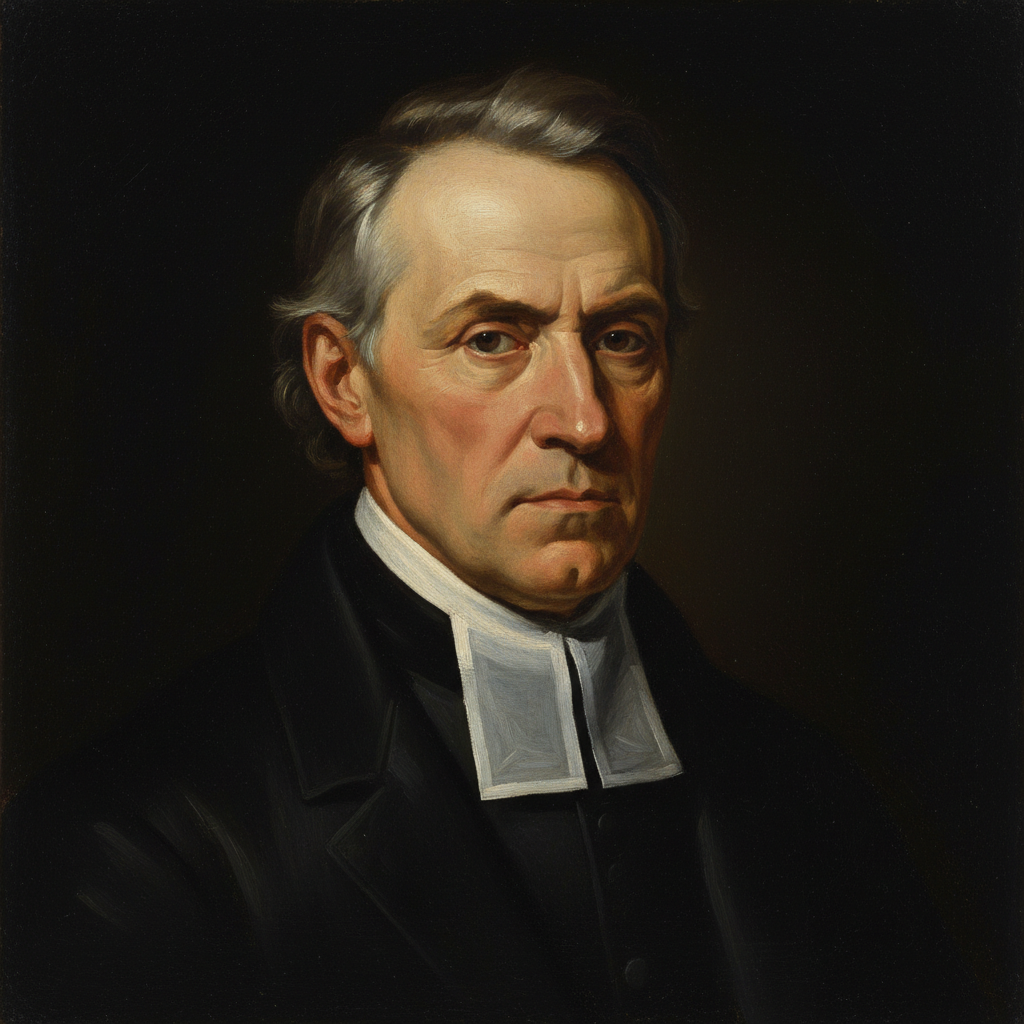
John Wesley — "My hair is much whiter than it was a year ago; but my eyes are not much dimmer, …"
My hair is much whiter than it was a year ago; but my eyes are not much dimmer, nor my natural strength much abated.
My hair is much whiter than it was a year ago; but my eyes are not much dimmer, nor my natural strength much abated.
Click any product to generate a realistic preview. Up to 3 at a time.
* Initial load can take up to 90 seconds — revising the preview in another color is nearly instant.
"I desire no other epitaph, than 'Here lies the friend of all, and the enemy of none.'"
"Preach not doctrines, but Christ."
"I set myself on fire, and people come to watch me burn."
"The Bible knows nothing of solitary religion."
"Diseases are the instruments of God to punish men for their sins."
English Anglican cleric and founder of Methodism, whose open-air preaching and class-meeting structure created the largest 18th-century evangelical revival. Closely associated with Charles Wesley (his hymn-writing brother) and George Whitefield (early co-revivalist, later doctrinal opponent). For an intellectual contrast, see George Whitefield, Calvinist evangelical revivalist — Whitefield's predestinarian Calvinism vs Wesley's free-grace Arminian theology split the early Methodist movement permanently in the 1739-41 break. The founding evangelical Calvinist-Arminian schism — the two parallel evangelical traditions American Christianity descends from.
Found in 1 providers: grok
1 source checked
The speaker acknowledges one visible sign of aging—whitened hair—while noting that eyesight and physical strength have not significantly declined. It is a personal accounting of the body's condition, expressing quiet gratitude that capability has outlasted appearance. The distinction matters: looking older is accepted, but losing the ability to work and serve is what would truly signal decline. It is resilience noted without boasting.
Wesley kept meticulous journals for over fifty years, regularly recording his physical condition alongside his ministry work. He rode more than 250,000 miles on horseback and delivered over 40,000 sermons, continuing well into his eighties. This observation reflects his lifelong habit of self-monitoring and his conviction that God preserved his body for Methodist work. For Wesley, sustained physical strength was not personal pride—it was the engine of his evangelical mission.
Eighteenth-century England saw average life expectancy at birth around 35 to 40 years, making vigorous old age genuinely rare. Wesley lived through the Evangelical Revival, a mass religious awakening amid early industrialization and social upheaval. Medical understanding of aging was primitive, and physical endurance in old age was commonly interpreted as divine favor. For someone who had endured decades of outdoor travel, hostile mobs, and relentless preaching schedules, retaining sharp faculties past eighty was considered extraordinary.
AI-generated insights based on extensive research and information for context. Factual errors? Email [email protected].
Your cart is empty