What it means
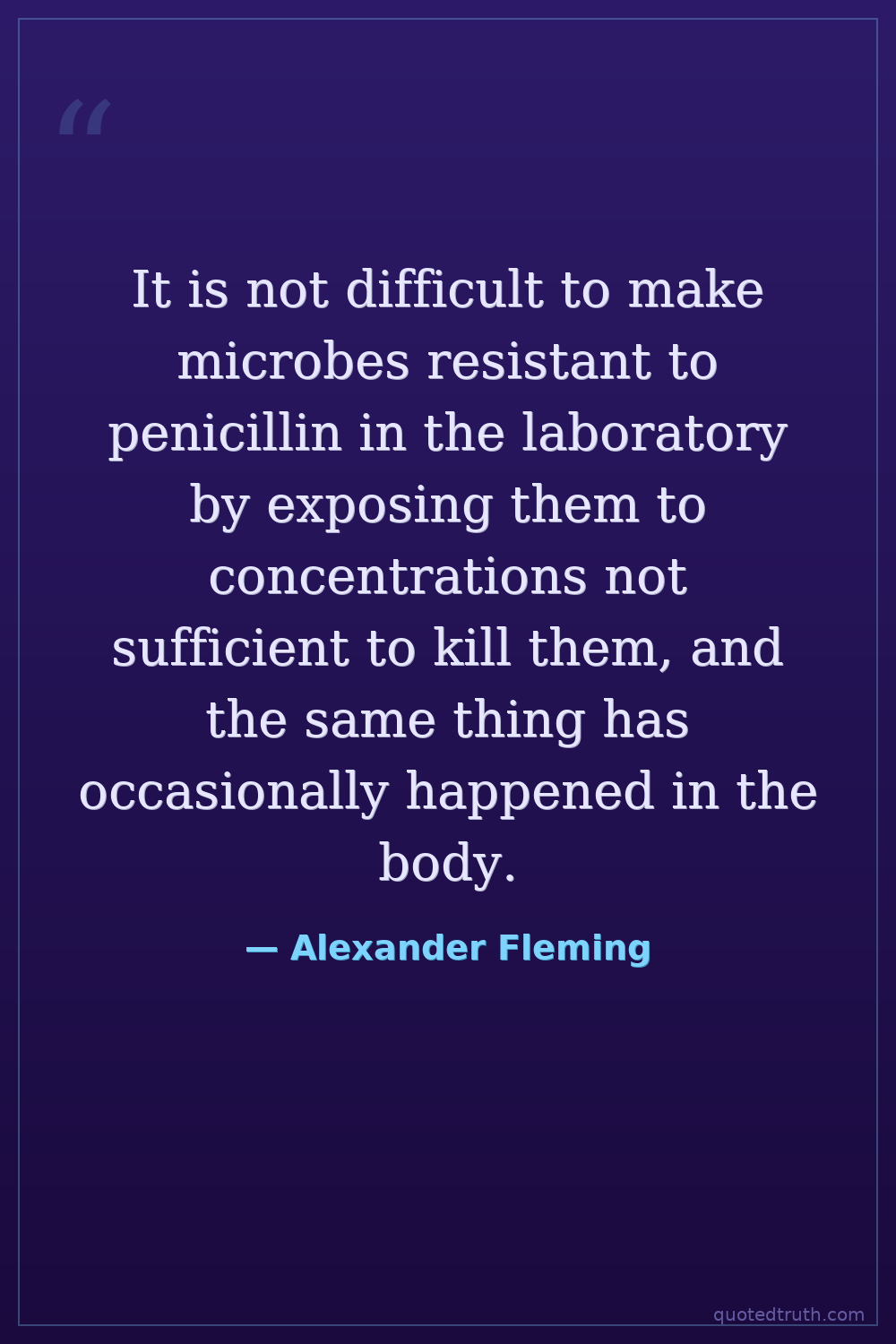
Bacteria exposed to penicillin doses too weak to kill them can survive, adapt, and become resistant — in a lab or inside a patient's body. Partial treatment doesn't just fail; it actively breeds stronger bacteria. The danger isn't only using too little medicine — it's that using too little can render the medicine permanently less effective for everyone. Fleming is warning that misuse of a cure can destroy the cure itself.
Relevance to Alexander Fleming
Fleming discovered penicillin in 1928 when mold accidentally contaminated a petri dish and killed surrounding bacteria. He spent years studying microbial behavior firsthand and understood how adaptable bacteria truly are. He delivered this warning in his 1945 Nobel Prize lecture — at penicillin's moment of greatest triumph. As the man who gave the world its first antibiotic, he alone grasped how fragile that power was. His caution came directly from the lab bench, not theory.
The era
In 1945, penicillin was a genuine miracle — mass-produced during WWII, it slashed battlefield infection deaths and was becoming freely available to civilians. Doctors prescribed it widely and the public treated it as infallible. Fleming's warning arrived at this exact peak of confidence, when resistance was not yet a recognized concept in medicine or public health. His Nobel lecture essentially invented the concern — decades before drug-resistant superbugs became a recognized global crisis.
AI-generated insights based on extensive research and information for context. Factual errors? Email [email protected].