Alan Turing — "It is not easy to devise a game which is fair in this respect between the machin…"
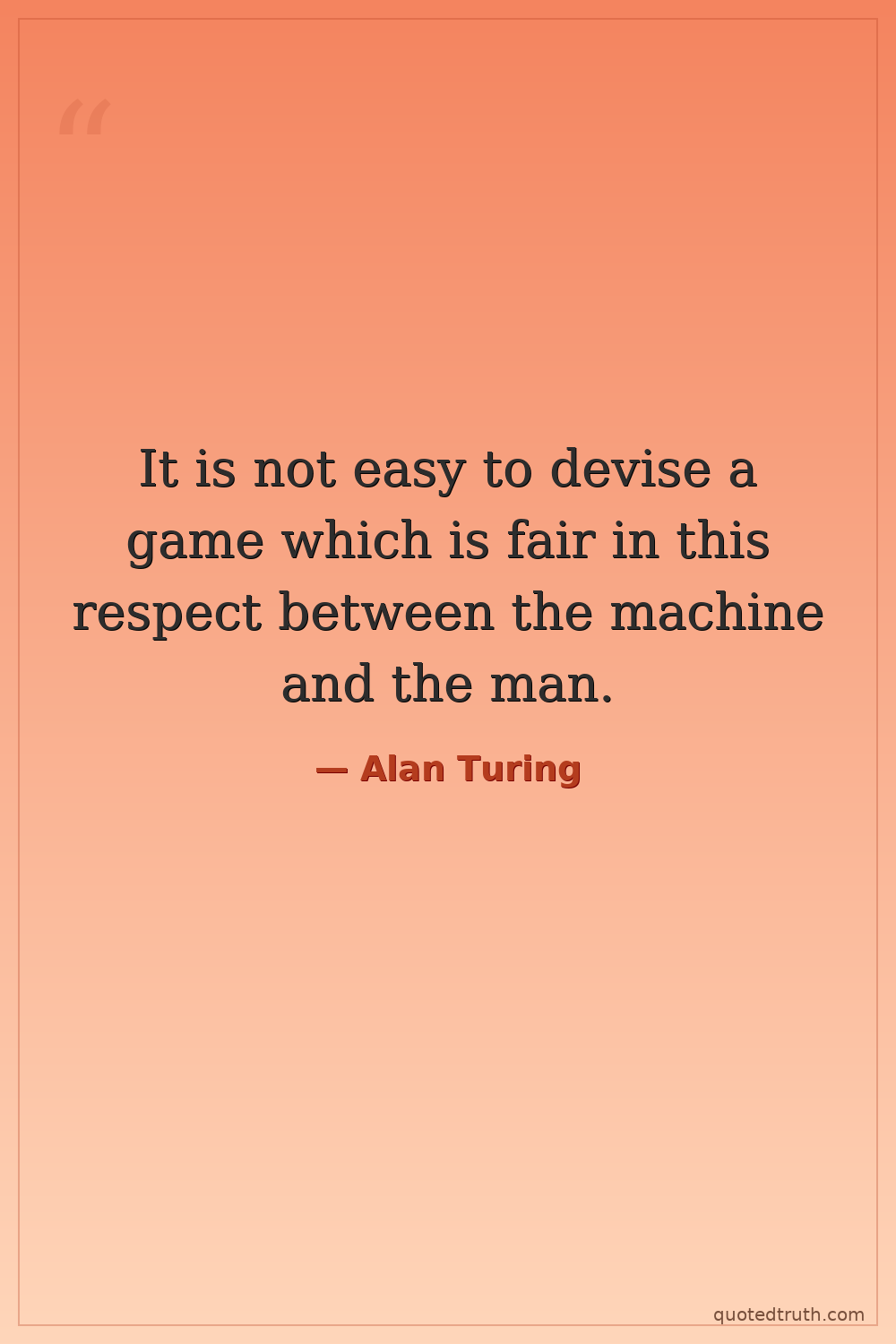
It is not easy to devise a game which is fair in this respect between the machine and the man.
It is not easy to devise a game which is fair in this respect between the machine and the man.
Click any product to generate a realistic preview. Up to 3 at a time.
* Initial load can take up to 90 seconds — revising the preview in another color is nearly instant.
"I believe that in about fifty years' time it will be possible to programme computers, with a storage capacity of about 10^9, to make them play the imitation game so well that an average interrogator w…"
"The machine should be able to understand what it is doing."
"If the man were to try and pretend to be the machine he would clearly make a very poor showing. He would be given away at once by slowness and inaccuracy in arithmetic."
"The human mind is a parallel processor."
"A human being is a machine for converting food into thoughts."
Found in 1 providers: grok
1 source checked
Creating a truly fair test between human and machine intelligence is harder than it seems. Any benchmark risks favoring human strengths or machine advantages. The rules of any game embed hidden assumptions about what thinking actually means. Designing neutral ground forces you to confront deep questions about what minds do — and whether human and machine cognition can even be compared on genuinely shared terms without loading the outcome in advance.
This line comes from Turing's 1950 paper proposing the Imitation Game, his landmark framework for machine intelligence. He spent WWII building Bombe machines to crack Enigma — living daily inside the tension between mechanical logic and human ingenuity. His intellectual honesty here is characteristic: rather than overselling his own test, he admitted its difficulty. He understood that fair criteria for intelligence required solving philosophy, not just engineering, a humility rare in foundational thinkers.
In 1950, the first stored-program computers had just been built — Manchester's Mark 1 ran in 1948. Artificial intelligence wasn't yet a named field (McCarthy coined the term in 1956). Post-WWII computing was shifting from military codebreaking toward broader civilian possibility. Society had no framework for evaluating machine cognition because nothing like it had existed before. Turing's paper landed at the exact moment humanity first had to seriously ask whether machines could think — and how we'd ever know.
AI-generated insights based on extensive research and information for context. Factual errors? Email [email protected].
Your cart is empty