What it means
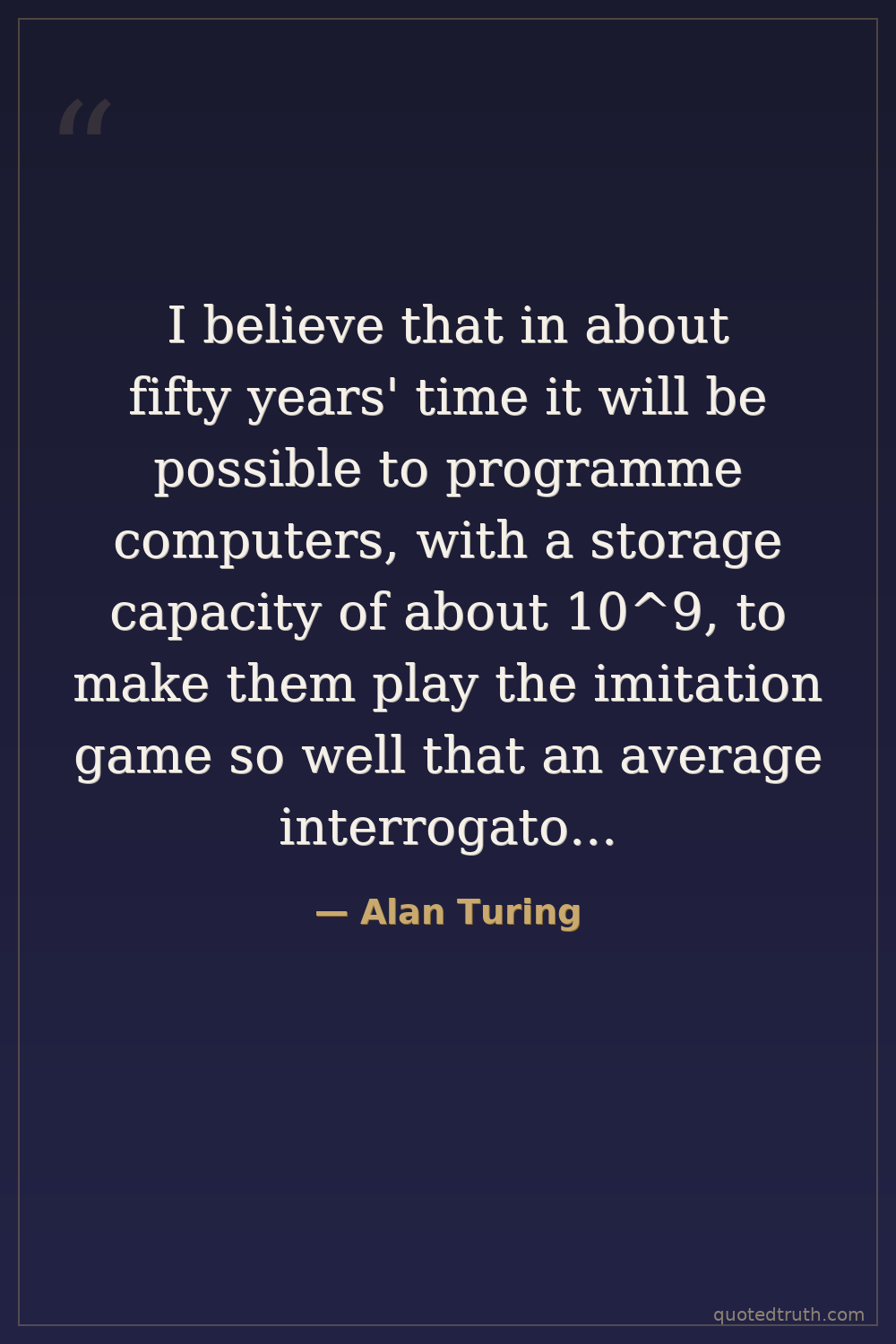
Within fifty years, computers will be programmable to convincingly mimic human conversation so well that a person questioning both a machine and a human for five minutes would correctly identify which is which only 70% of the time — barely better than chance. Machines, given enough memory and programming, can approximate human-level conversational intelligence in ways that blur the line between artificial and genuine thought.
Relevance to Alan Turing
Turing wrote this in his landmark 1950 paper 'Computing Machinery and Intelligence,' which introduced the Turing Test. As the father of theoretical computer science and artificial intelligence, and having cracked Nazi Enigma codes at Bletchley Park, Turing understood machines' logical potential intimately. This prediction reflects his conviction that intelligence is fundamentally computational — a radical belief during an era when computers filled rooms and barely solved arithmetic.
The era
In 1950, the first stored-program computers had just emerged — ENIAC and Manchester Mark 1 existed but had kilobytes of memory, not the billion bytes Turing predicted. Cold War tensions made computing a military priority. Most scientists viewed machines as pure calculators, incapable of thought. Turing's proposal that machine intelligence was achievable and measurable was philosophically explosive, challenging religious, philosophical, and scientific assumptions about what made humans unique.
AI-generated insights based on extensive research and information for context. Factual errors? Email [email protected].