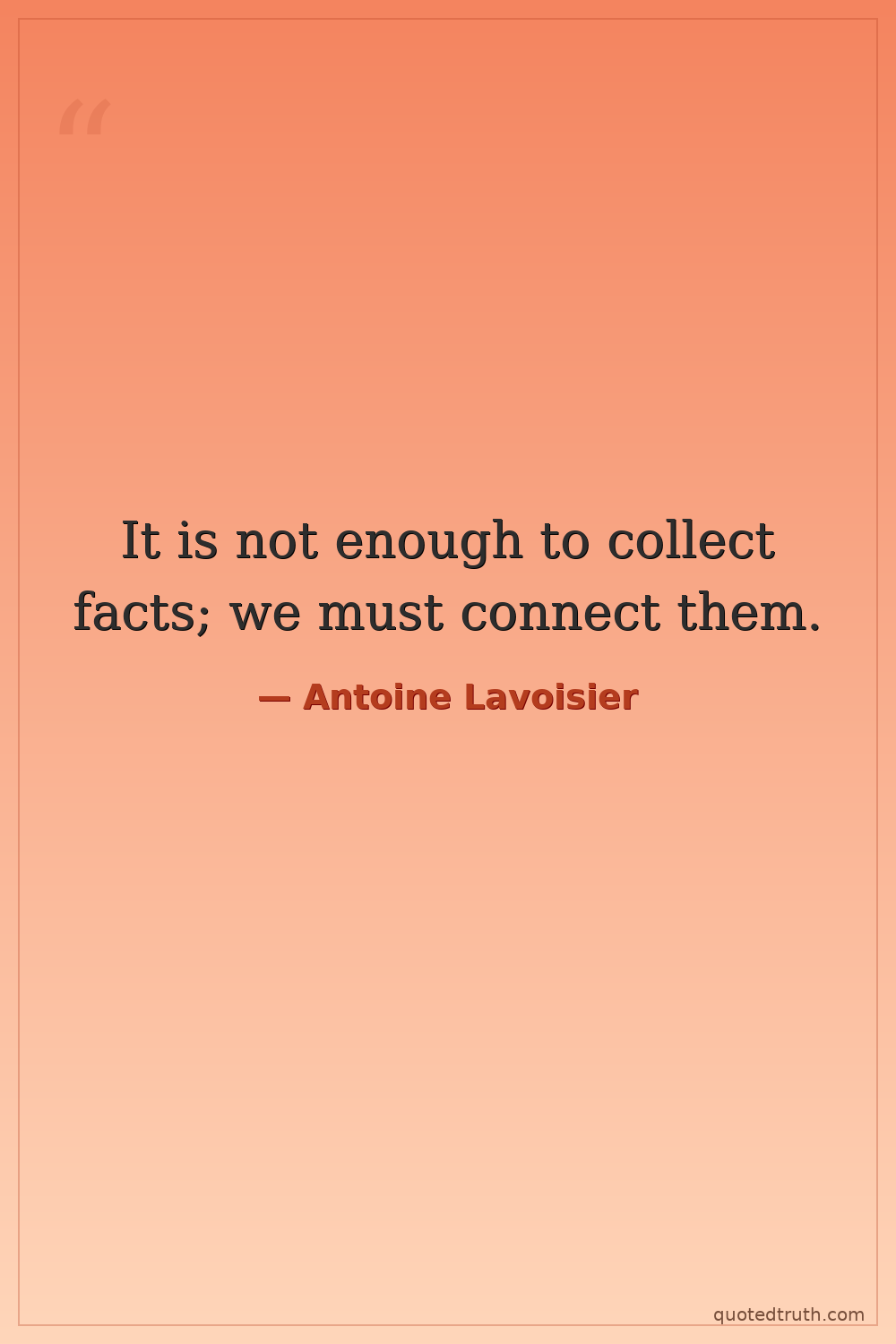
Antoine Lavoisier — "It is not enough to collect facts; we must connect them."
It is not enough to collect facts; we must connect them.
It is not enough to collect facts; we must connect them.
Click any product to generate a realistic preview. Up to 3 at a time.
* Initial load can take up to 90 seconds — revising the preview in another color is nearly instant.
"The imagination is a dangerous guide in science, but it can be a useful servant."
"Here, then: a revolution [in science and chemistry] has taken place in an important part of human knowledge since your departure from Europe… I will consider this revolution to be well advanced and ev…"
"We must trust to nothing but facts, for we are to have no other guide."
"Imagination, on the contrary, which is ever wandering beyond the bounds of truth, joined to self-love and that self-confidence we are so apt to indulge, prompt us to draw conclusions which are not imm…"
"The more exact the science, the more difficult it is to make progress."
Found in 1 providers: grok
1 source checked
Gathering facts alone produces nothing useful. The real intellectual work is synthesis — finding patterns, drawing connections, and building frameworks that explain why things happen. Raw data is inert until someone links cause to effect, observation to principle. This is a call for analytical thinking over mere accumulation: knowing many isolated things is less valuable than understanding how they relate to each other and to larger truths.
Lavoisier embodied this principle. He didn't merely observe that substances change during burning — he connected that observation to oxygen's role, dismantling phlogiston theory. He linked combustion to respiration, recognizing both as oxidation. His 1789 Traité Élémentaire de Chimie didn't just list chemical facts; it reorganized chemistry into a connected, systematic science with rational nomenclature. His genius was synthesis, not just experimentation.
During the Enlightenment, Europe was awash in accumulated natural observations — centuries of alchemical records, taxonomies, astronomical data — but theory lagged behind raw fact. The Encyclopédie project reflected a cultural hunger to organize and connect knowledge. Scientists were drowning in isolated observations while phlogiston theory misconnected them. Lavoisier's era demanded synthesizers, not just collectors — thinkers who could impose rational order on the flood of empirical data reshaping natural philosophy.
AI-generated insights based on extensive research and information for context. Factual errors? Email [email protected].
Your cart is empty