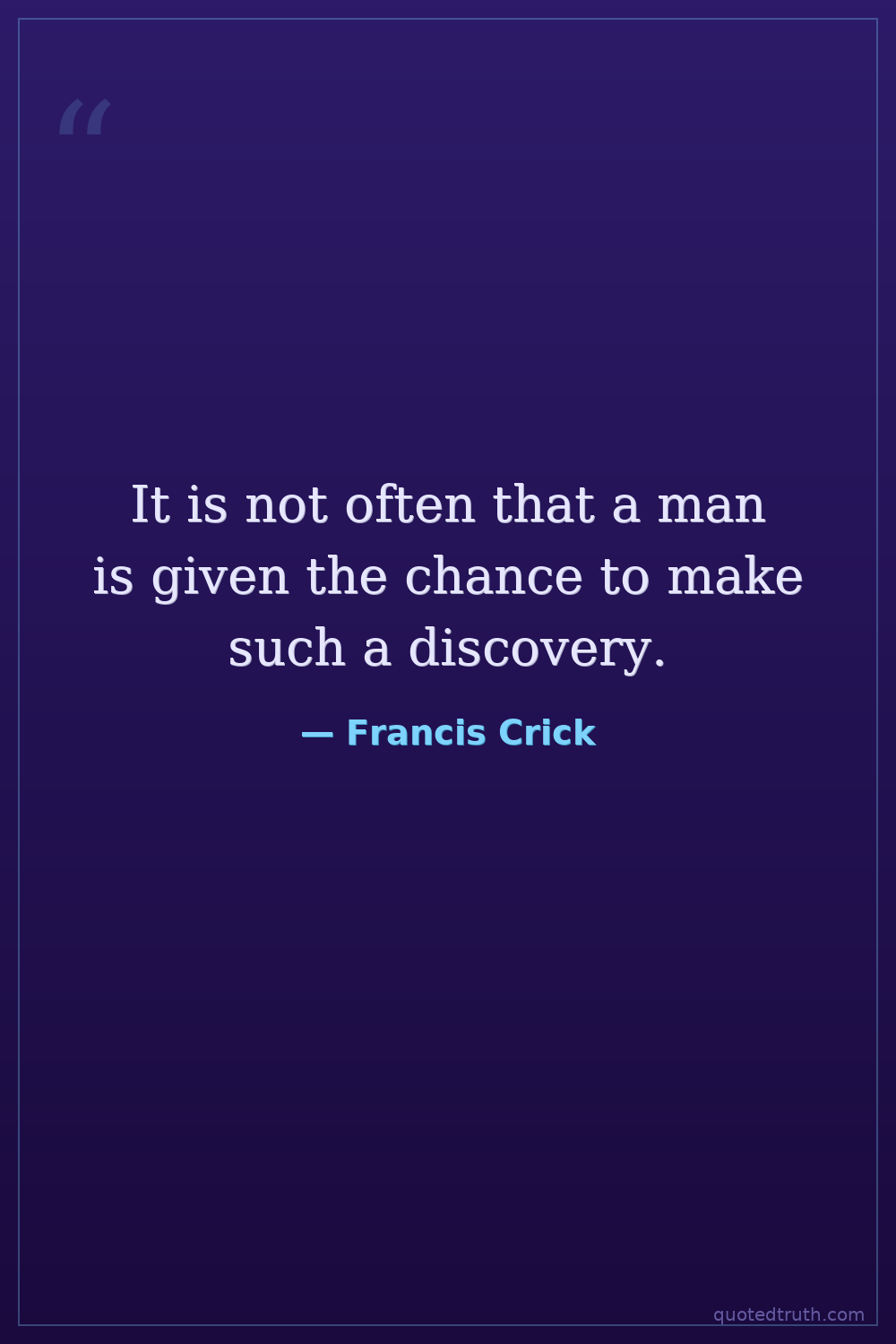
Francis Crick — "It is not often that a man is given the chance to make such a discovery."
It is not often that a man is given the chance to make such a discovery.
It is not often that a man is given the chance to make such a discovery.
Click any product to generate a realistic preview. Up to 3 at a time.
* Initial load can take up to 90 seconds — revising the preview in another color is nearly instant.
"Free will is an illusion."
"There is no ghost in the machine."
"The Christian believer is like a tenant who is about to sign a lease on a flat when someone tells him that the owner of the flat does not exist."
"The scientific method is a powerful tool, but it is not the only way to understand the world."
"Our brains are machines."
Found in 1 providers: grok
1 source checked
This statement captures the rare awareness of standing at a pivotal moment in human knowledge. The speaker recognizes that monumental breakthroughs—the kind that reshape entire fields—come along once in a lifetime, if ever, and most people never encounter such an opportunity. It expresses humility mixed with awe at being positioned, through circumstance and preparation, to uncover something fundamental that nobody has ever seen before.
Crick co-discovered the double-helix structure of DNA with James Watson in 1953 at Cambridge's Cavendish Laboratory, arguably the most consequential biological finding of the twentieth century. Trained originally as a physicist before pivoting to biology after WWII, he understood how rarely a researcher cracks the molecular basis of heredity itself. He later won the 1962 Nobel Prize and spent decades probing consciousness, always conscious that the DNA moment was singular.
The early 1950s were a frantic race among Cambridge, King's College London, and Caltech to decode genetic material, fueled by Rosalind Franklin's X-ray diffraction images and Linus Pauling's competing models. Postwar science was flush with funding, physicists were flooding into biology, and the molecular revolution was beginning. Crick's remark reflects an era when foundational mysteries—heredity, the atom, the cosmos—still seemed crackable by small teams with chalkboards, before Big Science bureaucratized discovery.
AI-generated insights based on extensive research and information for context. Factual errors? Email [email protected].
Your cart is empty