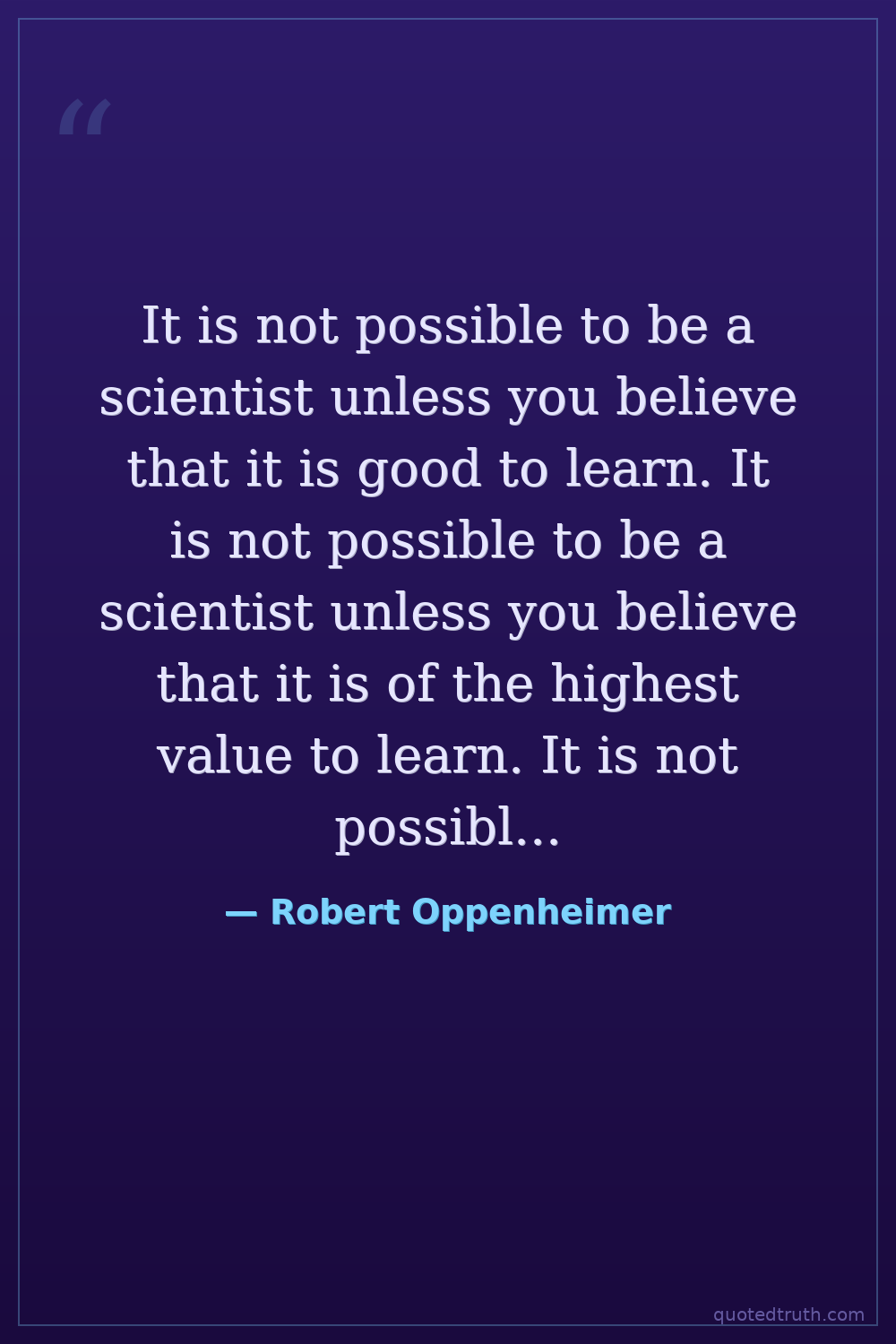
Robert Oppenheimer — "It is not possible to be a scientist unless you believe that it is good to learn…"

It is not possible to be a scientist unless you believe that it is good to learn. It is not possible to be a scientist unless you believe that it is of the highest value to learn. It is not possible to be a scientist unless you believe that the knowledge of the world, and the power which this gives, is a thing which is of intrinsic value to humanity, and that you are using it to help in the spread of knowledge and are prepared to take the consequences.
Robert Oppenheimer — Robert Oppenheimer Modern · Manhattan Project leader

Get This Quote & Author's Image Illustrated On:

Click any product to generate a realistic preview. Up to 3 at a time.
* Initial load can take up to 90 seconds — revising the preview in another color is nearly instant.

Kitchen

Apparel

Other

About Robert Oppenheimer (1904-1967)

American theoretical physicist who directed the Manhattan Project's Los Alamos Laboratory and oversaw the atomic bombs; lost his security clearance in 1954. Closely associated with Niels Bohr (Manhattan Project consultant and atomic-policy advisor) and Hans Bethe (Los Alamos theoretical-division chief). For an intellectual contrast, see Edward Teller, Hungarian-American physicist and 'father of the H-bomb' — Teller pushed the H-bomb against Oppenheimer's objections and testified against him at his 1954 security hearing — the precise moment that ended Oppenheimer's career. The canonical 'physicist-of-conscience vs physicist-of-state' pairing in nuclear-age ethics; Christopher Nolan's Oppenheimer (2023) dramatized this rivalry for a mass audience.

Details

Address to the American Philosophical Society

Date: 1947

Educational

Verification

Unverifiable

Found in 1 providers: grok

1 source checked

Understanding this quote

What it means

Being a scientist requires an unwavering belief that knowledge itself is inherently valuable — not just useful, but morally good. A true scientist commits to expanding human understanding and accepts responsibility for whatever consequences that knowledge unleashes. Learning isn't merely a profession; it's an ethical stance requiring courage to pursue truth even when its applications become dangerous or morally complicated.

Relevance to Robert Oppenheimer

Oppenheimer led the Manhattan Project, creating the atomic bomb — then spent his life wrestling with the consequences. This quote captures his core tension: he believed deeply in scientific inquiry's intrinsic worth, yet watched his knowledge kill hundreds of thousands. His post-war advocacy for nuclear arms control and subsequent government persecution reflected exactly this burden of 'taking the consequences' he described.

The era

Oppenheimer spoke during the Cold War's early years, when atomic science had shattered old assumptions about knowledge being purely beneficial. Scientists who split the atom suddenly faced moral accountability previously reserved for soldiers and politicians. The scientific community was divided between pursuing knowledge freely and accepting ethical constraints — a debate the Manhattan Project made permanently urgent and personally devastating for those involved.

AI-generated insights based on extensive research and information for context. Factual errors? Email [email protected].

Your Cart

Your cart is empty