What it means
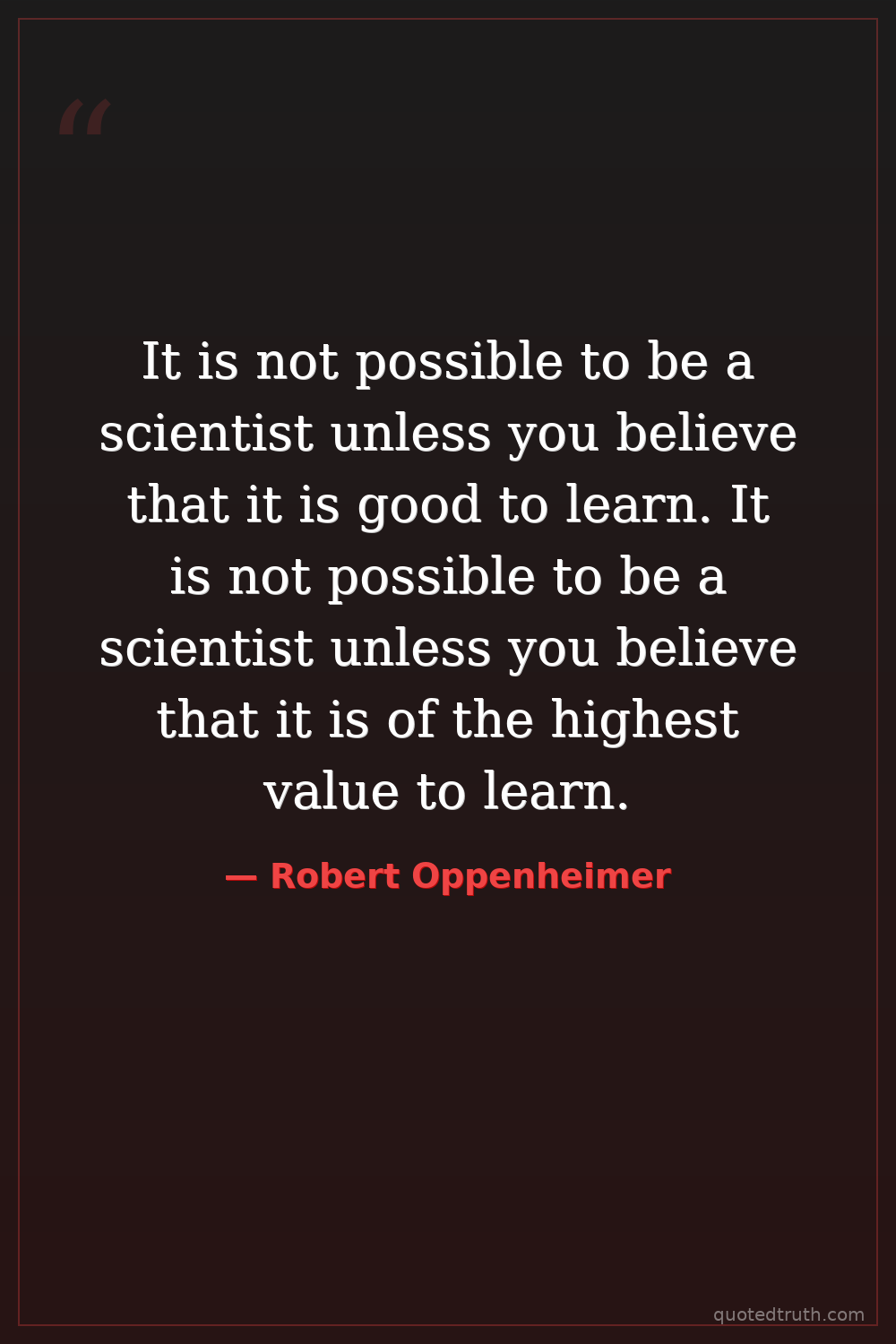
Being a scientist demands more than curiosity or skill — it requires a foundational belief that acquiring knowledge is inherently good and supremely worthwhile. This isn't about utility or career; it's a moral conviction. The repeated phrasing underscores that this belief isn't optional background noise but the core identity of anyone who calls themselves a scientist. Without that conviction, the enterprise of science loses its justification.
Relevance to Robert Oppenheimer
Oppenheimer embodied this ideal and its tragic limits. A polymath who read Sanskrit and loved poetry alongside physics, he led the Manhattan Project with conviction that knowledge mattered above all. Yet after Hiroshima, he famously quoted the Bhagavad Gita: 'Now I am become Death.' His 1954 security clearance revocation — punishment for his H-bomb doubts — showed a man who believed in learning's value even when that learning carried catastrophic consequences.
The era
The mid-20th century forced science into a moral crisis. The Manhattan Project and subsequent Cold War arms race demonstrated that scientific knowledge could reshape civilization or end it. The Bulletin of Atomic Scientists launched in 1945; the Einstein-Russell Manifesto warned of nuclear annihilation in 1955. Scientists debated their responsibilities publicly. Oppenheimer's insistence on learning's supreme value came precisely when the world was asking whether certain knowledge should perhaps never have been pursued.
AI-generated insights based on extensive research and information for context. Factual errors? Email [email protected].